Evanston Epoxy Flooring brings more than 20 years of epoxy-flooring in Winnetka homes and businesses to jobs that usually start with a question about paperwork rather than color. Before we price a garage, a basement or a shop floor, we want to know what the slab is, what sits on it, and which line of the village’s permit list the work runs closest to.
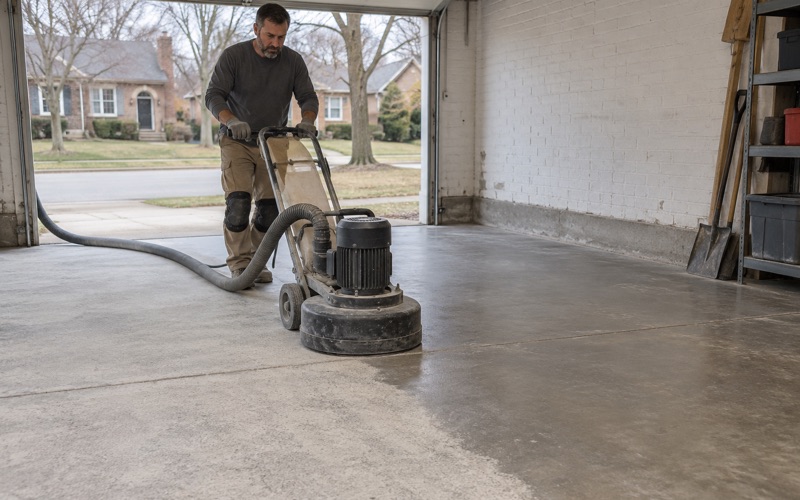
That order matters because a coating is only as good as the concrete under it. Every slab we take on is opened with a diamond grinder or a shot blaster to a measured ICRI surface profile, and we do not acid etch. The proposal names the product, the system build and the finished thickness, so you can hold the quote up against the floor once it cures.
We also say early what a floor coating cannot do. It is a film that follows the slab, so a moving crack will telegraph through it, and we will tell you when a slab needs repair before it can be coated at all. What follows is how that plays out against Winnetka’s own rules.
Where Epoxy Shows Up on the Village Permit List
Epoxy injection is a foundation repair, not a floor
The word epoxy appears on the Village of Winnetka’s Work Requiring Permits page in one place, and it is not about floors. The list requires a permit for “all foundation repairs except minor maintenance and repair, such as epoxy injections.” In plain terms, injecting resin into a cracked foundation wall is named as the kind of minor repair that falls outside that requirement.
That exception belongs to foundation repair and nothing else. It does not say a coated garage or basement floor is exempt, and we do not read it that way when we quote. A floor system of 100% solids epoxy under a polyaspartic topcoat is a different piece of work from an injected wall crack, even though both start with resin chemistry.
Reading cracks before anything is quoted
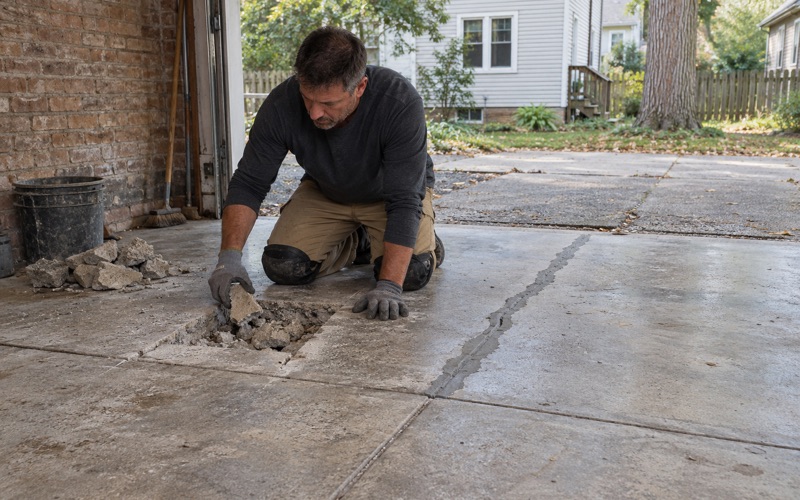
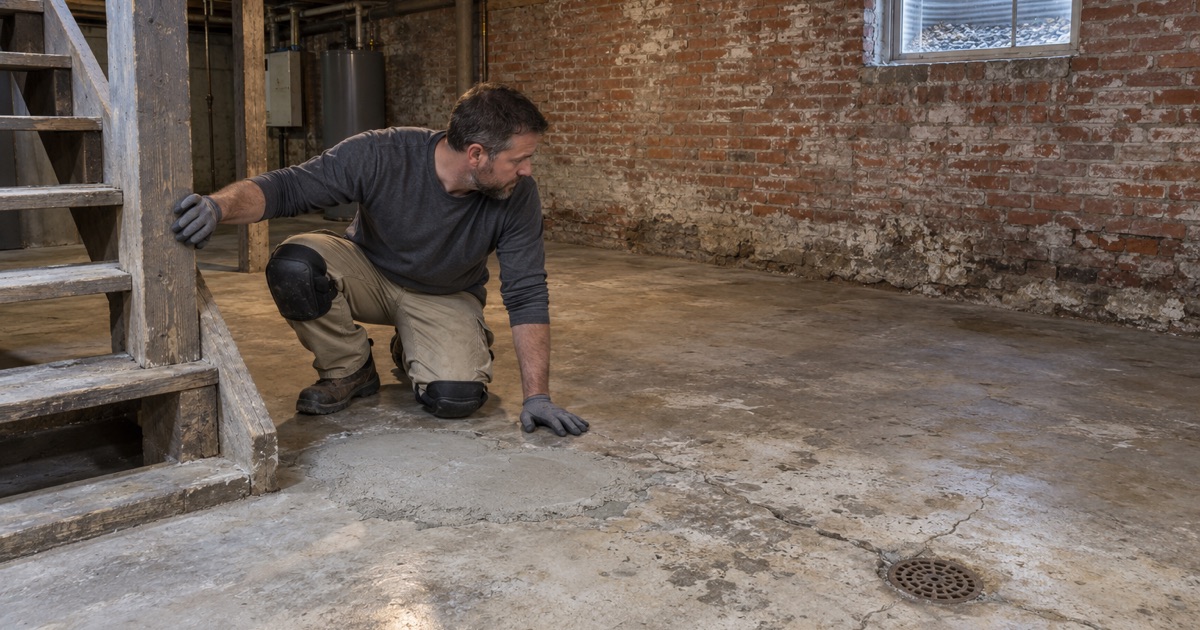
Where the injection exception does touch our work is at the edges of a basement. If a wall crack has already been injected, or needs to be, that is a foundation question to settle before a floor goes down. We note every crack on the slab itself, mark which ones move, and price crack repair as its own line rather than burying it under the coating.
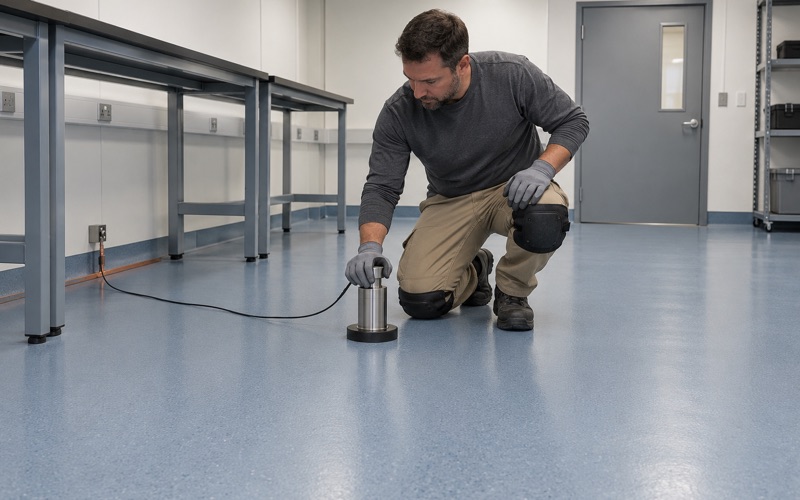
Moisture comes next. On basement and garage slabs alike, moisture testing is written into the scope, using ASTM F2170 in-situ relative humidity probes or an ASTM F1869 calcium chloride test depending on the slab. When a reading calls for it, the system starts with a moisture-mitigation primer, and the warranty exclusions, moisture first, are read out before anything is signed.
New garages and the building official’s call
The permit list is direct about one thing a floor contractor meets often: installing an attached or detached garage requires a permit. If your coating is going into a new garage, it follows that permitted construction, and the new slab has to cure long enough to test before we schedule. A fresh pour that reads wet is the most common reason a new garage floor waits.
Coating an existing garage floor is a quieter question. The permit list does not name it, and we do not decide on the village’s behalf whether it counts. The Village of Winnetka Department of Community Development handles building permits, and when a project sits in a gray area we ask the building official before work is scheduled rather than after.
Looking for epoxy-flooring closer to Norridge? See Norridge Epoxy-Flooring.
Driveways, Patios and Walkways: The Impermeable-Surface Line
What the village rule says
The second line that matters to us requires a permit “to install, alter or replace any impermeable surface such as driveways, patios, terraces, walkways, parking lots.” A new concrete driveway or patio is plainly inside it. So is a replacement, and so is a slab that grows to cover more of the lot.
Coating an existing driveway or patio is where the wording runs out. Whether a resin system over sound concrete is an alteration of the surface is a question for the building official, and we have not seen it settled either way. We will not tell you a permit is required, and we will not tell you one is not; we will help you ask before the job is booked.
Why exterior concrete needs a different system
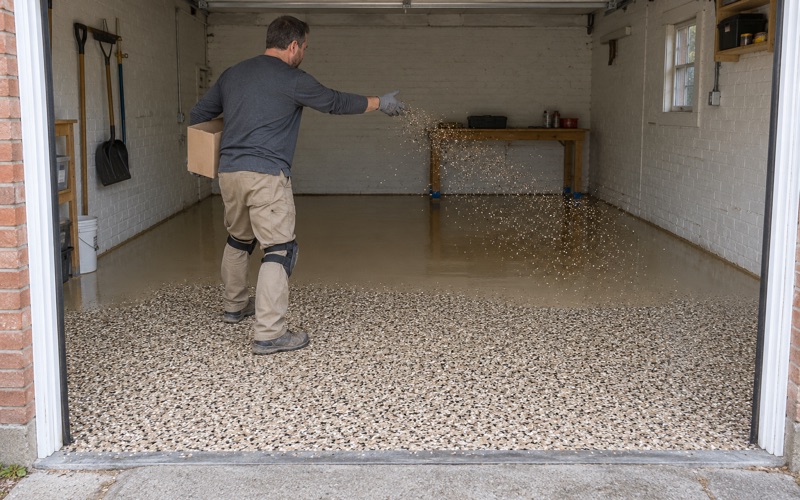
Outdoor concrete is a harder place for a coating than a garage. Sunlight yellows plain epoxy, so an exterior system leans on polyaspartic or polyurea topcoats that hold their color under ultraviolet light. A broadcast of quartz aggregate or vinyl flake into the base coat builds traction that a smooth film lacks when it is wet.
Exterior slabs also push moisture upward through any film laid over them. If a patio was poured without a vapor retarder beneath it, we test before recommending anything sealed, and sometimes the honest answer is a penetrating lithium silicate densifier instead of a full coating. That choice changes the look, but it keeps the finish from lifting.
Terraces, walkways and the edges of a job
Terraces and walkways bring smaller surfaces with more edges, steps and transitions. Each step nose and threshold is a place where a film can chip if the profile underneath was not opened properly, which is why we grind those edges by hand rather than skipping them.
If the work turns into replacing sections of concrete before coating, the job has crossed into the plain “replace” language on the permit list. At that point we stop treating it as a coating job and say so, and the concrete work is permitted and finished before we come back.
A $25,000 Bond, Not a Village License
What Winnetka actually asks of contractors
Winnetka does not run a contractor licensing program. Its Contractor Licensing page says so, and the village accepts State of Illinois licenses for trades such as plumbing, irrigation and roofing, plus tested municipal licenses for electricians. Illinois itself issues no license for general, flooring or coatings contractors, so there is no license number to look up for a floor like yours.
What the village does require is a $25,000 License and Permit Bond. It applies to the general contractor and to any subcontractor working in the village right-of-way, and it must be in place before any permit issues. That is a bond the village requires, not a credential it grants, and we describe it that way.
What we show you instead of a license number
Because there is no state or village license to quote, we show what a municipality asks for on its own terms: the bond where the work calls for one, along with certificates of insurance. If a permitted job puts us in the right-of-way, the bond is arranged before the permit application goes in, not after a crew is booked.
Every home job also gets a written contract and the state’s Home Repair: Know Your Consumer Rights pamphlet before work starts. The Illinois Home Repair and Remodeling Act requires both, and they protect the homeowner whether or not the floor ever needs a permit.
Noise, hours and products on a residential street
Winnetka is overwhelmingly a village of owner-occupied houses: about 92.0 percent of occupied homes are lived in by their owners, and 3,586 of those owners live in detached houses. Most of our work here happens off a driveway with neighbors on either side, so the loud stage, diamond grinding and shot blasting, is planned inside the village’s construction hours.
The coatings themselves are chosen within the Illinois VOC limits for architectural coatings under 35 Ill. Adm. Code Part 223 Subpart C, which bind the installer as well as the manufacturer. A 100% solids epoxy base helps on that front, and because the proposal names the product, the choice can be checked.
Business and Multifamily Floors Under Annual Fire Inspection
What the Fire Prevention Bureau looks at
Commercial floor work in Winnetka is small in scale, but it runs under closer review. The Winnetka Fire Department’s Fire Prevention Bureau inspects every business, commercial and multi-family residential building each year, reviews plans for newly constructed and remodeled structures, and tests fire protection systems.
A floor remodel in one of those buildings may therefore pass through the bureau’s plan review before it reaches us. We ask early whether the owner has filed plans, and while a floor cures we keep coating, masking and equipment clear of exits and of the fire protection equipment the bureau checks.
Multifamily buildings and shared floors
The village has relatively few large residential buildings, with 157 units in buildings of 20 to 49 units and 63 in buildings of 50 or more. Where we do work in one, a parking level, a storage room or a common corridor floor belongs to the association as much as to any single owner.
Those jobs are scheduled with the association before the first bag is opened. Curing is planned against slab temperature and dew point rather than the calendar, so the board knows how long a garage level or hallway will be out of service and when the topcoat can take traffic again.
Shops, kitchens and floors that stay open
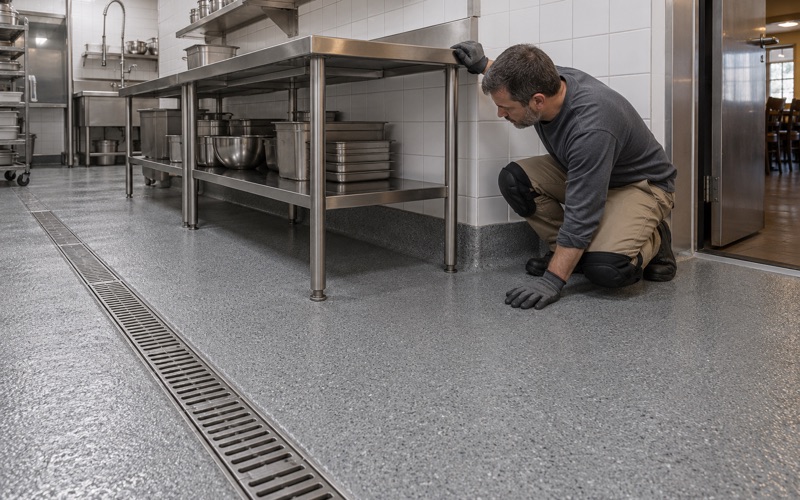
Business floors bring their own specifications. A food space falls under the Illinois Food Code, which adopts the 2022 FDA Food Code, including coved floor and wall junctures under section 6-201.13; a workroom full of electronics may call for static-dissipative flooring held to a defined resistance range. We build the system to the use, not the other way around.
Commercial jobs are scheduled around the hours a building has to stay open, which often means grinding after closing and coating in sections. When a slab needs repair first, the proposal says so in plain terms, and that repair is priced ahead of the coating rather than discovered in the middle of it.
- 20+ Years in Business
- Moisture Testing in Every Quote
- Written Proposals