Evanston Epoxy Flooring has spent more than 20 years installing epoxy flooring in Westchester and across our territory, and the first thing we ask about a basement or garage slab here is whether it has ever been under water. That question is not a sales line. It decides which tests we run, which primer we specify and what the warranty can honestly promise.
A coating on that slab is a finish, not a barrier. It will not keep water from coming up through the floor or in under the door, and we tell homeowners that before a proposal is written. What it does well is give a basement or garage a seamless, wipeable surface that is far easier to clean out after water has been and gone.
This page covers what the village’s flood record means for a floor job, how we test and prepare a slab that may have been wet, and which village offices a basement project runs past before the first grinder is switched on. Where a fact below comes from a public record, we say which one.
89 Properties FEMA Has Paid for More Than Once
What a repetitive-loss count measures
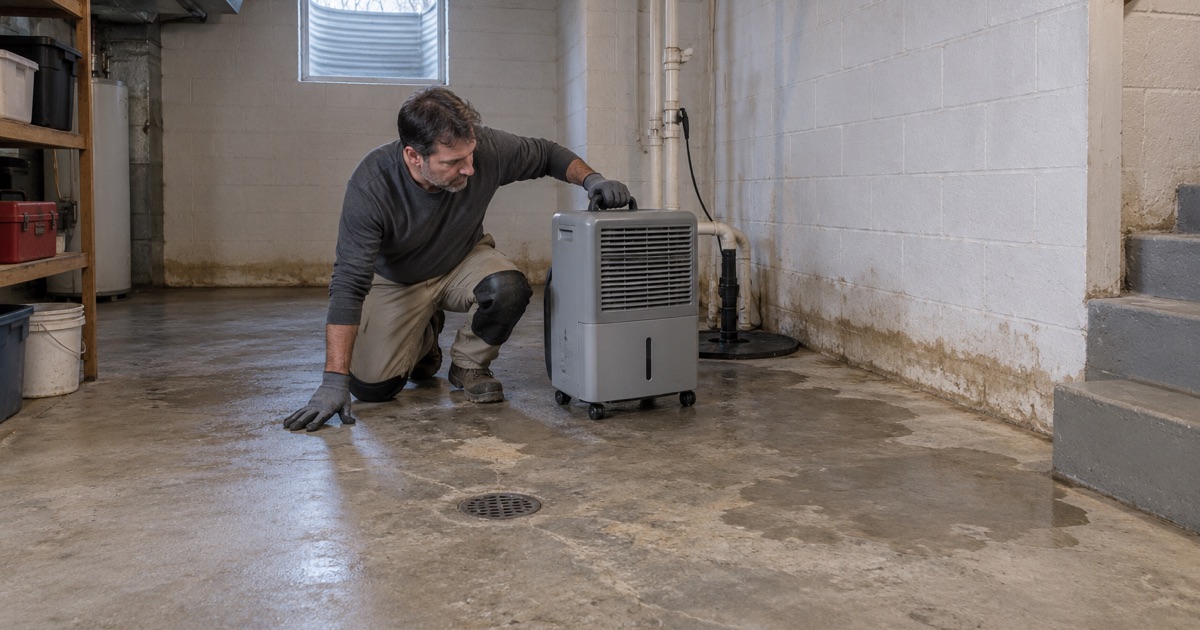
FEMA identifies 89 repetitive flood-loss properties in Westchester, and 88 of them are single-family houses. The remaining one is a non-residential property. A repetitive-loss listing means flood insurance claims have been paid on that property more than once, so these are not houses that might flood someday but houses that already have.
The same records list one severe repetitive-loss property, also a single-family home, and show none of the 89 as mitigated. For us that changes the first conversation. In a village where 90.8 percent of occupied homes are lived in by their owners, the person asking about a garage or basement floor may well be the one who hauled wet boxes up the stairs.
June 2010, October 2008 and autumn 2007
The Westchester annex of the county hazard plan records flooding in streets and homes on June 23 and 24, 2010. It lists earlier events in October 2008 and across September and October 2007. Three events in under three years is the history a basement slab here may be carrying when we first look at it.
What a past flood leaves behind is usually visible once you know where to look. We check for efflorescence, the white mineral bloom water carries to the surface, along with tide lines on the walls, lifted paint and old coating that has let go in sheets. Each of those goes into the written assessment, because each one changes the preparation and the primer.
Where water enters a slab
Street flooding of the kind recorded in 2010 can reach a basement several ways: through a floor drain backing up, through the joint where wall meets floor, or by hydrostatic pressure pushing groundwater up through the slab itself. A garage at grade takes water differently, usually under the overhead door. We ask which happened, because the answer shapes the floor detailing.
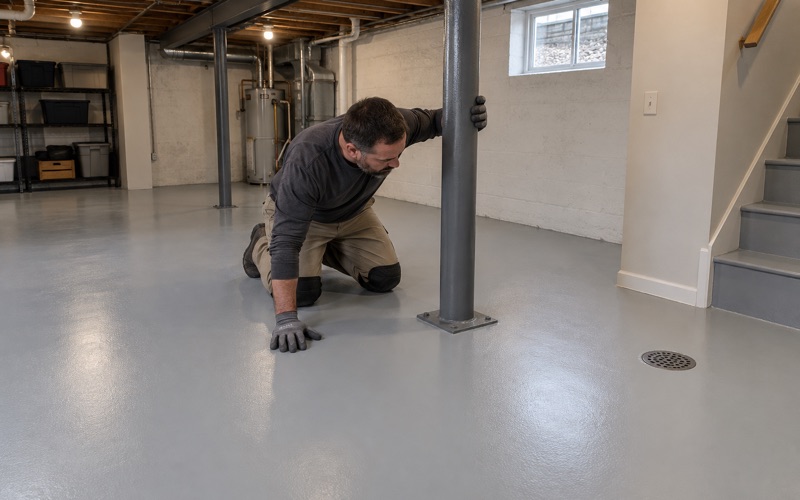
Around a floor drain or sump pit we stop the coating at a clean edge rather than burying the grate, so the drain still takes water and can be serviced. Homes with an ejector pit and overhead plumbing get the same treatment at the pit lid. None of this changes how much water arrives; it keeps the drains usable when it does.
Looking for epoxy-flooring closer to Brookfield? See Epoxy-Flooring Services in Brookfield.
After a Flood, a Coated Floor Cleans Up Faster
Cleanup, not prevention
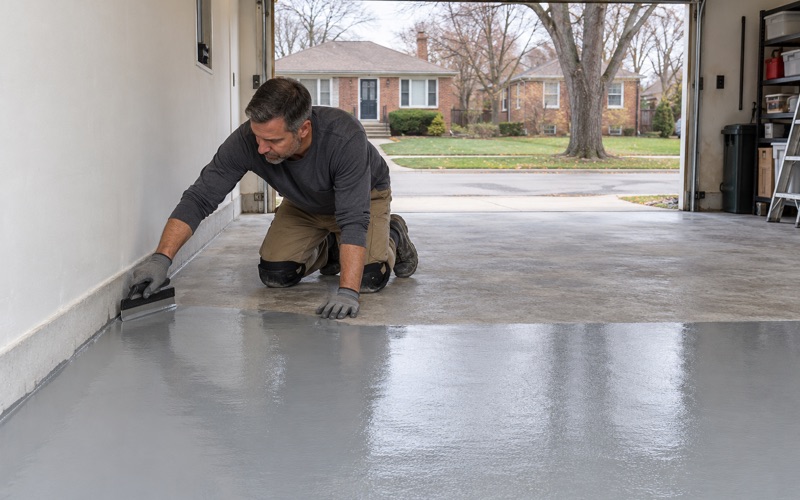
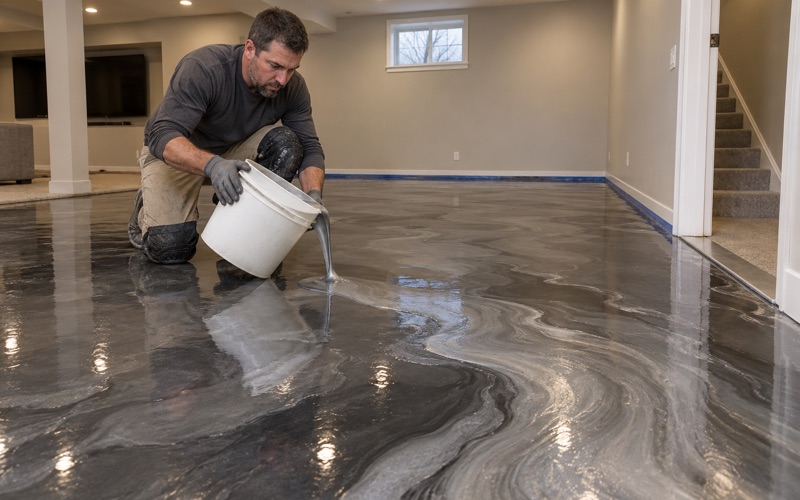
The value of a coated basement floor in a house that has flooded is measured in cleanup time. Bare concrete soaks up silt and odor, while a 100% solids epoxy base with a polyaspartic topcoat gives mud and sediment a nonporous surface to sit on, so a squeegee and a hose do most of the work.
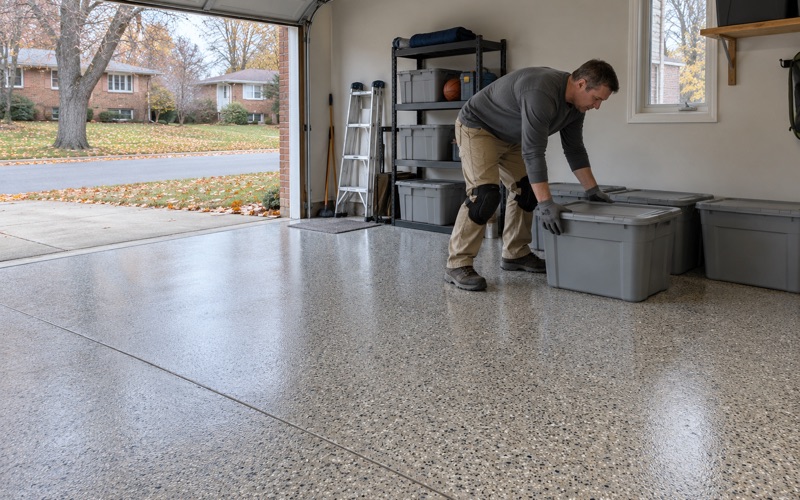
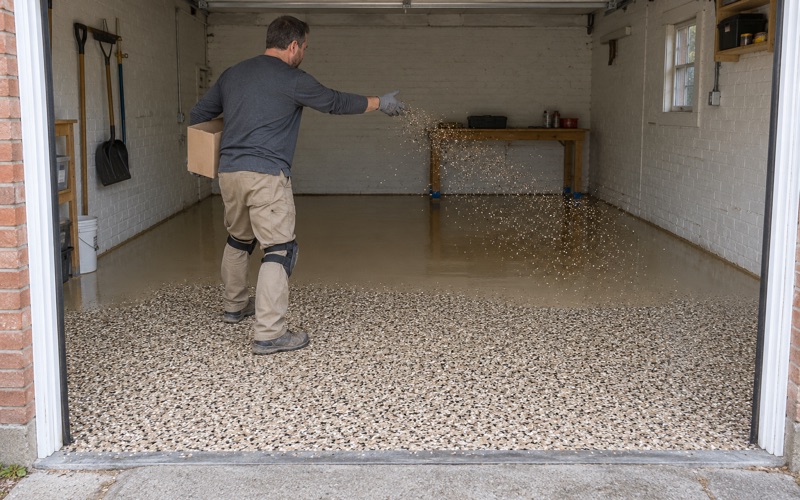
For a basement with a flood history we also lean toward a broadcast texture. A vinyl flake or quartz aggregate broadcast locked under the topcoat gives some grip on a floor that may be wet underfoot during cleanup, and it hides the fine scratches that sediment leaves behind when it is swept out.
Water that sits on a coated floor long enough will still find any spot where the bond was weak, which is why the preparation matters more here than the color chart. After a flood we look at the floor again before anyone recoats, because the problem is usually underneath the film rather than on top of it.
Testing a slab that has been wet
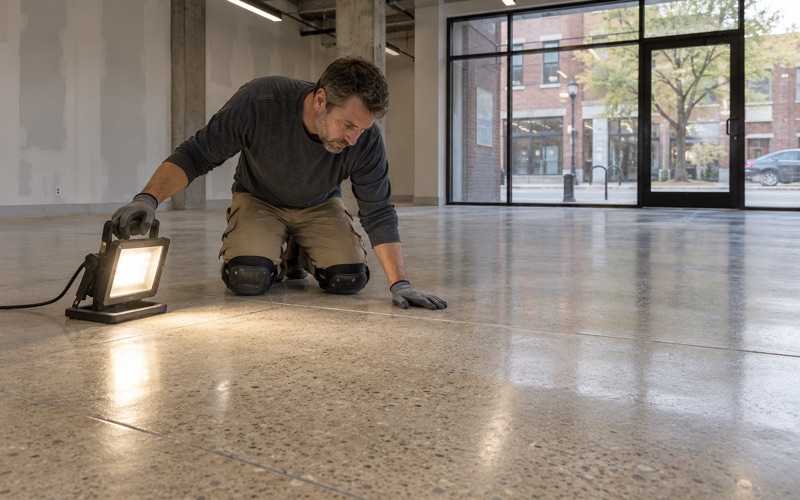
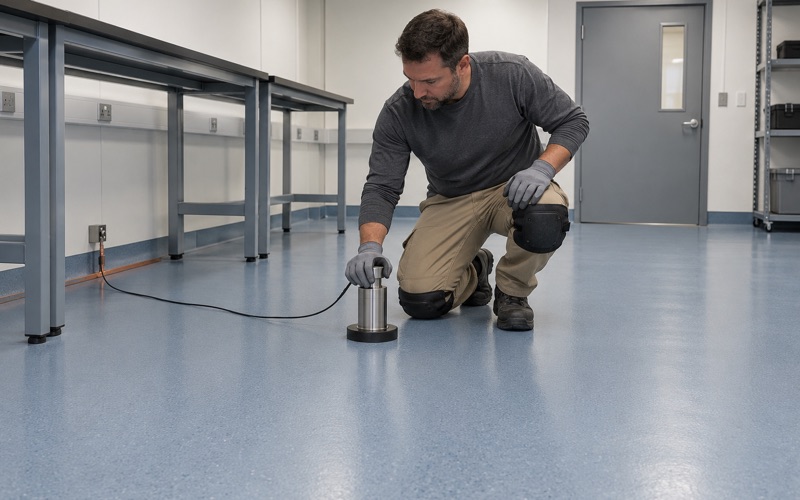
On a Westchester basement that may be one of the 88 houses on FEMA’s list, moisture testing is not optional, and it is priced into the proposal as its own line rather than offered after a blister appears. We start with an ASTM D4263 plastic sheet test as a quick screen, then move to quantitative numbers.
Those numbers come from ASTM F2170 in-situ relative humidity probes set into the slab, and where a manufacturer asks for it, an ASTM F1869 calcium chloride test of the vapor emission rate. If the readings sit above the product’s limits, the system changes to include a moisture-mitigation primer, and the price changes with it.
Opening the surface
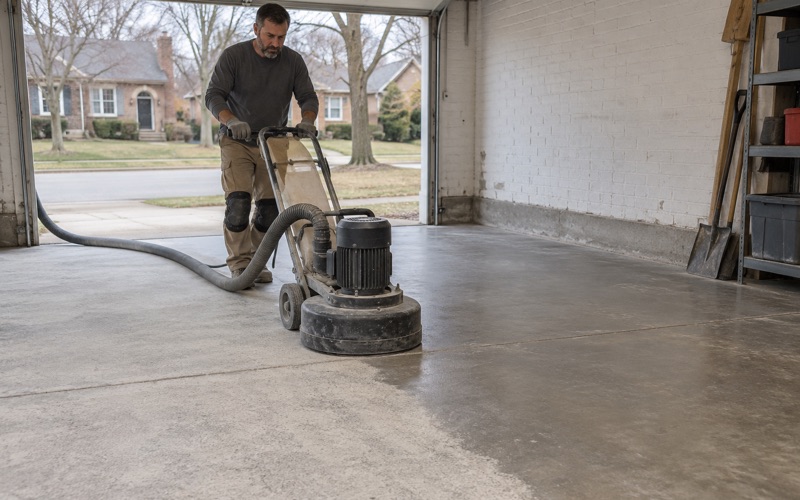
Flood water leaves sediment, mineral bloom and sometimes paint that has half released. We remove all of it with a diamond grinder or a shot blaster, cutting to the ICRI CSP surface profile the product data sheet calls for. We do not acid etch, which would put more liquid into a slab we are trying to read dry.
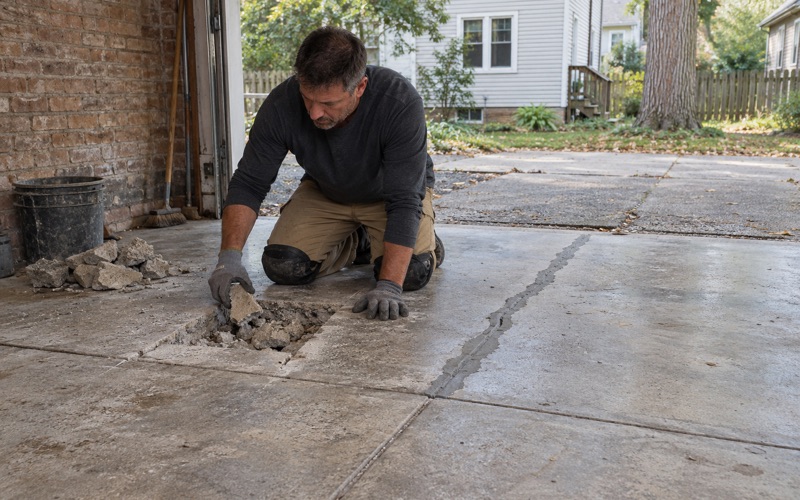
On a floor that may have sat through the 2007 to 2010 floods, cracks get read before the quote. A coating is a film that follows the concrete beneath it, so a crack that is still moving will telegraph through, and we say that rather than promise otherwise. Where a slab needs patching or joint repair before it can carry a coating, the repair is priced as its own step.
Class 8 Since 2012: Reading the Village’s CRS Number
What the Community Rating System measures
Westchester has taken part in FEMA’s Community Rating System at class 8 since October 2012. The program rates how a community manages its floodplain, on a scale where class 10 means no credit and lower numbers mean more credit, and the rating applies to the village as a whole rather than to any single house.
Class 8 tells you the village treats floodplain management as ongoing work. Read alongside the repetitive-loss count, it explains why we treat every Westchester basement inquiry as a moisture question first and a color question second. That order of questions is the same whether the job is a full basement or a single-car garage.
What a floor coating has to do with it
Nothing, and we would rather say so up front. Coating a garage or basement has no bearing on a homeowner’s flood insurance, on the village’s CRS class or on whether a property appears on FEMA’s lists. Anyone who sells an epoxy floor on those grounds is selling something a floor cannot deliver.
The same goes for radon. A sealed-looking floor is sometimes pitched as radon control, but in Illinois radon mitigation is licensed work under IEMA, and we do not offer it. If a basement needs a radon system or a drainage contractor, we tell you that and coat the floor afterward, once the other trade is finished.
Warranty terms read out first
Because the village’s flood record is documented, warranty exclusions get read aloud before a job is sold, and moisture is named first. A coating that lets go because water pushed up from below is not a defect in the product, and we would rather you hear that from us before signing than in a dispute later.
For the same reason, the proposal spells out the product, the system build and the finished thickness. If a floor is ever opened up after a basement backup, you and we can both check what went down against what was quoted.
Chapter 14.20, the 2012 Codes and Your Contract
The Building Department and the floodplain chapter
Westchester’s floodplain rules sit in chapter 14.20 of the village code, and building questions run through the Community Development/Building Department. The village reports that it has adopted the 2012 International Codes, but we confirm the edition actually in force with that department before writing a specification, rather than assuming a newer code applies.
A straightforward coating over an existing slab usually involves no structural change, but a basement job that adds a drain, alters a sump or moves plumbing can bring the floodplain chapter and the building code into play. We ask those questions at the walk-through so a homeowner is not surprised mid-project, and the village’s answer always outranks ours.
Contract, pamphlet and the license question
Illinois issues no state license for flooring or coating work, so what we show in Westchester is whatever contractor license, bond and insurance the village asks for. Every home job also gets a written contract and the Home Repair: Know Your Consumer Rights pamphlet before work begins, as the Illinois Home Repair and Remodeling Act requires.
Westchester is mostly single-family detached houses, but the village also has attached homes and two-unit buildings. On those, we schedule with the association or the other owner before the first bag of material is opened, so a shared garage or common wall is not a surprise to anyone.
Grinding hours, VOC limits and curing
Westchester describes itself as primarily residential and built-out, bounded by Forest Preserve District land, cemeteries and a golf course, so nearly every job sits close to a neighbor. We plan diamond grinding and shot blasting inside the village’s construction hours, which keeps a one-day garage from running loud into someone’s evening.
Products are chosen within the Illinois VOC limits in 35 Ill. Adm. Code Part 223, which bind the installer as well as the manufacturer. Curing is scheduled against slab temperature and the dew point spread at the surface rather than the calendar, and an unheated garage that is too cold simply waits for spring. Garage systems are built to stand up to the calcium chloride brine and rock salt that come in on the tires.
- 20+ Years in Business
- Moisture Testing in Every Quote
- Written Proposals