Evanston Epoxy Flooring handles epoxy flooring in Summit with more than 20 years behind us, and the work here is almost always on concrete that has been in place for decades. Few new slabs get poured in this village, so a coating job usually begins with a floor someone else placed, patched or painted long before we arrive. We plan the whole job around that fact.
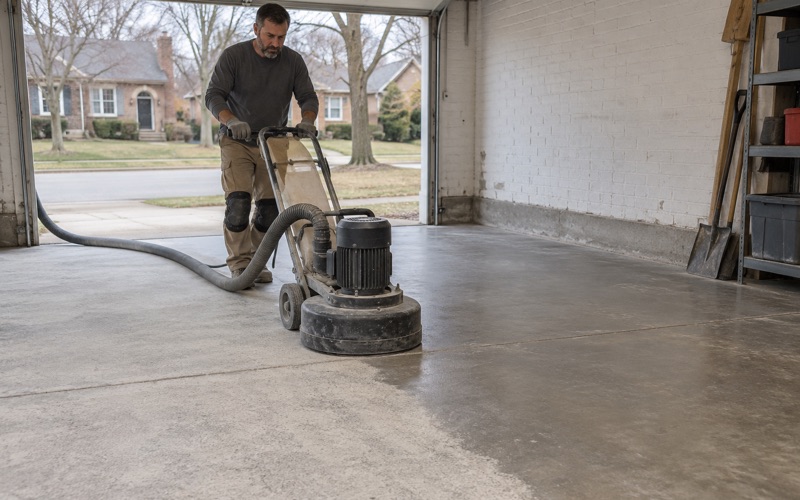
Every slab is opened with a diamond grinder or a shot blaster, never acid, because an old floor may carry old sealer and paint that etching cannot remove. Moisture testing sits in the written scope as its own line item. The proposal then names the product, the system build and the finished thickness, so you can check what went down against what was quoted.
We also tell you up front what a coating can and cannot do. It is a film that follows the concrete beneath it, so it will not stop a moving crack, and warranty exclusions are read aloud before you sign, with moisture named first.
845 Homes From Before 1940
What the Census Count Shows
Summit has 4,063 housing units, and 845 of them, 20.8 percent, were built in 1939 or earlier according to the Census Bureau’s 2024 five-year American Community Survey. That is roughly one home in five standing since before 1940. Behind it come 363 units from the 1940s, 939 from the 1950s and 873 from the 1960s.
For a floor contractor, the year a house went up matters because it hints at what the basement slab has been through. A floor poured before 1940 has had more than eight decades to collect patches, paint, adhesive and the occasional repair done by hand. We assume nothing about it until we have looked.
Why the Oldest Slabs Need a Slower Start
A slab from that era may have been placed without the plastic vapor retarder that later codes came to expect under a floor. Without one, ground moisture can move upward through the concrete, and an impermeable film of 100% solids epoxy laid over it can lose its grip. That is why, on a Summit basement older than 1940, moisture testing is the first line of the scope rather than an upsell.
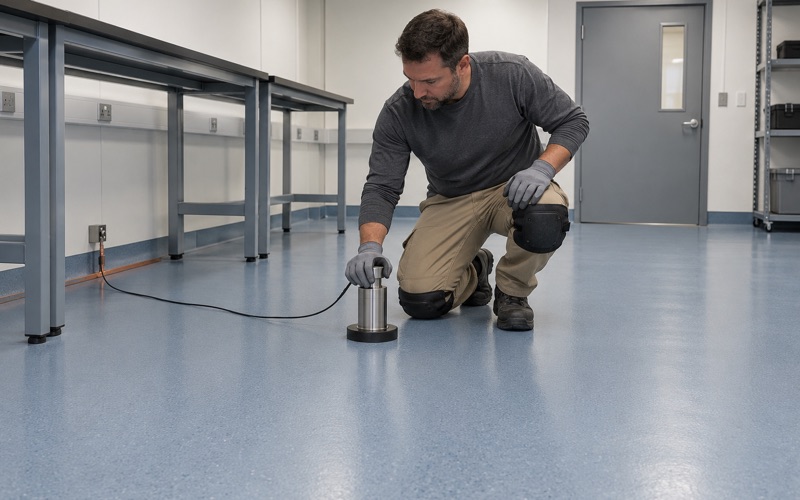
We start with an ASTM D4263 plastic sheet taped down overnight as a quick screen, then use ASTM F2170 in-situ relative humidity probes drilled into the slab when the numbers matter. If the readings run high, a moisture-mitigation primer goes into the proposal before any color coat does, and you see that cost before work begins.
The Postwar Wave Behind It
Summit’s 1950s and 1960s houses together outnumber the prewar stock more than two to one, and their slabs usually arrive with a different history. We expect to find old paint, sealer or tile adhesive on these floors, and when a hardware-store paint has started to lift, it all has to come off.
Grinding takes those layers down to sound concrete and leaves an ICRI CSP 2 to CSP 3 profile, the texture most epoxy primers are written to bond to. Where the grinder exposes a crack or a spalled patch, we stop and show you, because some floors in this age band need repair before any coating can go down.
Looking for epoxy-flooring closer to La Grange? See La Grange Epoxy-Flooring.
A Town That Grew Between Two Canals
The Illinois and Michigan Canal Years
Summit’s name, in use since 1836, refers to the highest point on the Chicago Portage between the northeast-flowing Chicago River and the southwest-flowing Des Plaines River, located just north of the city. Construction of the Illinois and Michigan Canal began that same year and ran until 1848. The town grew up between that canal and a second one dug decades later.
We bring this up because it helps explain why Summit’s housing is old in a way that newer suburbs are not. A village whose growth followed canal and quarry work had houses standing before modern slab practice settled in, and that history is what we are reading when we kneel on a basement floor here.
Quarry Jobs and the Second Canal
Limestone quarries north of the canal provided jobs from after 1865 into the 1920s, and those quarries have since closed. Between 1892 and 1900 the Chicago Sanitary and Ship Canal was built, and Summit grew between the two waterways. None of that quarry work continues in Summit today, yet the era it belongs to is the era of the village’s oldest houses.
We do not know which of those early houses sheltered quarry or canal workers, and we will not pretend to. What we do know is that a basement from this period can hide almost anything in its layers: an early topping, a hand-troweled repair, a filled-in drain or an old coal-room floor at a different height.
The Heritage Corridor Line Today
Metra’s Heritage Corridor line runs through Summit on the former Chicago and Alton route, one more layer in a village that took shape around canals and rail. In a village this compact, the noise of a crew carries, so how we work matters as much as how we grind.
Diamond grinding and shot blasting are loud, so we plan both inside Summit’s construction hours and keep a one-day job from running into a neighbor’s evening. We confirm the allowed hours with the village when the job is booked rather than guessing at them.
Reading an Old Basement Floor Before We Quote It
Cracks, Paint and Old Coatings
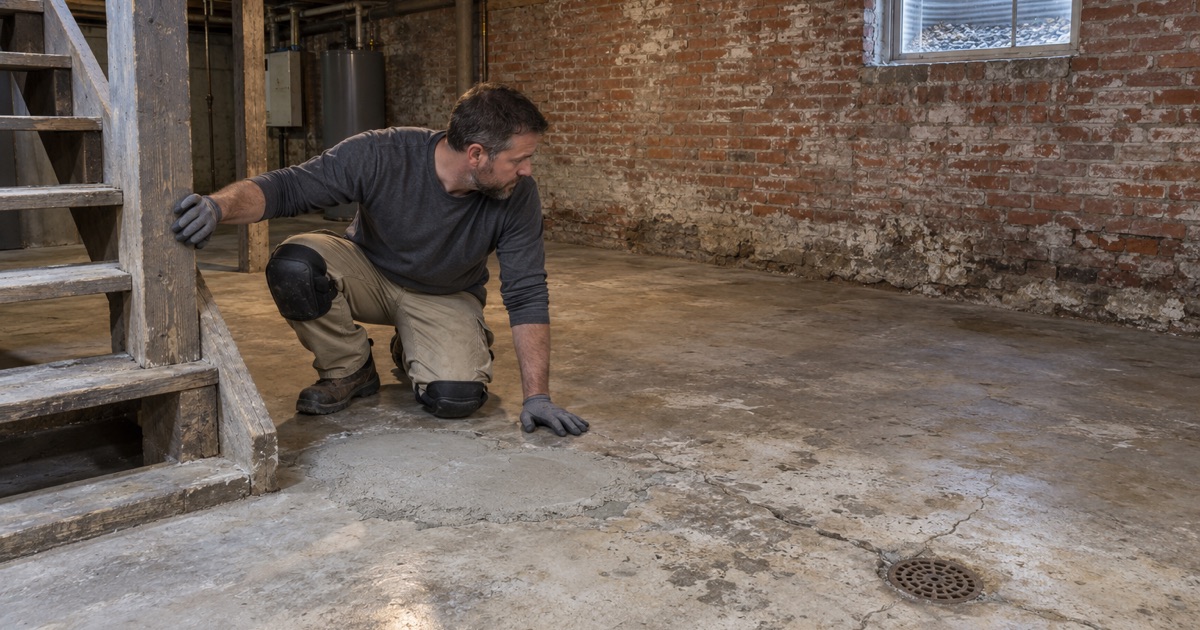
Before we price anything in Summit, we walk the slab and read it: where the cracks run, whether they have shifted in height, what the old paint is doing and whether a previous coating is bonded or just resting there. A pre-1940 floor often tells its story in patches, and each patch is a place a new coating can fail.
When a slab needs repair before it can be coated, we say so plainly and put the repair in its own line. A crack that is still active will telegraph through any epoxy, so we treat it as a joint to detail rather than a flaw to bury under resin. In a village where little housing has gone up since the 1970s, it is a conversation we expect to have.
Drains, Sump Pits and White Residue
An older basement may have a floor drain, a sump pit or an ejector pit added long after the original slab was poured. We detail around each one so the coating stops cleanly at the rim and the cover still lifts, rather than sealing a drain shut under resin.
White, powdery efflorescence on the concrete is another thing we look for, because it means water has been carrying salts up through the slab. When we see it on a floor this old, the moisture readings decide whether a mitigation primer goes in, and that line is priced before you sign anything.
Matching the System to the Slab
A sound, dry basement in one of Summit’s postwar houses can take a 100% solids epoxy base with a vinyl flake broadcast and a polyaspartic topcoat. A damp or heavily patched prewar slab may be better served by a urethane cement system, which tolerates more vapor, and we will tell you when that is the honest choice.
Whatever we choose, the product sits within the Illinois limits on VOC content for architectural coatings, which bind the installer as well as the manufacturer. That matters in a closed basement under a lived-in house, where the fumes have nowhere to go but up the stairs. We also do not sell a coating as radon reduction, since that work takes a state radon mitigation license in Illinois.
Garages get their own read. A detached garage slab may have been poured without a vapor retarder, which the IRC’s R506.2.3 exception allows for garages, so we test it the same way as a basement and finish it with a topcoat that resists hot tire pickup.
Village Hall and Firehouse on 59th Street
Who Signs Off in Summit
Summit’s Strzelczyk Municipal Center sits at 7321 W 59th Street, and its Building and Public Works department is where we check local requirements. Illinois issues no state license for flooring or coating work, so rather than quoting a license number, we show whatever contractor registration, bond and insurance the village asks for.
The village sits in Lyons Township in Cook County, and that detail matters for more than a mailing label. Health questions for a commercial kitchen floor here go to the Cook County Department of Public Health, because the addresses we checked in Summit fall in Lyons Township rather than Stickney Township, which runs its own public health district.
Commercial Floors and the Firehouse Next Door
The Summit Fire Department, a village department at 7339 W 59th Street, handles fire prevention alongside its emergency work. On a commercial job, such as a shop floor or a food-service kitchen, we ask early whether the fire prevention side needs to see the product data before the coating goes down.
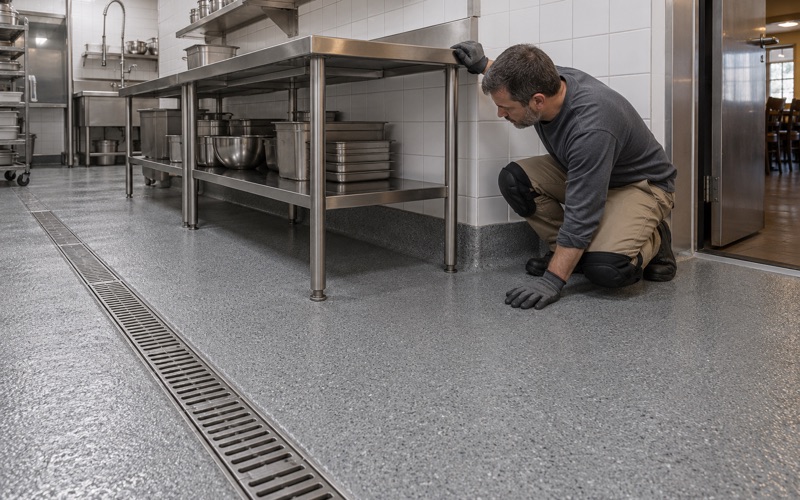
Kitchen floors fall under the Illinois Food Code, which adopts the 2022 FDA Food Code, so we plan coved floor-to-wall junctures under section 6-201.13 and use the antislip exception in 6-201.11 where a textured finish is wanted. Commercial work is scheduled around the hours the building has to stay open, with grinding done while the doors are closed.
The Paperwork You Receive
Every home job in Summit starts with a written contract and the Home Repair: Know Your Consumer Rights pamphlet, as the Illinois Home Repair and Remodeling Act requires. The contract carries over the proposal’s product and thickness line word for word, along with the moisture readings that shaped it.
With 2,260 of Summit’s 3,709 occupied homes lived in by their owners, many of the people signing that contract will be standing on the finished floor for years. We write every proposal for that reader, someone who should be able to check exactly what went into the slab long after our crew has packed up.
- 20+ Years in Business
- Moisture Testing in Every Quote
- Written Proposals