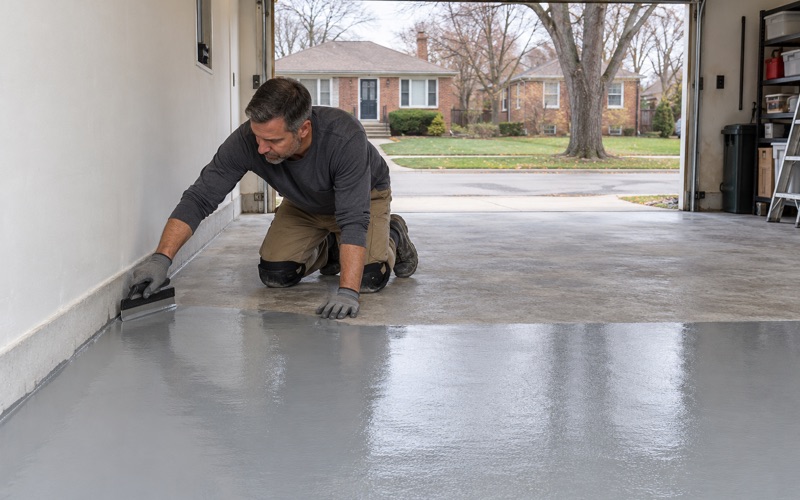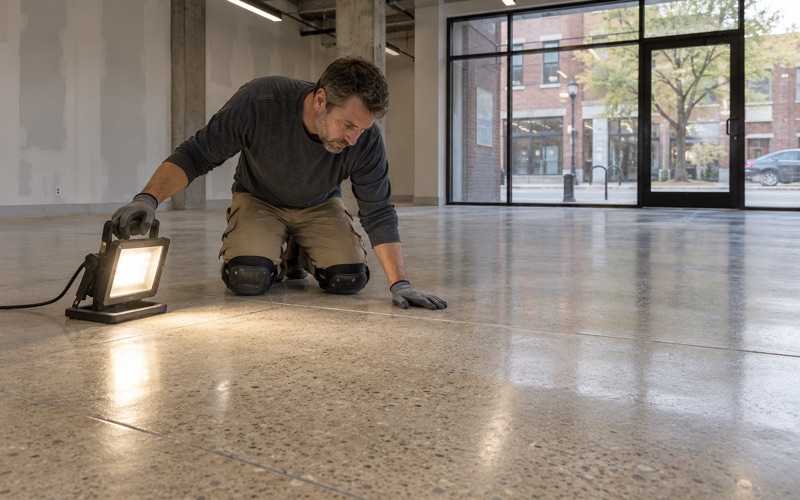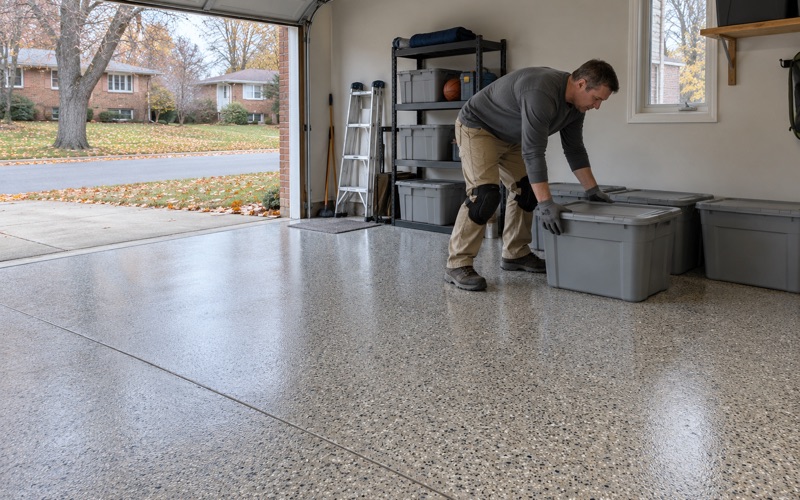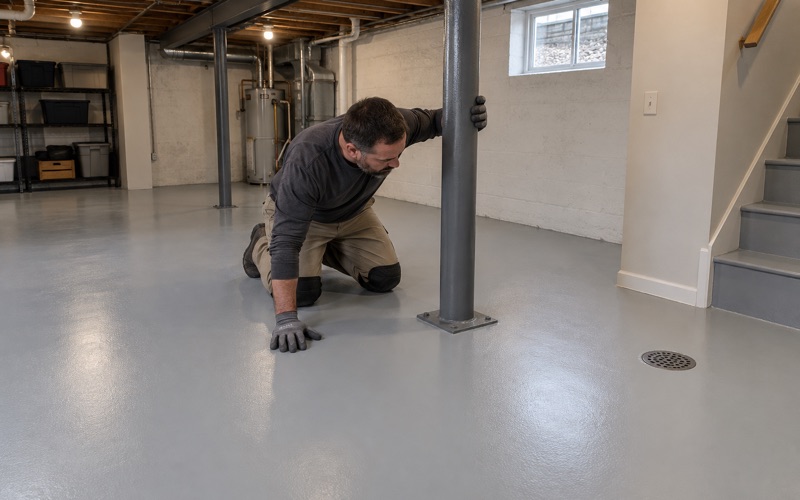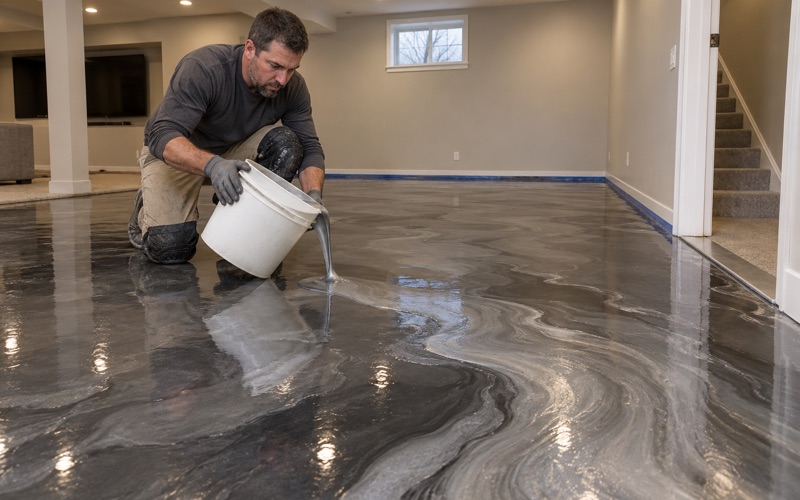
Evanston Epoxy Flooring handles epoxy-flooring in Schiller Park with more than 20 years behind us, coating warehouse aisles, self-storage corridors, shop floors and the garages under the village’s older homes. Most of what we quote here is commercial concrete that carries wheels all day, and the system has to be chosen for that load rather than for how it looks on a sample board.
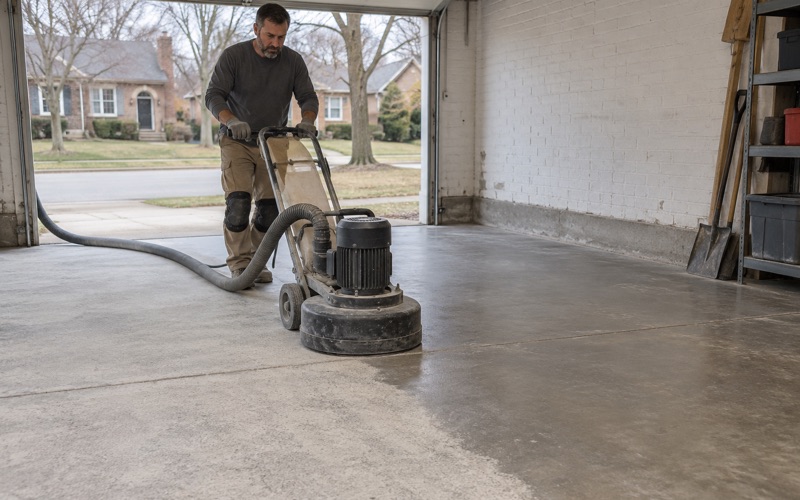
Every slab we touch is opened with a diamond grinder or a shot blaster before any coating goes down. We do not acid etch, because a chemical wash leaves a profile nobody can measure and residue nobody can see. The grinder or blaster gives us a surface we can check against a profile chart and a bond we can stand behind.
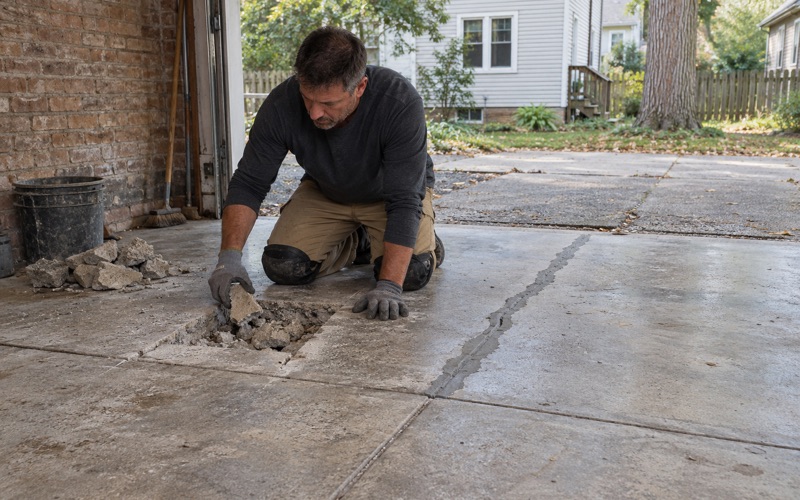
Before a price goes out, we walk the floor and read its cracks, its old paint and any failed coating. When a slab needs repair before it can be coated, we say so in writing, and the proposal names the product, the system build and the finished thickness so a building owner can check what went down against what was quoted.
Who owns the big floors: ProLogis and storage on the tax roll
The village’s own FY2024 annual comprehensive financial report tells the story of who holds the concrete here. Commercial property made up 55 percent of the 2023 equalized assessed value of $491,441,198, with housing carrying the other 45 percent. For a village of 2.77 square miles, that is a heavy commercial share, and much of it sits on slab floors.
ProLogis at the top of the tax roll
CO ProLogis was the largest property taxpayer in Schiller Park in 2015 and again in 2024. The 2024 figure is $30,405,265 of assessed value, or 6.19 percent of the village total. ProLogis is an industrial owner, so its place at the top of the roll points to the kind of floor that defines this market: wide warehouse and distribution slabs.
That ranking measures taxable value, not the number of workers inside or the square footage under a roof. We read it as a signal about the type of building that leads the commercial base, and we price each floor on its own measurements. No single building is assumed; we quote what we walk, aisle by aisle, after a moisture test.
Self-storage and the rest of the top ten
Public Storage IL appears on the same 2024 list of principal property taxpayers, alongside several realty holding companies. Self-storage sitting that high on the roll tells us storage is a real part of the village’s commercial floor, with its own wear pattern that we cover further down.
The village describes its business community as more than 400 businesses, ranging from hospitality-related travel firms to machine shops. Arpac, with 435 employees, and Willow Electric Supply, with 76, are both on the 2024 principal employer list. Manufacturers and supply houses generally want a floor that sheds oil, takes a pallet jack and sweeps clean at the end of a shift.
Looking for epoxy-flooring closer to River Grove? See Epoxy-Flooring Services in River Grove.
Dock aisles, racking lines and forklift traffic
A warehouse slab that has been in service for years has often been sealed or painted at least once, and it carries a pattern of wear you can read from the doorway. The dock approach, the turn at the end of each racking row and the path to the charging station take the punishment. Those are the places we test first and build thickest.
Grinding to a profile a warehouse slab can hold
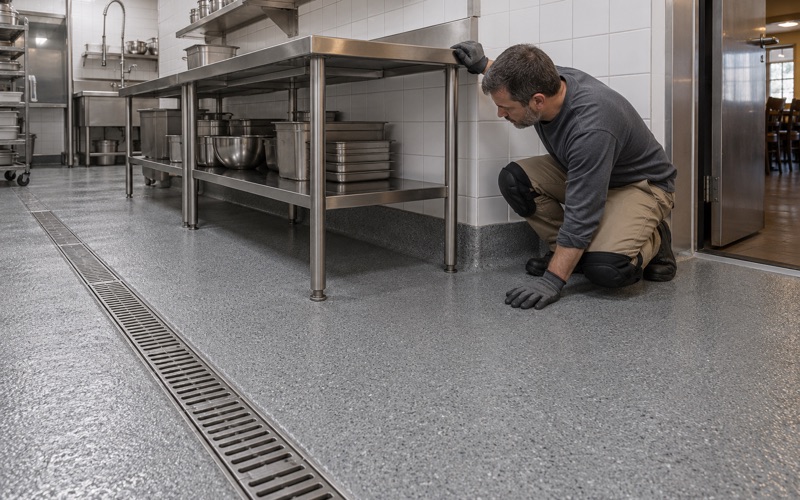
We grind or shot blast to a measured ICRI CSP profile matched to the system being installed. A thin sealer wants a lighter profile; a 100% solids epoxy body coat or a urethane cement system needs a coarser one. Old coatings come off completely where they are failing, and we do not bury loose paint under a new film and hope it stays.
Joints and cracks get read before they get filled. A coating is a film that follows the slab beneath it, so a moving joint will telegraph through anything we put on top. We tell owners that before the job starts, detail control joints so the floor can still move, and repair spalled edges where forklift wheels have been chipping them for years.
Thickness, broadcast and topcoat for wheels
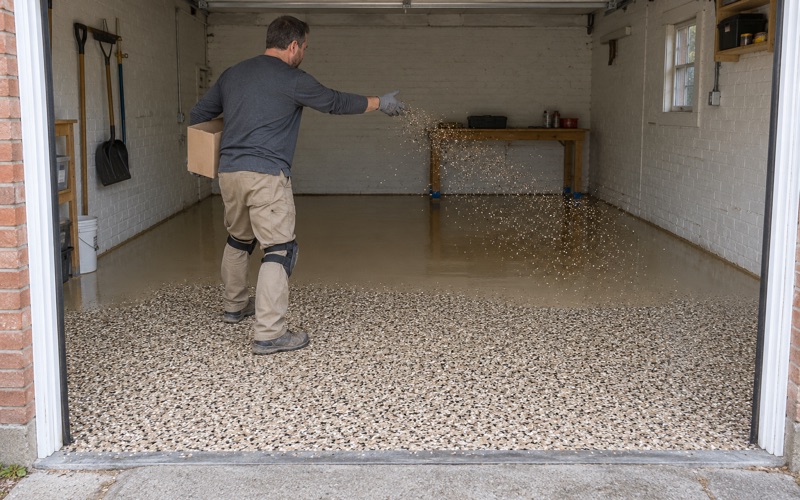
For forklift aisles we lean toward a 100% solids epoxy build with a quartz aggregate broadcast, finished with a polyaspartic or polyurea topcoat. The broadcast gives traction and adds body to the system; the topcoat takes the abrasion. Where an area is hot, wet or handles harsh chemicals, urethane cement is often the better answer, and we explain why in the proposal.
Static-dissipative and ESD flooring is a separate system with its own resistance range, and we only recommend it where the work inside calls for it. Lighter storage rooms that never see a forklift may be better served by a lithium silicate densifier on ground concrete. The right answer depends on what moves across the floor, not on what sells the most material.
Moisture testing before anyone commits
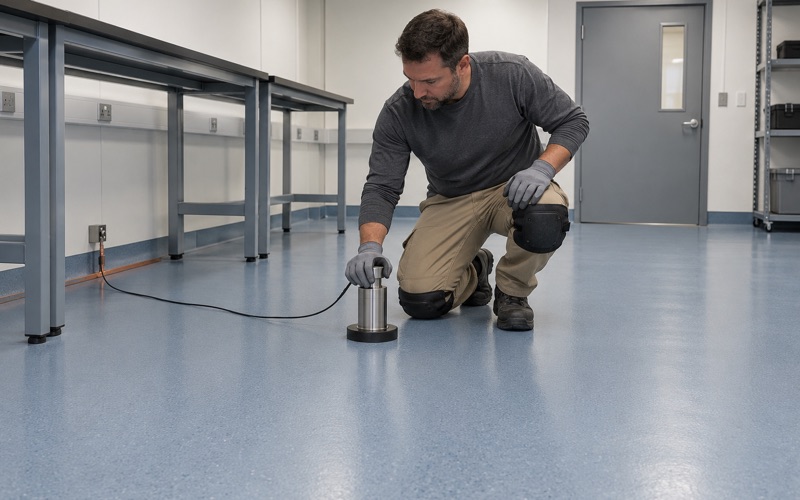
Moisture testing is a written line item on our commercial scopes, not something offered after a floor has already blistered. We use ASTM F2170 in-situ relative humidity probes and, where it fits, ASTM F1869 calcium chloride tests. An ASTM D4263 plastic sheet test is a quick screen, but on its own it does not settle whether a slab is ready.
When the readings come back high, a moisture-mitigation primer goes into the build before the epoxy does. Our warranty exclusions are read out before the job is sold, and moisture is named first. An owner signing off on a warehouse floor should know exactly what the coating is and is not promising before the first bag is opened.
Self-storage corridors and the New West Gateway TIF
A self-storage facility rarely closes for a floor job. Commercial jobs here are scheduled around the hours a property has to operate. That can mean phasing corridors, working nights, or splitting a floor so tenants still reach their units while one lane cures.
Corridors and unit floors
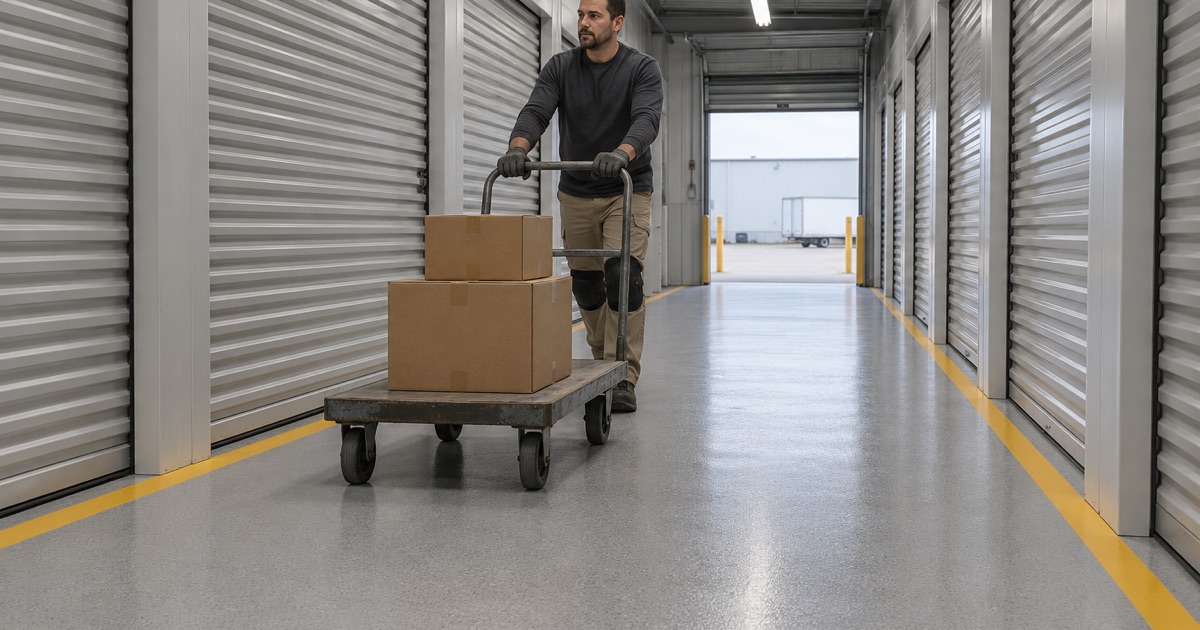
Storage corridors take rolling carts, foot traffic and the scrape of roll-up doors along the threshold. A vinyl flake broadcast under a polyaspartic topcoat is a common choice because it hides dust between cleanings and recoats well. Unit floors see less traffic and are often better left ground and densified, which keeps the cost per unit sensible across a large facility.
Thresholds and door tracks deserve their own detail. We cut the coating back cleanly where a door seals, so the film does not peel when the door drags across it. Where water collects at an exterior door, we check the slab there for moisture and efflorescence before quoting, because that spot tends to fail first if it is coated without testing.
The New West Gateway TIF: where development is still coming
The village’s financial report names the New West Gateway TIF district as the primary remaining development area in Schiller Park. That makes it the likeliest place in the village for new commercial floor to be poured. New concrete brings its own question: the slab has to cure and dry before any resin goes down over it.
On a new slab we ask about the under-slab vapor retarder, test with relative humidity probes rather than counting days on a calendar, and grind off curing compounds and laitance before priming. A building going up in the TIF district can save itself a failed floor by scheduling the coating after the slab is ready, not on the date the tenant wants to move in.
Rail and highway freight around the village
Schiller Park describes itself as sitting at a crossroads of local arterials, the Tri-State Tollway and the Canadian National rail yard. Schiller Park Yard is shared by CN and CP, and CN lists a Schiller Park East intermodal facility at 9665 West Lawrence Avenue. That freight access sits alongside the distribution and storage owners at the top of the village tax roll.
For a coating contractor that means floors that serve trucks, trailers and pallets rather than parked cars. Dock plates, trailer wheels and pallet jacks wear a coating very differently from a homeowner’s sedan. We size the system and the broadcast to that wear, and we are plain with owners when a heavily used dock zone will need a recoat sooner than the rest.
Licensed with the village from May 1 to April 30
Illinois issues no state license for flooring or coatings work. What Schiller Park requires is its own contractor license, and we license with the village before construction starts. On every job here we show that village license along with our bond and insurance, because that is what the village actually asks a coating contractor to carry.
Registering through Community Core
Contractors register with the village through the Community Core app, listing the cost and scope of work, paying a fee by service type, and submitting a state license where one applies, a certificate of insurance, a surety bond and workers’ compensation as applicable. Licenses run from May 1 to April 30 and renew every year, so we track the renewal date.
The village’s Community Development Department includes a Building Official, a Permit Coordinator and Inspectors. Grinding and shot blasting are loud, so we plan them inside the hours the village allows for construction. A one-day garage job should not run into a neighbor’s evening, and a commercial job should not surprise the businesses next door.
Older garages on 1950s and 1960s slabs
The housing side of the village stopped growing more than a decade ago. Of 4,514 housing units, none were built in 2010 or later, and 1,395 date from the 1950s and 1,425 from the 1960s. Every residential garage we coat here is an existing slab, often carrying old paint, oil stains and patched cracks from earlier owners.
Every home job gets a written contract and the Home Repair: Know Your Consumer Rights pamphlet before work starts, as the Illinois Home Repair and Remodeling Act requires. Part of the village’s housing sits in two-unit and small multi-unit buildings, so condominium and two-flat garages are scheduled with the association or the other owner first. We do not present a floor coating as radon reduction, because that work takes a state radon mitigation license.
- 20+ Years in Business
- Moisture Testing in Every Quote
- Written Proposals