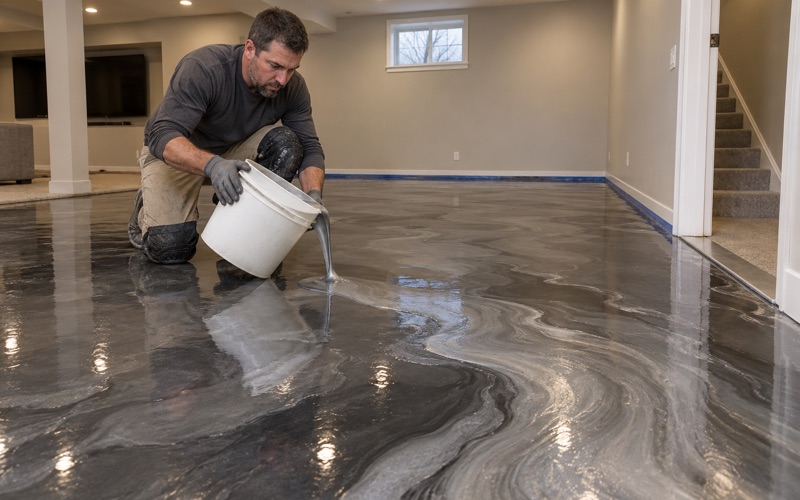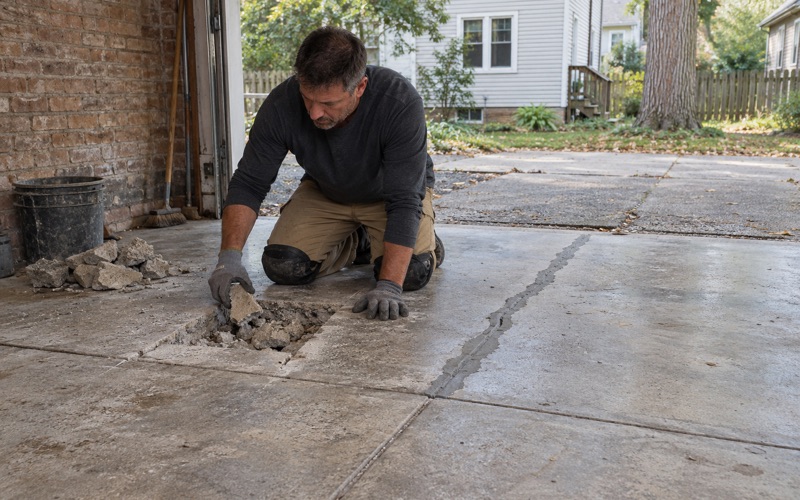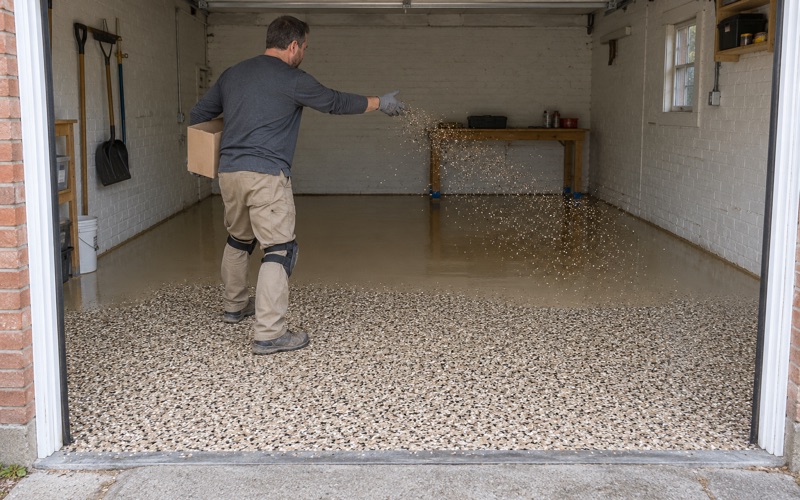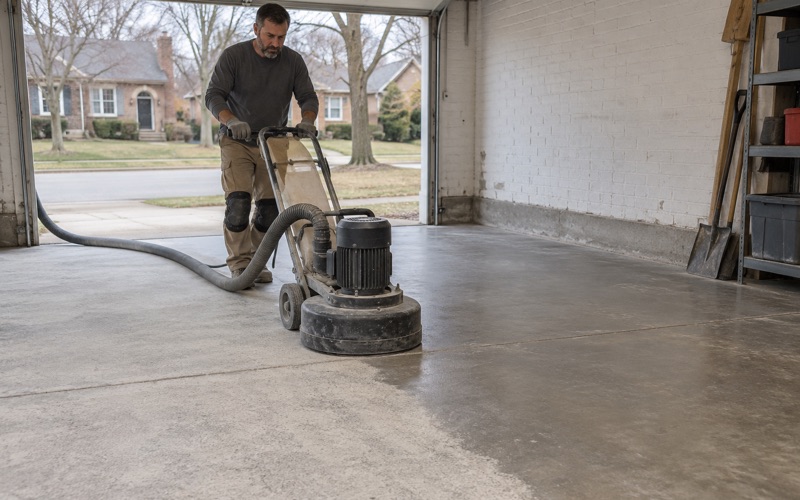
Evanston Epoxy Flooring approaches epoxy flooring in River Grove with more than 20 years in the trade, and here the person who books the work is often not the person who lives on the floor. That changes the first conversation. It turns on turnover dates, tenant access and a surface that has to hold up under years of other people’s use.
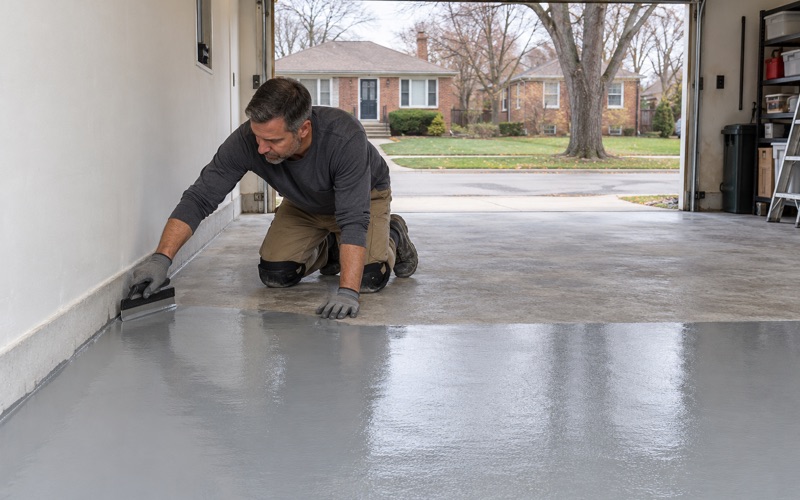
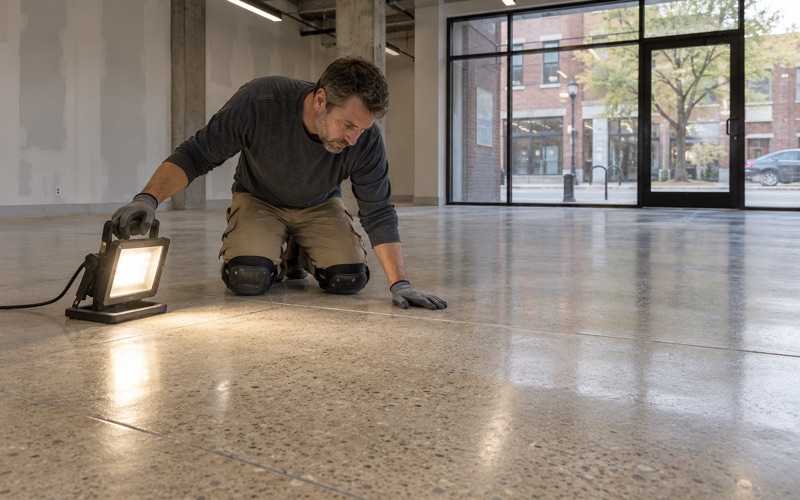
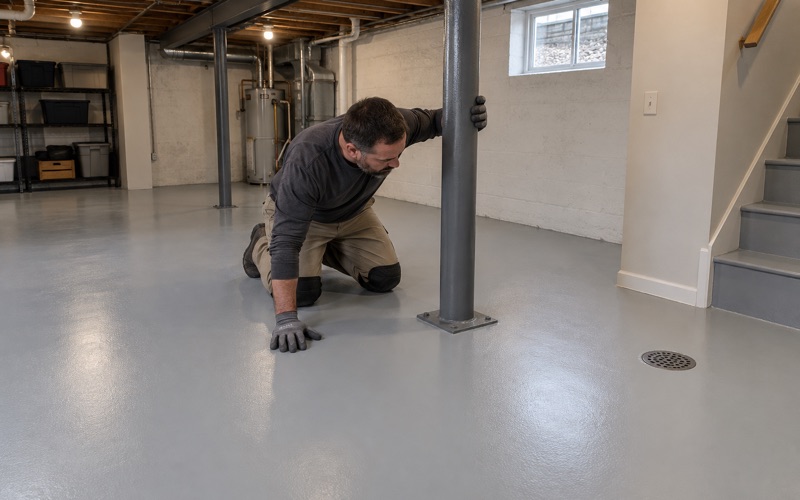
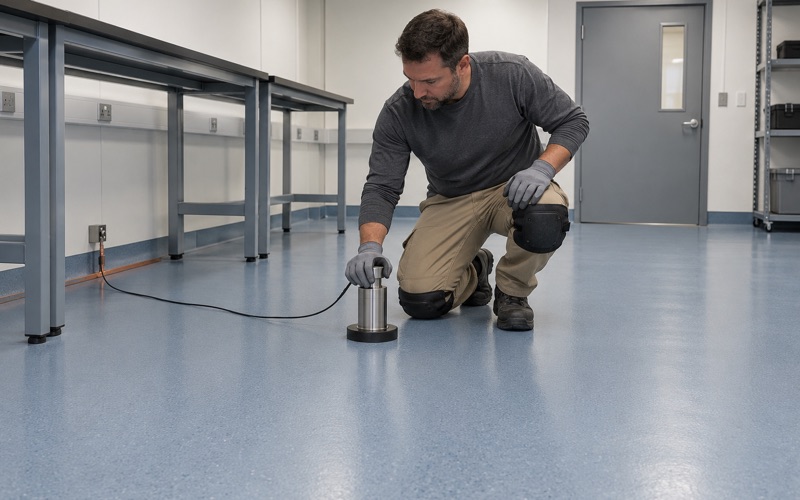
Before anything is applied, we open every slab mechanically with a diamond grinder or a shot blaster, and we do not acid etch. Moisture testing sits in the scope as its own line item, on garage and basement slabs alike, so an owner pays for the answer before the coating rather than after a blister. The written proposal names the product, the system build and the finished thickness.
That last point matters more to an owner than to most buyers. Someone who will not walk the finished floor every day needs a document that can be checked against what went down, and a plain statement of what a coating cannot do. A coating is a film that follows the slab beneath it; it will not stop a slab from moving, and we say so up front.
Five-to-nine-unit buildings and the owner who books the floor
The village’s second housing type
River Grove is not a village of detached houses alone. The Census Bureau’s 2024 five-year American Community Survey counts 998 of the village’s 4,573 housing units in buildings of five to nine units, making that the largest multi-unit form here and second only to the 2,040 detached houses. Taken together, 53.8 percent of homes sit in buildings of two or more units.
Of those 998 units, 825 are rented. Village-wide, renters hold 1,864 of 4,196 occupied units, so the 55.6 percent owner share still leaves a large rental market packed into mid-sized walk-up buildings. For our work, that means the person who calls us about a River Grove floor is often an owner or a manager rather than the household that uses the space.
When the person paying does not live on it
An owner who does not live in the unit judges a floor differently. The questions are how long the surface lasts between tenants, how easily it cleans at move-out and whether the next occupant will notice wear in the first year. Those are fair questions, and they point toward a full-build system rather than a thin roll-on coat.
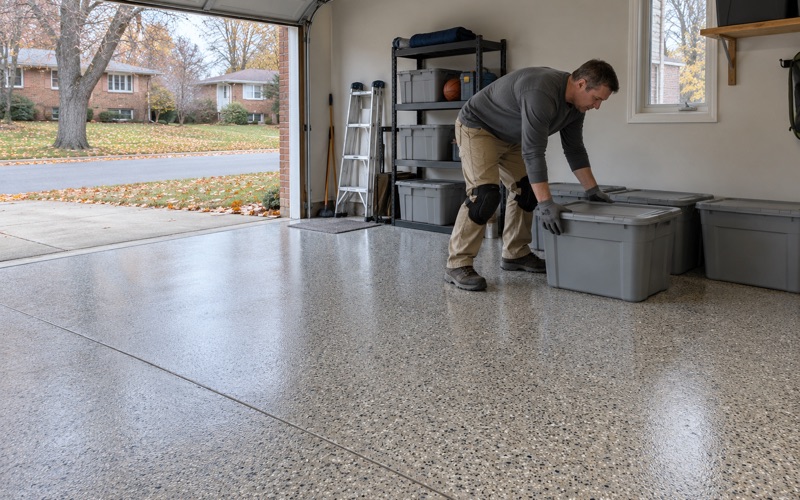
For that buyer we usually price a 100% solids epoxy base with a vinyl flake or quartz aggregate broadcast and a polyaspartic topcoat, because the broadcast hides scuffs and the topcoat takes cleaning chemicals well. Where an owner wants a lower first cost, we explain what a thinner system gives up rather than quietly substituting it.
Who we need to hear from before work starts
When the booking party is not the occupant, access becomes part of the scope. We need to know who is living in or next to the space, when the tenant has been notified, and who can confirm the floor is clear the morning we arrive. In a building with several units, grinding noise travels, so the timing has to be agreed with the owner first.
Where a unit is part of a condominium or a two-flat with a second owner, we schedule with the association or that owner before the first bag is opened. Loud grinding and shot blasting are kept inside the village’s construction hours, so a one-day floor does not run into the evening of the household upstairs.
Units where a tenant is still in place are a different job from an empty one. We can work a coated floor in stages when the owner needs part of a space kept in use, but a single continuous pour without seams gives the cleaner result, and we explain that trade-off before the owner chooses.
Looking for epoxy-flooring closer to Deerfield? See Deerfield Epoxy-Flooring.
335 rented houses and the landlord’s garage
Detached houses on the rental side
Not every River Grove rental is an apartment. The same survey counts 335 detached houses that are renter-occupied, set against 1,579 owner-occupied detached houses and 73 owner-occupied attached ones. A rented house brings its own kind of floor work: the owner may want a garage or utility-space slab coated once and left alone for the length of several leases.
That brief favors durability over appearance. Where a rented house has a garage, the floor takes whatever each tenant drives in, and in a northern Illinois winter that includes calcium chloride brine and rock salt carried in on the tires. We build garage systems for that load rather than for a showroom finish.
Hot tire pickup and the tenant’s car
A single-coat floor from a hardware-store kit often fails first where tires sit. Hot tire pickup lifts a thin film off the slab when a warm tire cools on it, and a landlord typically hears about it only at the next move-out. A properly profiled slab and a full-thickness system resist that failure far better.
We grind to an ICRI surface profile matched to the system, usually in the CSP 2 to 3 range for a broadcast floor, and we read the old paint, the old coating and every crack before quoting. When a slab needs repair before it can take a coating, the proposal says so in plain words rather than pricing around it.
Moisture first, on every slab
Garage and utility slabs in rented houses are where moisture surprises tend to surface, because an owner who lives elsewhere rarely sees the floor between tenants. We test using ASTM F2170 in-situ relative humidity probes or ASTM F1869 calcium chloride kits, with an ASTM D4263 plastic sheet as a first read. When readings run high, a moisture-mitigation primer goes into the build.
Moisture is also the first exclusion we read aloud when we go through the warranty. An owner deciding between bids should know exactly what is and is not covered before signing, and that goes double when the owner will learn about a problem secondhand from a tenant.
Scheduling floor work between leases
Cure time against a move-in date
Most rental floor work happens in the gap between one lease and the next, and that gap is rarely generous. We schedule curing against slab temperature and the dew point spread at the slab surface rather than the calendar, because epoxy laid on a slab too close to dew point can develop amine blush and lose adhesion.
For an owner, that means telling us the move-out and move-in dates when you call, not after the unit is empty. A polyaspartic topcoat can shorten return-to-service on a garage, while an unheated garage in deep winter may simply have to wait for spring, and we say that before booking rather than on the morning of the job.
Permits and the village license
The River Grove Building Department, at 2621 N Thatcher Avenue, handles permits and contractor licensing for the village. Its rule is broad: all remodeling valued over $100 requires a building permit, and concrete work is named on the list. We confirm with the department how a coating job is treated before the schedule is set, so a permit question does not eat into a turnover window.
Illinois issues no state license for flooring or coatings work, so what we show an owner is the local paperwork instead. River Grove contractor licenses run on the calendar year, January 1 to December 31, whatever the application date, and carry a $10,000 trade-specific license and permit bond plus a certificate of liability insurance naming the village.
Paperwork the owner receives
When the property is a home, every job gets a written contract and the state’s Home Repair: Know Your Consumer Rights pamphlet before work starts, as the Illinois Home Repair and Remodeling Act requires. If a tenant asks whether a floor coating lowers radon, the answer is no; in Illinois that work takes a state radon mitigation license, and we never sell a coating as radon reduction.
An owner with several units needs records that outlast one tenancy. The proposal, the moisture readings and the warranty terms we hand over are written to be read by whoever books the next floor, not only by the person who signed this one.
A 2.39-square-mile village, half of it open space
A small built footprint
The Village of River Grove, incorporated in 1888 and part of Leyden Township in Cook County, covers about 2.39 square miles of land. Roughly half of that is open space: 350 acres of forest preserve, 290 acres of golf courses and cemeteries, 35 acres of school property and 6 acres of parkland. The homes and businesses that need floors sit in what remains.
With so much land given to forest preserve and fairways, the residential streets form a compact built area, and our crews plan for working close to the neighbors. We run grinders with dust collection attached and put the noisiest work early in the day rather than letting it slide into the evening.
A busy permit desk
The Building Department issued 1,066 building permits in 2023, valued at $147,073,935, a heavy volume for a village of 10,612 people at the 2020 census. A coating job lands in that queue alongside everything else, which is why we raise the permit question at the quote rather than the week of the install.
Commercial floors keep their own clock. We schedule them around the hours a building has to stay open, and fire-code questions on a commercial job go to the River Grove Fire Department, a village department working from one station at 2601 Thatcher Avenue with six full-time equivalents on duty at all times.
What to send us first
If you own a River Grove building or a rented house, the most useful first message names the address, the type of space, the turnover dates and who has access. Photos of the cracks, any old paint or coating, and the slab around drains let us judge whether repair comes before coating.
From there we build a written scope with the product, the system and the thickness spelled out, test the slab for moisture and set the schedule against the slab’s conditions rather than a wish date. An owner who never stands on the finished floor should still be able to check every line of it.
- 20+ Years in Business
- Moisture Testing in Every Quote
- Written Proposals