Evanston Epoxy Flooring brings more than 20 years of work to epoxy flooring in River Forest, and some of the floors we quote here come with a question a detached-house owner never has to ask: who else gets a say? We answer that before we price anything, because a floor several owners share is a decision several owners make.
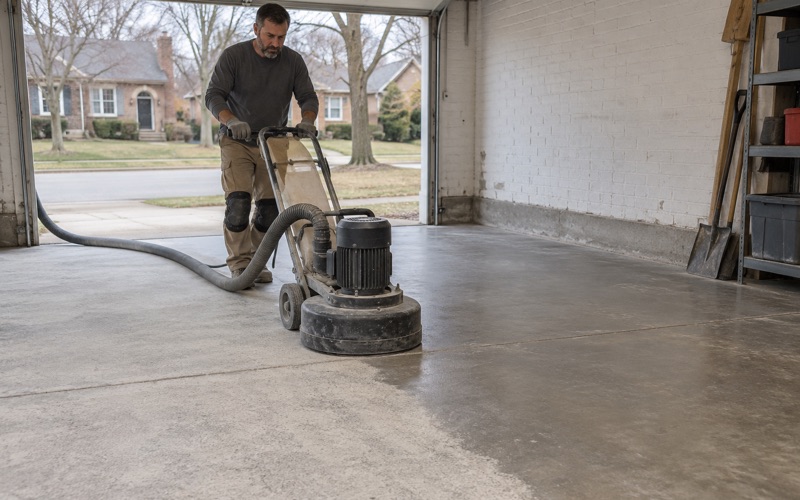
The work itself does not change with the address. Every slab is opened with a diamond grinder or a shot blaster, never acid etched, and moisture testing is a written line item rather than an upsell after a blister appears. The proposal names the product, the system build and the finished thickness, so every owner reading it can check what was promised against what went down.
That matters for garages, basements and shop floors alike, and it matters most when the people paying for a floor do not all live behind the same door. Below is how we approach owner-occupied condominium buildings, the village center along Lake Street and the commercial frontage at the village’s edges.
467 Units, Every One Owner-Occupied
What the Census Count Shows
The American Community Survey’s 2024 five-year estimates count 467 River Forest housing units in buildings of 20 to 49 units, and every one of those 467 is owner-occupied. Another 164 owner-occupied units sit in buildings of 50 or more, which puts 631 owner households in buildings of 20 units or larger.
That is not a rental market with a landlord signing off on floors. Across the village, 3,911 of 4,460 occupied units are owner-occupied, or 87.7 percent, and the buildings of 20 units or more carry no renter-occupied units at all in that count. For us, the person asking about a floor there is an owner, and usually one of several.
Where Renters Do Live
The rental stock is concentrated elsewhere. Of the village’s 549 renter-occupied units, 337 are in buildings of five to nine units and 108 in buildings of 10 to 19. On those jobs the owner of the building is our client, and the tenants’ schedule is something we plan around rather than negotiate with.
The difference shapes how a quote is written. A landlord needs one signature and a clear finish date; an owner-occupied building may need the same proposal read by several households, each of whom will walk across the result. We write ours so that it survives being forwarded, with nothing in it that only makes sense in conversation.
Scheduling With Everyone Who Shares the Building
When owners share a building, they share the floor decision, and we treat that as part of the job rather than an obstacle to it. Condominium work is scheduled with the association before the first bag of material is opened, so nobody learns about a grinder from the noise in the hallway.
Every association sets its own rules, and we ask for them rather than assume what they say. What we can promise is the sequence: dates agreed with whoever manages the building, grinding and shot blasting kept inside the village’s construction hours, and cure times stated in advance so neighbors know when a space is off limits.
A single unit’s floor is usually one owner’s call, but the noise, dust and odor of the work travel past that owner’s door. That is why we plan even a one-room job as though the whole building were the client: dates shared early, protection laid down on any route we use, and the work area cleaned before we leave each day.
Looking for epoxy-flooring closer to Prospect Heights? See Prospect Heights Epoxy-Flooring.
What Every Owner Should See in the Proposal
Testing the Slab Before Anyone Votes on a Color
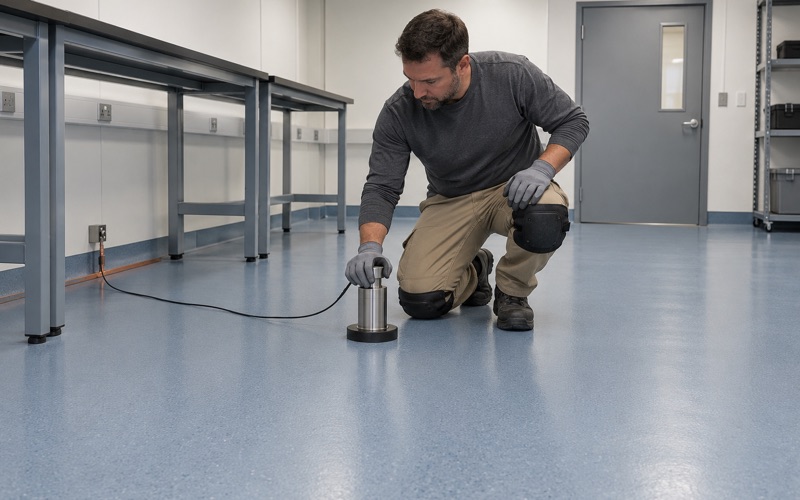
Moisture is the first thing we name and the first thing we test. Depending on the slab, that means ASTM F2170 in-situ relative humidity probes, ASTM F1869 calcium chloride tests for vapor emission, or an ASTM D4263 plastic sheet test as a quick screen, with results compared against published thresholds before a system is chosen.
If the numbers run high, the proposal says so and adds a moisture-mitigation primer rather than hoping the topcoat holds. Warranty exclusions are read out before anything is signed, moisture first, so no owner in the building is surprised later by what the coverage leaves out.
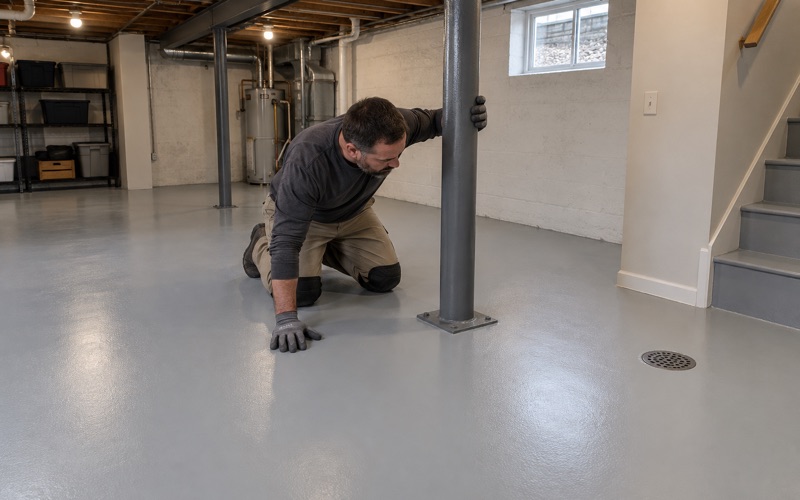
Basement slabs get the same testing as garage slabs. Hydrostatic pressure under a slab, efflorescence at the surface and a sump pit or floor drain that needs detailing all show up in the scope, because each one decides whether a coating will stay put.
Cracks, Old Coatings and Honest Limits
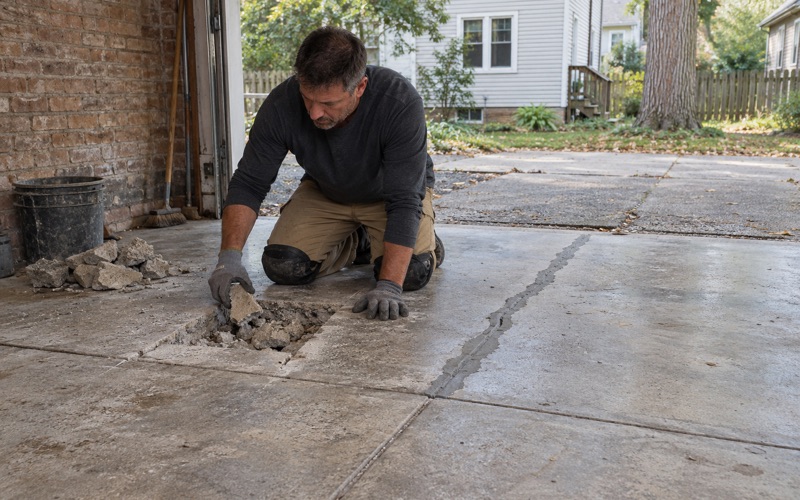
We read the cracks, any old paint and any earlier coating before we quote, and we say plainly when a slab needs repair before it can take a new system. A coating is a film that follows the concrete beneath it; it will not stop a slab from moving, and we would rather an owner hear that from us now.
Surface preparation is specified as a profile, not a promise. Diamond grinding or shot blasting opens the slab to an ICRI CSP range suited to the system, which is how a 100% solids epoxy or a polyaspartic topcoat bonds to concrete rather than to whatever was sitting on it.
A Written Spec Several Households Can Check
Because the spec is written down in full, it can do work a conversation cannot. In a building with many owners, the people who approve a floor and the people who later look at it are not always the same, and a named product and stated thickness give both groups one reference to hold the finished surface against.
Coatings are chosen within the Illinois VOC limits in 35 Ill. Adm. Code Part 223, which bind the installer as well as the manufacturer. For owners living above or beside the work, that is a practical point as much as a legal one, and we explain the ventilation and cure plan alongside it.
Lake Street Village Center and Town Center I and II
Floors Beside the Union Pacific West Line
The village’s Lake Street Village Center sits beside the Metra Union Pacific West line and its service into Chicago. Floors here belong to businesses that keep posted hours, so we plan the work around the hours the building has to stay open rather than asking anyone to close.
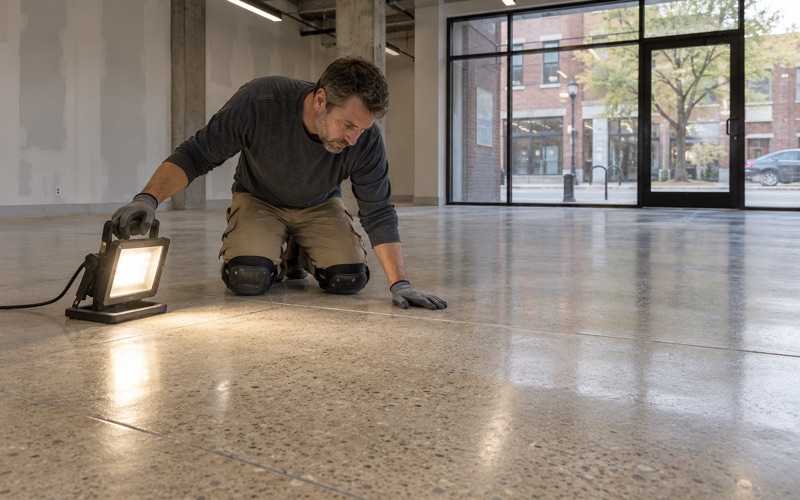
In practice that can mean grinding early within the village’s permitted construction hours, coating after close and choosing a system whose cure fits the window. A polyaspartic topcoat can return a floor to foot traffic far sooner than a slow epoxy, and where a space must reopen the next morning, the proposal says which system was chosen for that reason.
A Commercial Stock Dating to the Mid-1990s
The Cook County hazard mitigation plan’s 2024 River Forest annex names Town Center I and II, built in the mid-1990s, as the last major commercial development in the village. Nothing of that scale has been built since, so commercial floor work here means existing slabs, some with an earlier finish already on them.
That changes the first visit. A slab that has served for decades may hold sealers, tile adhesive or a coating nobody documented, and each one has to come off before a new system will bond. We identify what is there and price its removal as its own line, so the quote reflects the slab rather than an assumption.
It also raises the cost of a surprise. A business owner who books a weekend for a new floor cannot absorb a second weekend because a bond failed, so we would rather spend an extra hour testing adhesion on a small patch than learn about an old sealer after the topcoat is down.
Food Floors Under Cook County Rules
A restaurant, bakery or food counter in River Forest answers to the Cook County Department of Public Health, which covers suburban Cook County outside a handful of towns with their own departments. Illinois adopted the 2022 FDA Food Code, and section 6-201.13 asks for coved junctures where floors meet walls in the areas it covers.
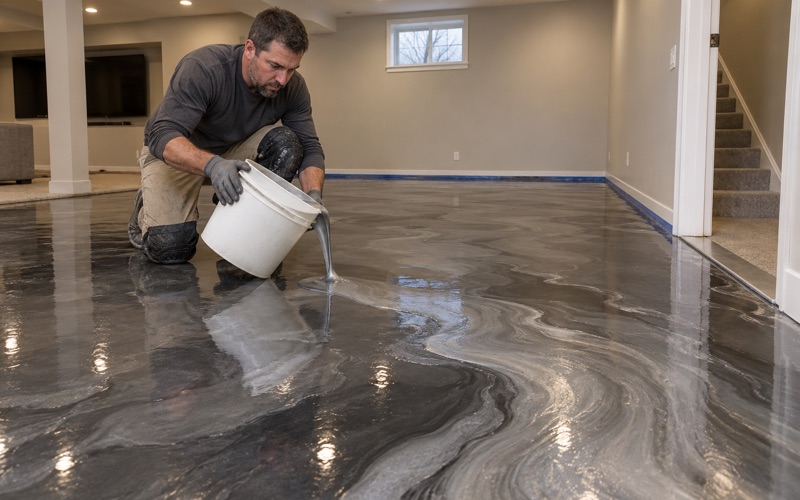
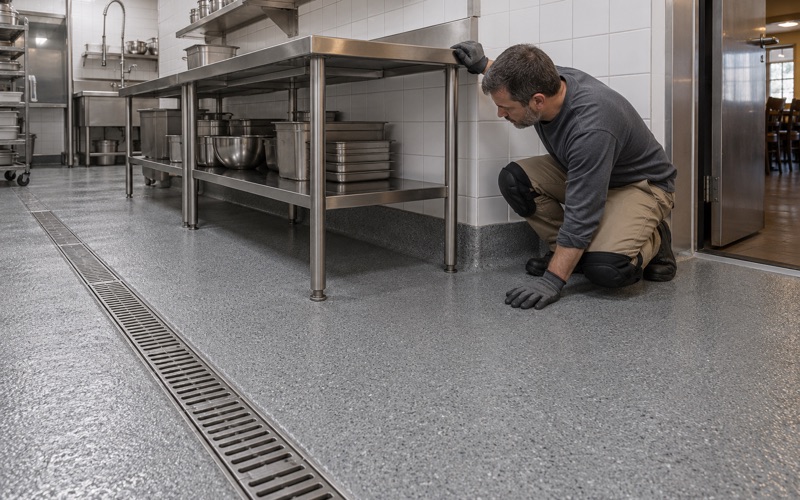
We build urethane cement or a broadcast quartz system with an integral cove base for those rooms, and we set the texture deliberately, since a kitchen floor has to be cleanable and safe underfoot at once. Drains, equipment pads and the hours the kitchen runs all go into the scope before a date is set.
North Avenue, Madison Street and Village Paperwork
Commercial Frontage on the Village Edges
River Forest is landlocked inside 2.48 square miles of land, bounded by the Des Plaines River to the west, North Avenue to the north, Harlem Avenue to the east and Madison Street to the south. Alongside the village center on Lake Street, the commercial frontage on North Avenue and Madison Street is the other place a business floor in River Forest is likely to sit.
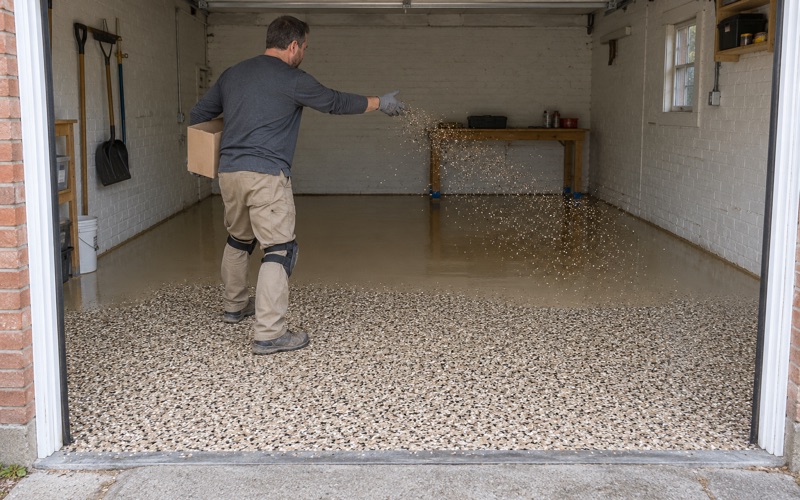
These are the village’s edges, and the work there follows the same rules as the center: a slab tested and ground, a schedule built around opening hours, and a finish chosen for the traffic it will carry. Retail and service floors usually suit a 100% solids epoxy body coat under a polyaspartic or polyurea topcoat with a vinyl flake or quartz broadcast.
Village Permits, Contracts and Credentials
Building work answers to the Village of River Forest, whose building codes sit in Title 4, Chapter 1 of the Municipal Code, and the village sits in River Forest Township, its own township rather than part of Proviso. Illinois issues no state license for flooring or coatings work, so instead of a license number we show whatever contractor license, bond and insurance the village asks for.
Every home job, including a single condominium unit, gets a written contract and the state’s Home Repair: Know Your Consumer Rights pamphlet before work starts, as the Illinois Home Repair and Remodeling Act requires. When a building’s owners are deciding together, the same documents can go to each of them.
Garages, Salt and the Cure Calendar
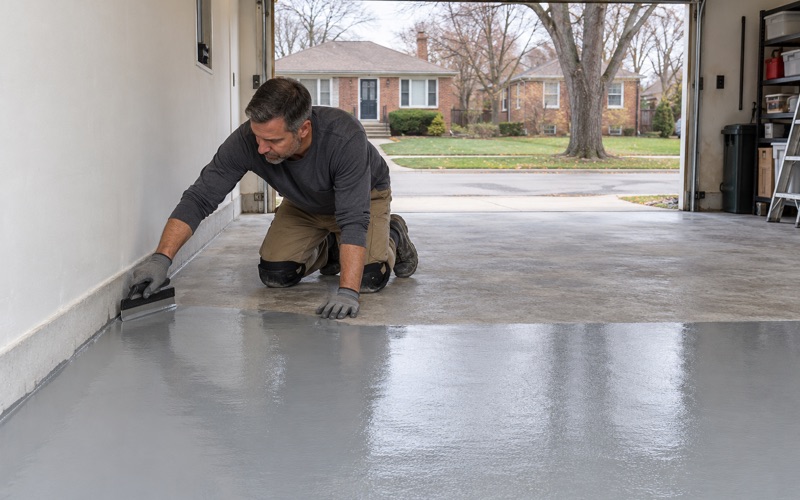
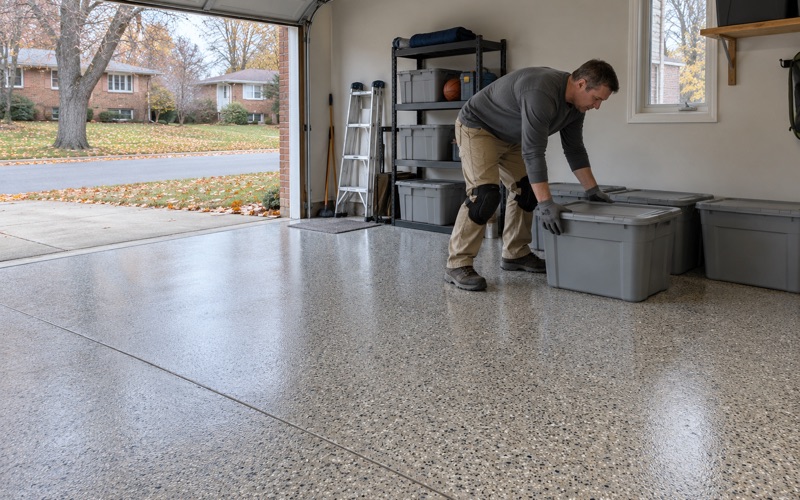
Most owner households still live in detached houses, 2,617 of them, and a garage floor at one of those houses faces a northern Illinois winter like any other. We build those floors for the calcium chloride brine and rock salt that ride in on tires, with a topcoat chosen to resist hot tire pickup.
Curing is scheduled against slab temperature and the dew point spread at the surface, not the calendar, because amine blush and poor adhesion follow a cold, damp slab. When an unheated garage cannot get warm enough, we say it should wait for spring, and we do not sell any coating as radon reduction, which in Illinois takes an IEMA radon mitigation license.
- 20+ Years in Business
- Moisture Testing in Every Quote
- Written Proposals