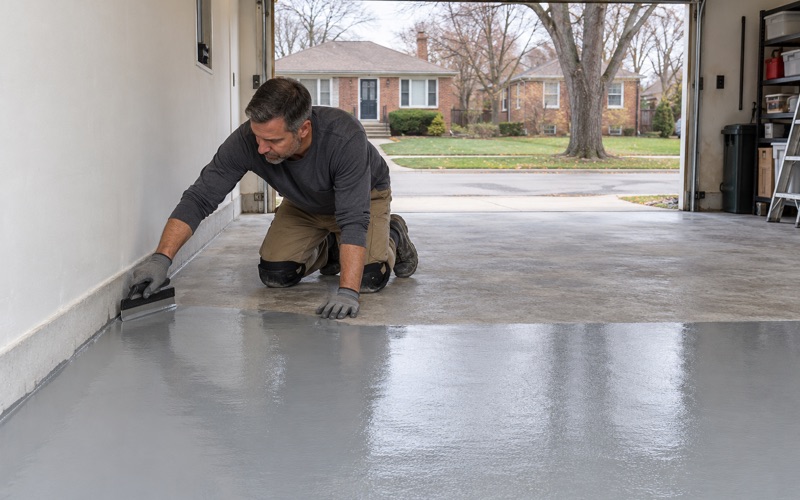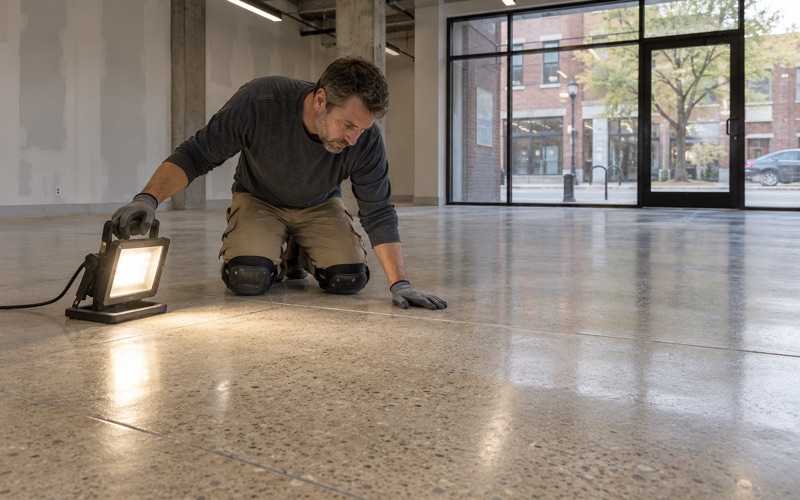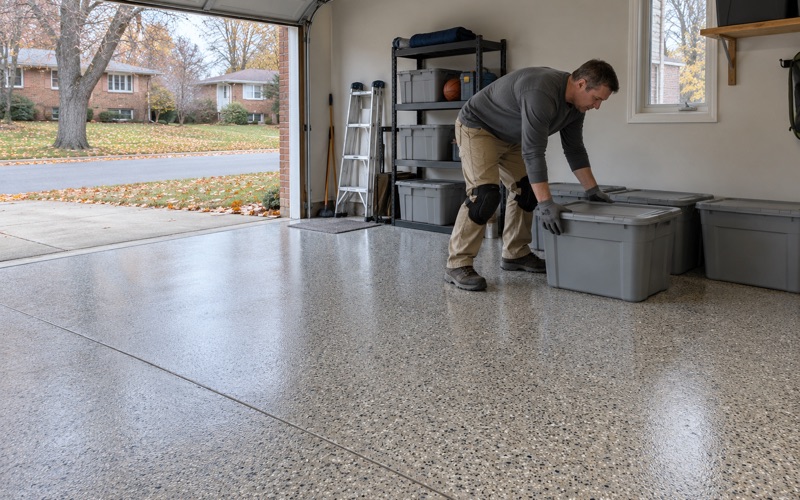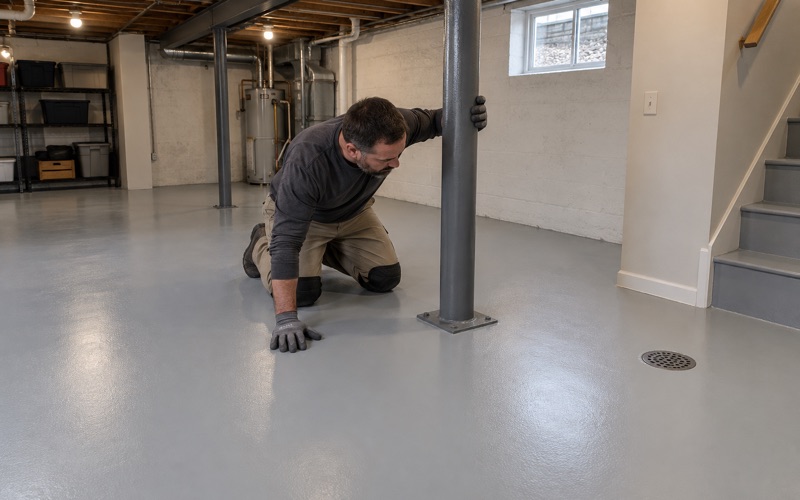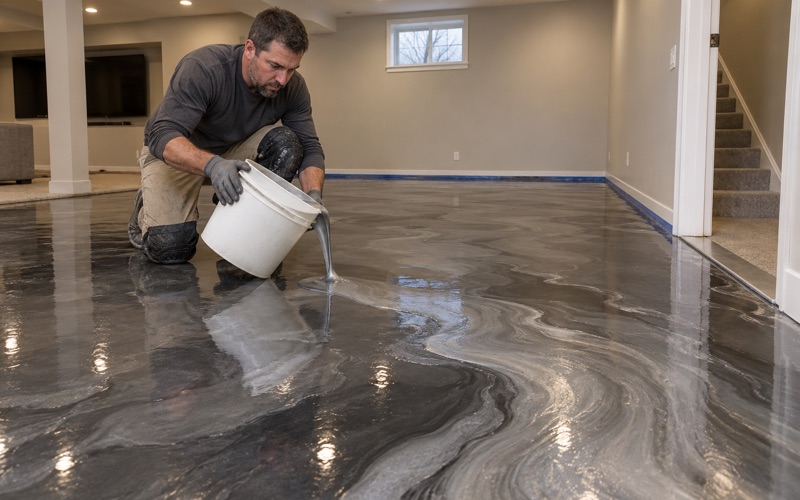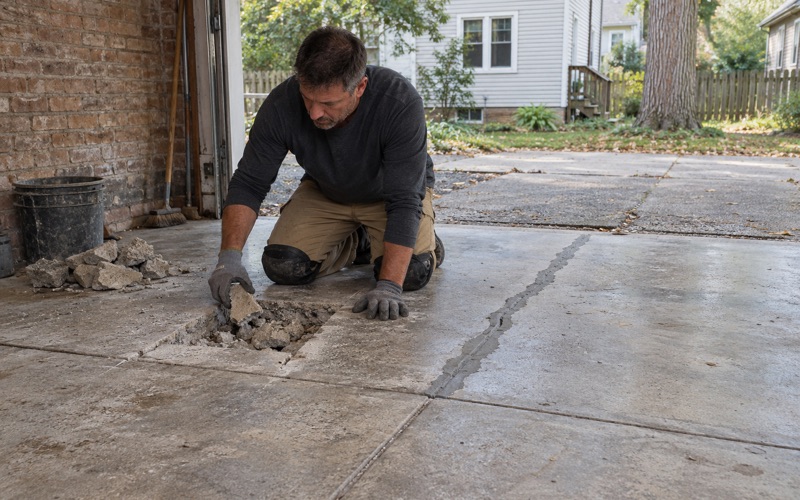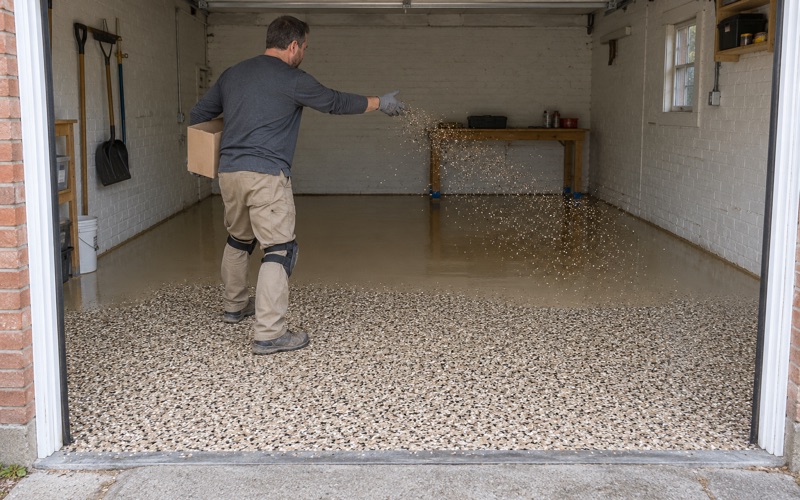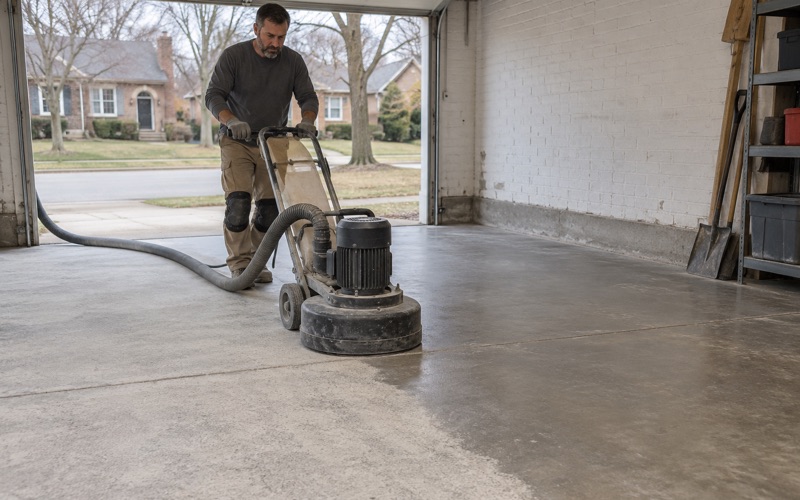
Evanston Epoxy Flooring installs epoxy flooring in Prospect Heights with more than 20 years in the trade behind every slab we prepare, and a fair share of the floors we price here belong to buildings rather than single households. A parking level under a condominium, a bank of storage cages, a ground-floor corridor between units: each needs the same slab preparation as a private garage, plus a schedule that several people have agreed to. Single-family garages and basements are still a large part of the work, and they get the same process.
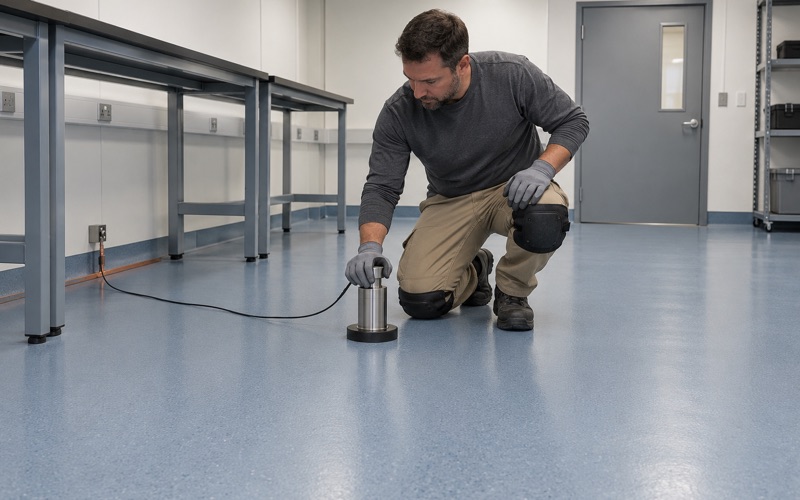
That process starts with the slab itself. We open every surface with a diamond grinder or a shot blaster, never acid, and we test for moisture as a written line item before a coating is chosen. Our proposals name the product, the system build and the finished thickness, so a board member, a property manager or a homeowner can check what went down against what was quoted.
More Than Half of Prospect Heights Lives in Multi-Unit Buildings
What the housing count shows
The Census Bureau’s 2024 five-year American Community Survey counts 6,915 housing units in Prospect Heights, and 3,610 of them sit in structures of three or more units. That is 52.2 percent of the city’s homes. The largest band within that group is 1,020 units in buildings of 50 or more, the kind of building that usually comes with shared parking, common storage and long interior halls.
The same table counts no units at all in two-unit buildings, so the two-flat arrangement familiar elsewhere in Cook County does not figure here. A Prospect Heights home is usually a detached house, an attached townhome or one unit in a building with shared halls and shared floors. That mix also means the first question on a call here is often whose floor it is, not what it will cost.
Townhomes sit in between
Single-family attached homes make up 749 units, 626 of them owner-occupied. A townhome garage looks like a private job, but the slab under it may be governed by an association’s declaration rather than by the owner alone, and the person who calls us may not be the only one with a say.
We ask that question at the first visit rather than after the grinder is on the trailer. If an association has rules about contractors, insurance certificates or work hours, the owner or manager shows them to us and we plan inside them; we do not guess at rules we have not read.
An older building stock
Most of the city’s housing went up between 1950 and 1989, 5,345 units or 77.3 percent of the total. Slabs of that age have often been painted, patched or coated at least once, and in a shared garage several owners may have tried several products over the years. Layers like that have to come off before a new system can bond, and we grind them away to an ICRI CSP 2 or 3 profile rather than coating over a mix of products we cannot vouch for.
We read the cracks, the old paint and any failing coating before we quote, and we say plainly when a slab needs repair first. A coating is a film that follows the concrete under it; it will not stop a moving crack, and we tell a board that before it votes on the budget.
Looking for epoxy-flooring closer to Forest Park? See Epoxy-Flooring in Forest Park.
Parking Levels, Storage Rooms and Who Signs Off
Shared garages and parking levels
A garage under or beside a large building takes more traffic than any private garage: dozens of cars turning on the same lanes, tires dragging grit and water in, and owners who need their spaces back quickly. For those floors we usually recommend a 100% solids epoxy base with a polyaspartic or polyurea topcoat and a quartz aggregate broadcast for grip where cars turn and people walk.
A shared garage rarely closes all at once, so we split the work into sections and give the board a map of which stalls are out on which days. Hot tire pickup is the failure owners notice first, and it usually traces back to a thin film over a slab that was never profiled, which is why the proposal states the finished thickness in writing.
Storage rooms, corridors and utility rooms
Basement storage rooms, trash rooms and laundry rooms in a 50-unit building are often below grade, and below grade is where moisture decides whether a coating lasts. We run ASTM F2170 in-situ relative humidity probes or ASTM F1869 calcium chloride tests as a priced line item, and where readings are high we specify a moisture-mitigation primer rather than hoping the topcoat will cope.
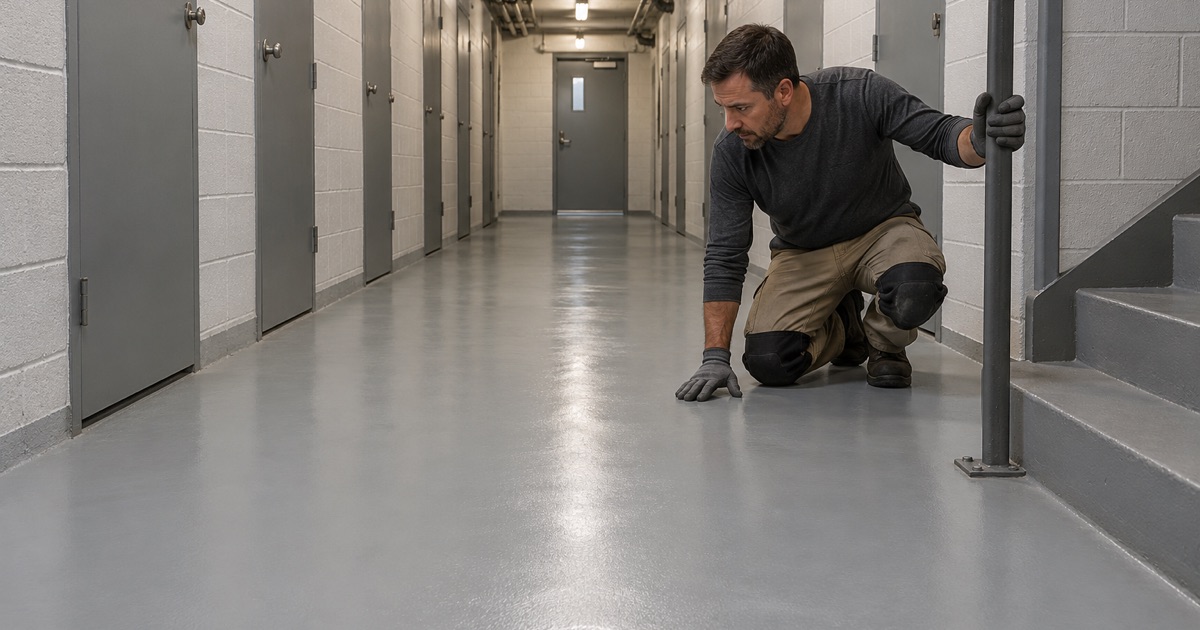
Corridors are a different problem: residents still have to get to their doors. We coat halls one half at a time where the product allows, choose coatings within the Illinois VOC limit for architectural coatings, and plan odor and ventilation with the manager before work starts, since people are living a few feet away. For a back service hall that only needs to stop dusting, a lithium silicate densifier is sometimes the better answer than a full coating.
Owners, renters and the board
Prospect Heights has 2,220 renter-occupied units, 33.2 percent of occupied homes, and only 288 owner-occupied units sit in buildings of 50 or more. In a large building, then, the people walking across a floor are often not the people paying for it, and the decision usually rests with a board or an owner’s management company.
We schedule condominium jobs with the association before the first bag is opened, and we put the scope, product and thickness in a document a board can circulate. For a home job inside a unit, the owner also gets a written contract and the state’s Home Repair: Know Your Consumer Rights pamphlet, as the Illinois Home Repair and Remodeling Act requires.
Rand Road, Milwaukee Avenue and the Wolf Road Corridor
Where the commercial floors are
Prospect Heights does its business along Rand Road, Milwaukee Avenue, and Elmhurst and Wolf Roads. The floors behind those storefronts are the usual commercial mix: retail stockrooms, restaurant kitchens, auto service bays and light warehouse space, each with a different use and a different tolerance for downtime. An auto bay wants resistance to hot tires and fluids, while a stockroom mostly needs a floor that sweeps clean and takes pallet jack traffic.
The city completed a comprehensive plan in September 2014 through CMAP’s Local Technical Assistance program, replacing its 1996 plan. Commercial properties along these roads include Palwaukee Plaza, at Milwaukee Avenue and Palatine Road, and Ascot Center, at Wolf Road and Camp McDonald Road. In centers of that kind, a tenant fitting out a space is often the one choosing the floor.
Working around open hours
A business on Rand Road or Milwaukee Avenue cannot lose a week of trade to a floor. We schedule commercial work around the hours the building has to stay open, which can mean grinding one bay while the next stays in service, or coating a sales floor across two closed days.
Grinding and shot blasting are loud, and a commercial lot in a city this mixed is rarely far from someone’s home. We plan the loud steps inside the city’s construction hours so a job does not run into a neighbor’s evening, and leave the quieter coating and broadcast work for later in the day.
Kitchens and food service
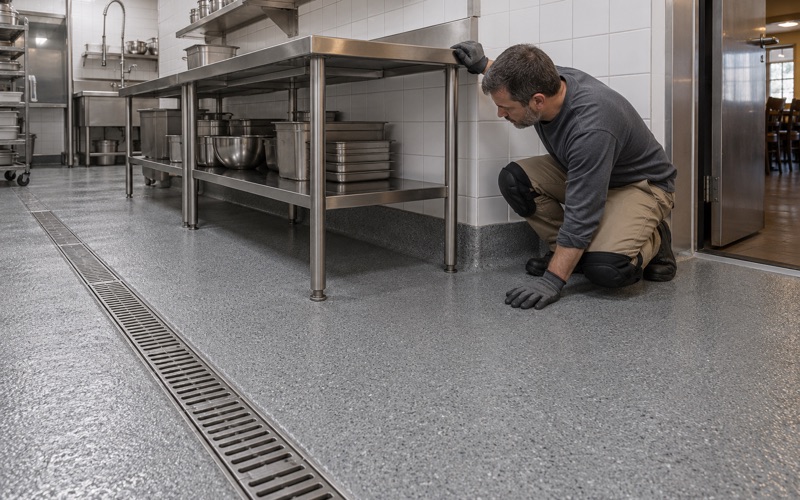
A restaurant kitchen on one of these corridors falls under the Illinois Food Code, which adopts the 2022 FDA Food Code. Section 6-201.13 of that code deals with coved, closed junctures where floor meets wall, so we build a cove base into the system instead of leaving a seam for water to find.
Grip matters as much as cleanability. A quartz aggregate broadcast under the topcoat gives a wet kitchen floor texture without making it impossible to mop, and we settle the texture with the owner before the full floor goes down.
The Fire District, Not City Hall, for Fire-Code Questions
A separate district with its own boundary
Fire protection here comes from the Prospect Heights Fire Protection District, a separate taxing district rather than a department of the city. It covers about 5 square miles from two stations with about 60 career and part-time personnel, and the city itself measures 4.29 square miles, so the two boundaries do not line up exactly.
The district has covered the area north of Dundee Road along Portwine Road since the early 1990s, when the former Palwaukee Area and Wheeling Rural districts were consolidated. An address can sit in the district without sitting in the city, and the reverse is worth checking too.
When a floor job raises a fire question
Garage and basement coatings rarely involve the fire service. A large building is different: a parking garage, an exit corridor or a stair landing is part of how people leave the building, and a manager may want to know who reviews work there or how long a route can be out of use.
For that question the authority to call is the fire protection district, not City Hall, while building permits run through the City of Prospect Heights. We do not state either office’s rules from memory; we ask the manager to confirm with the right one, and we phase corridor work so a usable route stays open while each section cures.
Paperwork that matches the building
Illinois issues no state license for flooring or coatings work, so a board or property manager will not find a state number for us. What we provide instead is the city contractor license, bond and insurance the municipality asks for, along with the certificates a management company typically requests before a crew is allowed on site.
We also read the warranty exclusions aloud before anything is signed, and moisture comes first on that list. Curing is scheduled against slab temperature and dew point rather than the calendar, so an unheated garage level may have to wait for spring, and we say so when the job is quoted rather than when the floor fails.
Radon comes up in basement conversations, too. A floor coating is not radon reduction, and in Illinois that work takes a state radon mitigation license through IEMA, so we point owners to a licensed mitigator rather than selling a coating as the fix.
- 20+ Years in Business
- Moisture Testing in Every Quote
- Written Proposals