
Evanston Epoxy Flooring brings 20+ years of floor work to every polyaspartic floor coating we apply in Evanston, IL, serving surrounding cities including Lincolnwood, Winnetka, Norridge, Schiller Park and River Grove. Polyaspartic is the fast-curing, color-stable member of the polyurea family, and it has changed how quickly a garage or a shop floor can go back into use.
Speed is also where polyaspartic goes wrong. A resin that sets in minutes gives no time to fix poor preparation, so a floor rushed onto an etched or damp slab fails as fast as it cured. We grind every slab open, test it for moisture and write the full build into the proposal before any polyaspartic is mixed.
This page explains what polyaspartic floor coating is, where it earns its higher price in homes and commercial buildings, and what has to go right on install day for it to stay bonded.
What Polyaspartic Floor Coating Is
Polyaspartic Compared With Epoxy
Polyaspartic is an aliphatic polyurea resin, which in practical terms means it cures quickly, stays clear and resists the yellowing that sunlight causes in many epoxies. It is also hard and abrasion resistant, which helps it stand up to tires, carts and dragged equipment.
Epoxy still has strengths polyaspartic lacks. It builds thicker in a single coat, flows into the pores of ground concrete well, and costs less per square foot. Our choice between them, or the decision to use both, comes from the floor’s use, sun exposure and schedule rather than from a house preference.
Polyaspartic as a Topcoat Over Epoxy
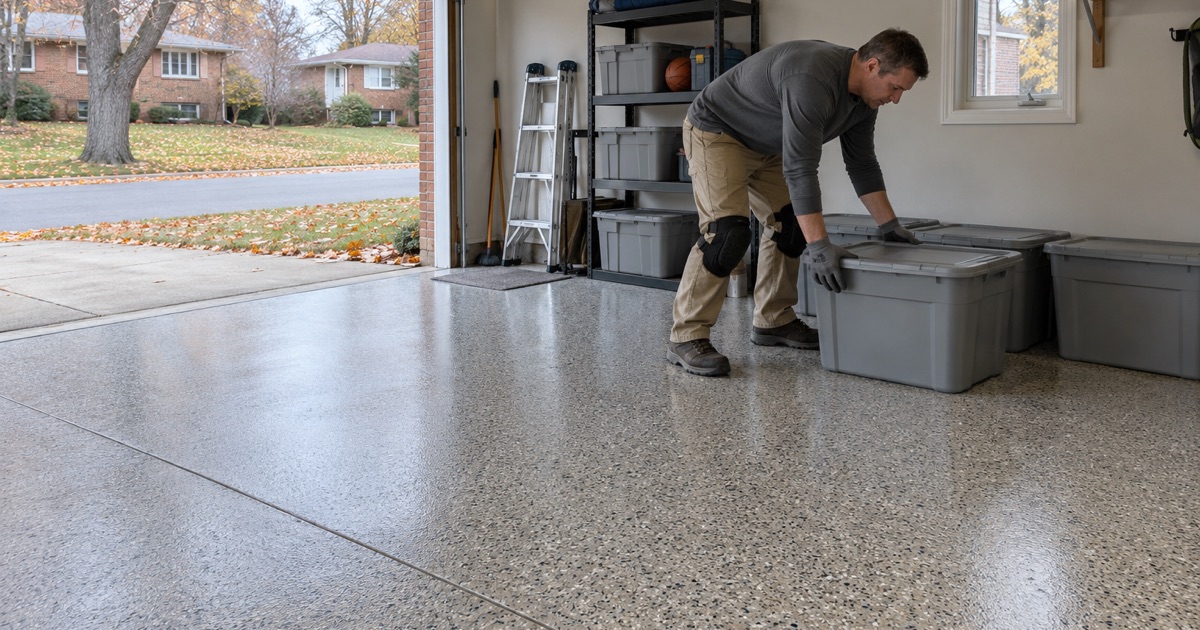
The most common way we use polyaspartic is as the topcoat over a 100% solids epoxy base and a vinyl flake broadcast. The epoxy provides the bond and the build, and the polyaspartic provides the wear layer, the gloss level and the ultraviolet stability. That combination is what we recommend on most attached garages, because it pairs epoxy’s forgiving application with a top surface that holds up to hot tires and road salt.
Full Polyaspartic Floor Systems
A full polyaspartic system uses polyaspartic for the base, broadcast and topcoat. It is the fastest way to return a floor to service and suits owners who cannot give up a garage or shop for several days. The faster schedule only holds when the slab is ready to coat, so a floor that needs major crack work or moisture mitigation will still take longer.
A full system also leaves less margin for error, because every layer sets quickly and the next has to follow on time. We plan the broadcast and topcoat sequence before the first batch is mixed, with enough hands on the floor that no section is left waiting while the resin begins to set.
Residential Polyaspartic Floors
Garages That Need to Be Back in Use Quickly
For many households the deciding factor is time without the garage. A polyaspartic system can shorten the gap between grinding and parking considerably compared with an all-epoxy build. We give you the walk-on time and the drive-on time in writing, set by the actual products and the slab temperature on the day.
Fast cure does not mean skipped steps. The slab is still ground to open concrete, the cracks are still filled, and the moisture test still happens before anything is mixed. The time saved comes from the resin chemistry, not from the preparation, and the proposal shows each step so you can see none of them were dropped.
Sun-Facing Garages and Ultraviolet Stability
A garage that faces south or west with the door up in the afternoon puts direct sunlight on the floor for hours. On an epoxy-only floor that light slowly ambers the finish, most visibly on light colors and near the door. A polyaspartic topcoat keeps the color closer to what you chose on install day.
The same holds for a detached garage with windows, a sunroom-style workshop or a showroom floor near glass. Where sun reaches the floor, we put polyaspartic on top, even if the base below it is epoxy, so the part of the system that takes the light is the part built to resist it.
Basements and the Limits of Fast Cure
Polyaspartic works in a basement, but it does nothing about moisture coming up through the slab. A basement floor still gets its moisture test, and if the readings call for it, a moisture-mitigation primer goes down first. A fast-curing coating over a damp slab simply blisters sooner.
A coating also cannot keep a basement dry when the water arrives from above the floor, through a floor drain during a sewer backup or seepage at the wall. It makes cleanup easier after such an event, and we say plainly that it does nothing to prevent one. Floor drains and sump pits are detailed so the coating stops cleanly at each.
Commercial Polyaspartic Floors
Retail and Restaurant Floors With Short Closures
Shops and restaurants that cannot close for a week are where polyaspartic earns its price. We phase the floor in sections, schedule around the hours the building has to stay open, and plan the loud grinding inside the town’s construction hours.
In food service, the floor finish and cove base still have to meet the Illinois Food Code, which follows the 2022 FDA Food Code on smooth, cleanable floors and coved floor-to-wall joints. Polyaspartic can be part of that system where hot washdown is not daily; where it is, urethane cement is the better choice.
Service Bays, Showrooms and Back-of-House
Auto service bays and showrooms benefit from polyaspartic’s hardness and its resistance to hot tire pickup. Back-of-house corridors, stockrooms and break rooms get a durable, easy-clean surface with a short closure. We pick the topcoat by the chemicals actually used in the space and add texture where the floor gets wet, rather than putting the same finish on every room.
Installing Polyaspartic Correctly
Short Pot Life Means Prep Comes First
Polyaspartic gives a crew only minutes to mix, spread and broadcast before it starts to set. That leaves no room to fix a missed patch of sealer or a damp corner once the resin is down. All of that work happens beforehand: grinding to an ICRI profile, crack repair, vacuuming and moisture testing.
Acid etching is never part of it. Etching leaves residue and an uneven, shallow profile, and a fast-setting resin locked onto a weak surface pulls that surface up with it as it cures. A diamond grinder or shot blaster gives the coating sound concrete to hold.
Temperature, Humidity and Dew Point
Humidity and heat speed up polyaspartic, sometimes too much, while a cold slab slows it. We measure slab temperature and the dew point spread at the surface before mixing, and adjust batch size and timing so the coating levels out instead of trapping bubbles from outgassing concrete.
Outgassing is air rising out of the concrete pores as the slab warms, and a fast-curing film can lock those bubbles in as pinholes. We avoid coating a slab while it is warming quickly, such as a garage floor catching morning sun, and use a primer where the concrete is especially porous.
Thickness, Texture and the Written Build
Your proposal names each product, the order of coats, the broadcast and the finished thickness, so the floor can be checked against what was quoted. Every product is chosen within the Illinois VOC limits for floor coatings, which bind the installer as well as the maker.
On home jobs you also receive a written contract and the Home Repair: Know Your Consumer Rights pamphlet before work begins, and we read the warranty exclusions out loud, starting with moisture.
- 20+ Years in Business
- Moisture Testing in Every Quote
- Written Proposals