Evanston Epoxy Flooring has spent 20+ years preparing and coating concrete, and we install metallic epoxy floor systems in Evanston, IL, serving surrounding cities including Lincolnwood, Winnetka, Norridge, Schiller Park and River Grove. A metallic floor uses reflective pigments that swirl and settle as the resin is worked, leaving a marbled, almost three-dimensional surface no two floors share.
Of all the coatings we install, metallic is the least forgiving of a poor slab. The glossy finish shows every ridge, patch line and pinhole beneath it, and a moisture problem shows up as blisters in the most visible floor in the house. That is why every metallic job starts with grinding, repair and a written moisture test.
Below we explain how a metallic floor gets its look, where it suits homes and businesses, how we install it step by step, and how to care for it once it is down.
What a Metallic Epoxy Floor Is
Metallic Pigments and How the Pattern Forms
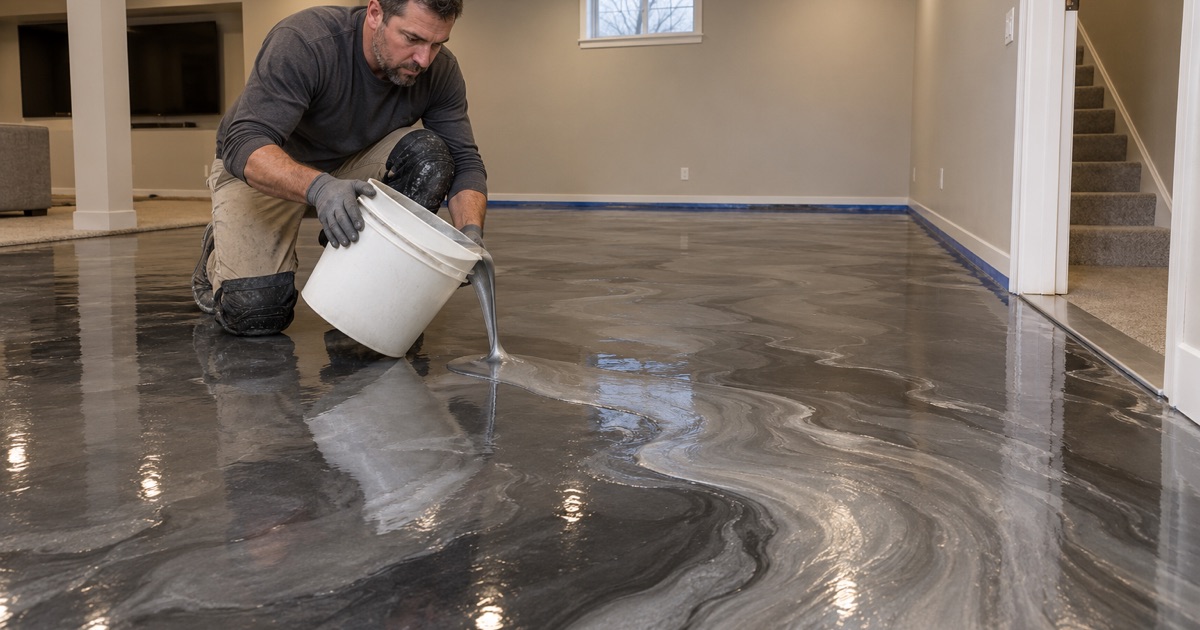
Metallic pigments are fine reflective particles mixed into a clear or tinted epoxy. As the resin is spread and worked with rollers, trowels or sprayed solvent, the particles turn and catch light differently, creating veins, cells and pools of color that look like polished stone, liquid metal or a lava pattern.
The installer’s technique shapes much of the result. Long strokes give a flowing marble, short swirls give a lunar texture, and two or three colors can be layered for depth. We agree on the style before the pour and keep to it across the room.
Why No Two Floors Match
Because the pattern forms as the resin moves, a metallic floor can never be copied exactly from a photo or even from a sample board. Light, room size and the slab itself all change how it reads. We pour sample boards in your colors and show a range of finished floors, so you choose a character rather than an exact picture.
Residential Metallic Epoxy Floors
Finished Basements and Lower Levels
Metallic epoxy suits a finished basement used as a family room, bar or office, where it reads as a design choice rather than a utility floor. It also cleans easily and holds up to furniture and foot traffic better than many soft finishes.
A basement only gets a metallic floor after its moisture test clears comfortably, since vapor rising through a below-grade slab is the most common reason a glossy coating blisters. Where readings are borderline, a moisture-mitigation primer goes down first, or we recommend a different floor.
Showcase Garages
A metallic garage floor can be striking for a car collection or a workshop that doubles as a display space. It needs a UV-stable polyaspartic or polyurea topcoat, since sunlight ambers epoxy, and some texture so it is not slick under melting snow.
We are also honest that in a garage taking northern Illinois road salt and calcium chloride brine every winter, a glossy metallic will show film and fine scratches sooner than a flake floor. For a daily-driver garage, flake is usually the better buy.
Kitchens, Mudrooms and Living Spaces on a Slab
In homes built on a slab, metallic epoxy can run through a kitchen, mudroom or living area as a seamless, easy-clean surface. These rooms take furniture, pets and dropped items, so the topcoat is chosen for abrasion resistance and, near doors, for grip.
A slab under a living space has often been covered by carpet, tile or vinyl for decades, and the adhesive left behind has to be ground off completely. We find out what is under the existing floor before quoting, because that removal can be the largest single line in the price.
Commercial Metallic Epoxy Floors
Showrooms and Retail Floors
Metallic floors are popular in showrooms, boutiques and galleries because they reflect light and give a space an identity no tile can. They also stand up to foot traffic and display fixtures when finished with a hard topcoat.
We schedule commercial pours around the hours the business has to stay open, often over a closure of a few days, and plan the loud grinding inside the town’s construction hours.
Offices, Salons and Dining Rooms
Offices, salons and restaurant dining rooms use metallic epoxy for a polished, seamless floor that wipes clean. In salons and dining rooms the topcoat is chosen to resist the chemicals and spills that actually happen there, and texture is added near sinks and service stations. Back-of-house kitchen floors, which must meet the Illinois Food Code, get a different system.
Our Step-by-Step Metallic Epoxy Floor Process
Step 1: Slab Assessment and Moisture Test
We check the slab for cracks, patches, old coatings and flatness, and run a moisture test written into the proposal as a line item, using calcium chloride kits under ASTM F1869 or in-slab probes under ASTM F2170. A slab that fails is not given a metallic floor until the moisture is addressed.
Step 2: Grinding, Repair and a Flat Surface
The floor is diamond ground to an ICRI surface profile, with every bit of old coating, adhesive and sealer removed. Cracks and low spots are filled and ground flush, because a metallic finish magnifies every ridge left behind.
We do not acid etch, and we take the extra time here that a flake floor would not need. On a metallic job, the hours spent on a smooth surface are the hours that decide how the finished floor looks.
Step 3: Primer and Base Coat
A penetrating primer seals the concrete and stops it from outgassing air bubbles into the decorative layer. A tinted base coat then gives the metallic a uniform background color and a smooth surface to flow over.
The base color matters more than most owners expect. A dark base gives a metallic floor depth and contrast, while a light one makes the pattern softer and brighter. We pour sample boards on both before the job so the choice is made by eye, not from a chart.
Step 4: The Metallic Pour
The metallic epoxy is mixed, poured and worked across the floor in one continuous session, so no section dries before it is blended into the next. Slab temperature and the dew point spread are checked before the pour, since a cold or damp surface can cloud the finish with amine blush.
Step 5: Topcoat and Cure
A clear topcoat protects the metallic layer from scratches and, where sunlight reaches the floor, from ultraviolet ambering. Foot traffic and furniture return on the schedule written into the proposal, which is set by the products and the room temperature.
Every product in the system is chosen within the Illinois VOC limits for floor coatings, which bind the installer as well as the manufacturer. We ventilate during application and cure, and on home jobs plan the schedule so the household is not living over a fresh coat if that can be avoided.
Living With a Metallic Epoxy Floor
Scratches, Sheen and Care
Glossy floors show fine scratches, mostly from grit tracked in on shoes. Dust mopping often, felt pads under furniture and mats at entrances keep the finish looking new. A worn topcoat can be lightly sanded and recoated later without touching the metallic layer underneath.
Warranty, Exclusions and Paperwork
Our proposal names the primer, base coat, metallic layer, topcoat and finished thickness, so you can check the floor against what was quoted. We read the warranty exclusions out before the job is sold, starting with moisture, and every home job comes with a written contract and the state’s consumer-rights pamphlet before work begins.
- 20+ Years in Business
- Moisture Testing in Every Quote
- Written Proposals