Evanston Epoxy Flooring brings more than 20 years of slab work to epoxy-flooring in Lyons, and in this village the first conversation is rarely about color or flake size. It is about water: whether the basement has taken it, how high it came and what it left behind in the concrete. We ask those questions before we measure a single square foot.
That order matters because a floor coating is a thin film bonded to whatever slab sits under it. If the concrete is still carrying moisture or contamination from a flood, the coating is the first thing to show it, usually as blisters or lifting edges. So our quote starts with the slab’s history, then the slab itself, and only then the product.
We work garages, basements and commercial floors with 100% solids epoxy, polyaspartic topcoats and urethane cement where the conditions call for it. On a Lyons basement, though, the system choice comes last. This page walks through why: the floods the village has seen, what the region is doing about them, and what a slab needs before we will coat it.
May 17, 2020: boats on Lyons streets
Rescues by boat on a Sunday night
On Sunday night, May 17, 2020, Salt Creek flooding forced about 40 people and their pets out of Lyons homes, and they left by boat. Lyons Fire Chief Gordon Nord said the water was higher than chest deep on some streets. We start every basement floor conversation in this village from that night.
The Lyons Fire Department is a village department responsible for fire prevention and suppression, and its chief was the one describing that night’s water. When we walk a basement here, we ask whether the house was on one of those streets and whether water reached the slab. A homeowner who bought after 2020 may not know, so we look for the evidence ourselves.
Where Salt Creek meets the Des Plaines
Lyons sits at the point where Salt Creek runs into the Des Plaines River, and both have put water into homes in living memory. A village at a confluence can take water from two directions, on two different schedules. A creek can rise fast after a heavy local storm, while a river carries rain that fell across a much larger watershed upstream.
The Des Plaines showed what it can do in April 2013. At the Riverside gauge, the river crested at 11.42 feet on April 19, a record against the prior 9.90 feet set on August 15, 1987. That reading is at Riverside, not Lyons, but it shows what the river beside the village is capable of.
Why history comes before the coating
Put those two events together and a basement here is a flood-history question before it is a coating question. We want to know whether the floor took creek water, river water or sewer backup, how long it stood, and what was done afterward. Each answer changes what we test for and how much preparation the quote has to carry.
A slab that was flooded, pumped out and left alone is a different job from one that was cleaned, dried and given time. Neither is automatically a bad candidate. What matters is that the history is known and written into the scope, so nobody is surprised by it after the coating is down.
Looking for epoxy-flooring closer to Summit? See Epoxy-Flooring Services in Summit.
Buyouts, a rebuilt levee and the houses that stay
Voluntary purchase along Salt Creek
The Metropolitan Water Reclamation District of Greater Chicago runs a voluntary purchase program for properties along Salt Creek in Lyons that repeatedly flood. The district helps those homeowners by buying the property, and the choice to sell is theirs. In a February 27, 2025 report, MWRD counted more than 20 projects in Lyons Township protecting more than 700 structures, with nearly $40 million invested.
That program is not a coating program, and nothing in it pays for floor work. We mention it because it shapes the conversation on a Salt Creek street. A homeowner weighing a sale to the district should not spend money on a new basement floor first, and we would rather say so than sell a floor on a house whose future is still undecided.
The Lyons Levee rebuild
On the Des Plaines side, MWRD proposed to repair, rehabilitate and replace the Lyons Levee to protect against a 100-year flood event. The project reaches from Joliet Road downstream through Ottawa Trail Woods to south of 47th Street. The district’s board approved it on May 11, 2017, and MWRD lists it as Lyons Levee Flood Control Improvements, contract 13-199-3F.
The 2013 overtopping of that levee flooded part of the Village of Forest View, not Lyons, and we keep that straight when we talk with customers. A rebuilt levee is meant to lower river risk along the stretch it covers. It is not designed for groundwater under a slab or a sewer that backs up through a floor drain.
Older basements that are staying
Plenty of Lyons homes are staying where they are. The village has 2,079 owner-occupied single-family detached houses, and most of its 4,390 housing units were built before 1980, including 1,131 from 1939 or earlier. Older basements like these often carry layers of patching, paint and sealer, and some have already seen water.
For those owners, a basement floor is a long-term decision. We read the cracks, the old paint and any failed coating before we quote, and when a slab needs repair before it can take a coating, the proposal says so in plain words. Sometimes the honest answer is that the floor is not ready yet.
After the water: what a flooded slab needs first
What a flood leaves in concrete
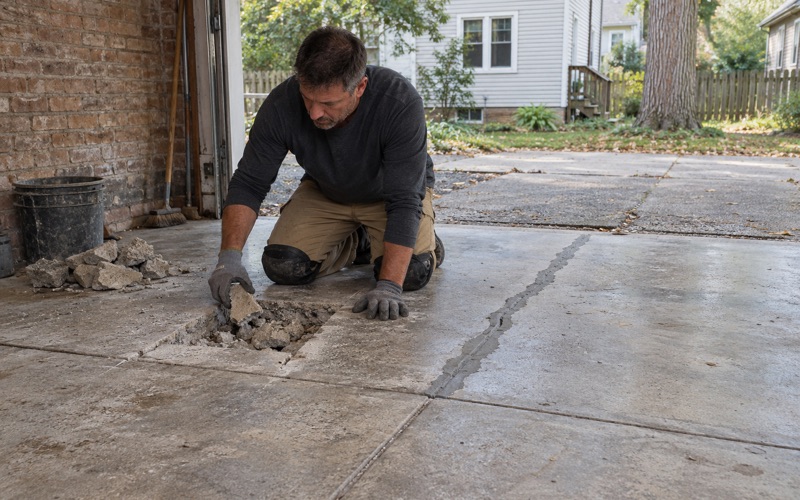
Creek and river water carry silt, oils and whatever was on the streets they crossed, and concrete is porous enough to take some of it in. On a Lyons slab that was under water in 2020, we look for staining, efflorescence, softened surface paste and old coatings that lifted and were never removed. Any of those will undermine a bond if they are coated over.
Flooding also tells us something about what sits under the slab. A basement that took water from outside may have a seasonal high water table or hydrostatic pressure pushing up from below, and that pressure can outlast the water on the street. We treat any flooded Lyons basement as a moisture problem until testing shows otherwise.
Testing written into the quote
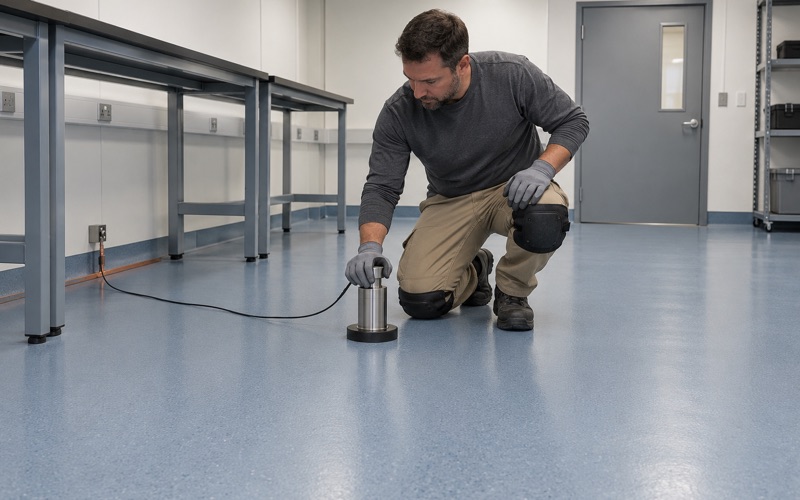
Moisture testing is a line item in our basement scopes, not an upsell after a floor blisters. Depending on the slab, that means ASTM F2170 in-situ relative humidity probes, ASTM F1869 calcium chloride vapor emission tests, or an ASTM D4263 plastic sheet test as a first screen. On a slab with Salt Creek or Des Plaines water in its past, we do not skip it.
The readings decide the system. A slab inside acceptable limits can take a standard build, while one that reads high gets a moisture-mitigation primer, more drying time, or a frank conversation about whether coating is the right call at all. We would rather lose a job on a reading than install a floor that later lifts off a wet slab.
Opening the slab, naming the build
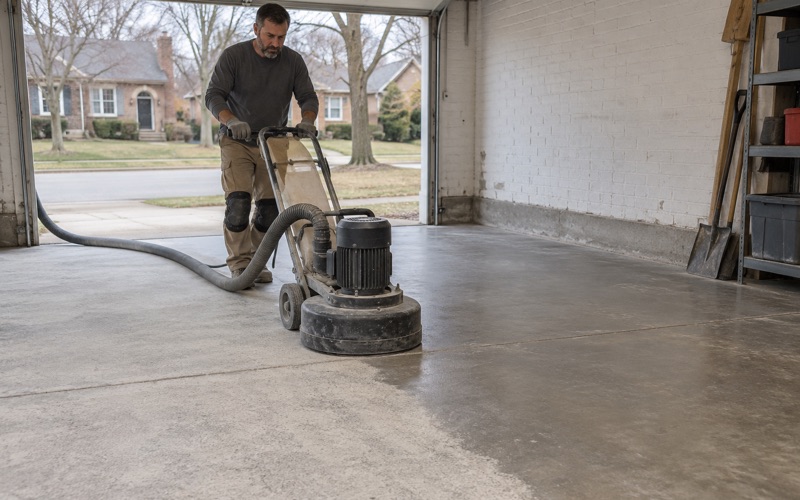
Once the slab passes, we open it mechanically with a diamond grinder or shot blaster to an ICRI concrete surface profile that suits the system, and we do not acid etch. On flood-exposed concrete that matters more than usual, because grinding removes the contaminated surface paste and any coating residue rather than washing chemistry into a slab that already took on water.
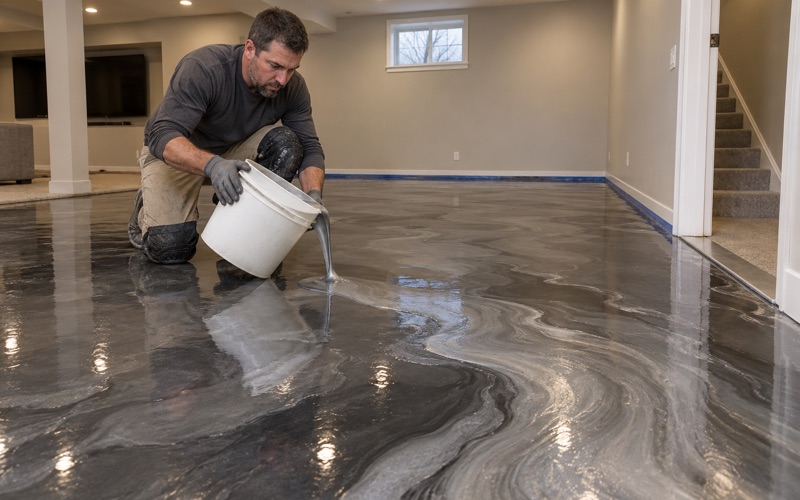
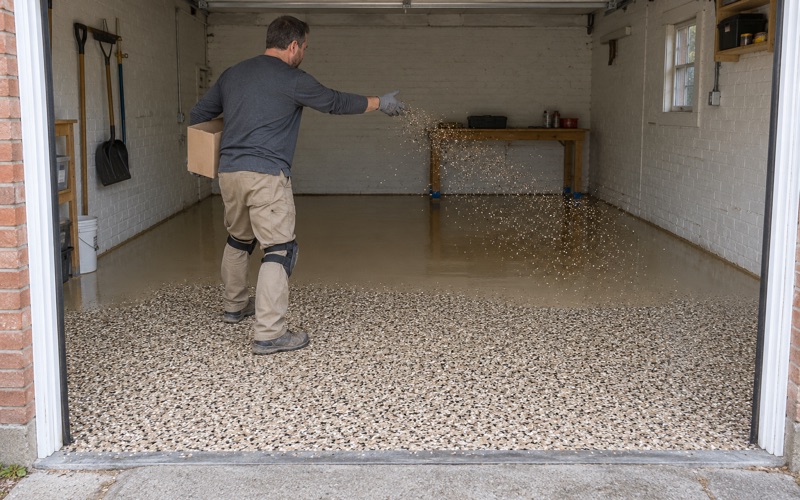
The proposal then names the product, the system build and the finished thickness, so what we quoted can be checked against what went down. For a Lyons basement that might be a 100% solids epoxy base with a quartz aggregate broadcast, or urethane cement where moisture readings run close to the limit. Either way, the paperwork lets you hold us to it.
What a coating can and cannot do in a flood-prone basement
A film that follows the slab
A floor coating does not waterproof a basement and it will not keep floodwater out. It is a film bonded to the concrete, and it follows the slab under it, cracks and movement included. We say that before the job, because a homeowner on a Salt Creek street deserves a straight answer about what the money buys.
What a good system does buy is a floor that cleans up. After a water event, a properly bonded coating with no trapped moisture under it can be washed down and disinfected far more easily than bare, dusty concrete. That is a real benefit in a village where the water has come up before, as long as nobody mistakes it for flood protection.
Drains, sump pits and backup
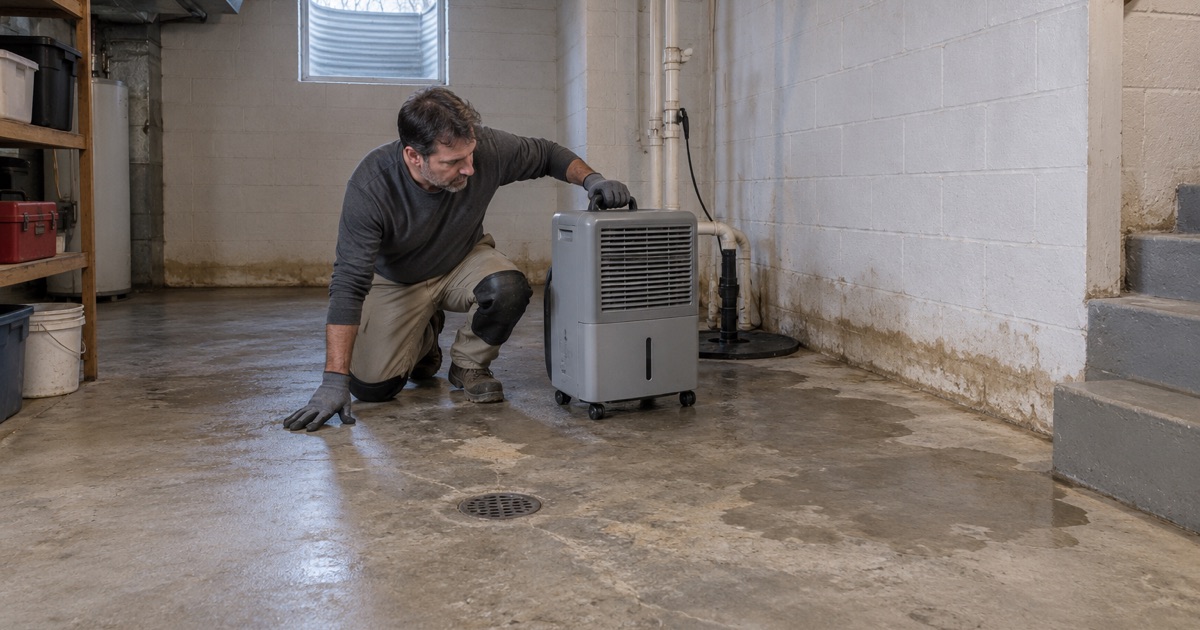
Flood-prone basements often have a floor drain, a sump pit or both, and those details decide whether a coating survives. We terminate the system cleanly at drain rims and sump pit edges so water has a path off the floor instead of under the film. Where a house relies on overhead sewer or an ejector pit, we work around that plumbing rather than over it.
Basement backup through a floor drain is a separate risk from creek flooding, and a coating does nothing to stop it. If backup is part of a Lyons home’s history, that is a plumbing question for the owner to settle first. A floor coated before the water path is solved is a floor that may have to be coated twice.
Exclusions and paperwork up front
Before we sell a basement job, we read the warranty exclusions aloud, and moisture is the first one named. In a village with Salt Creek and the Des Plaines on its doorstep, that is not fine print. A warranty covers how the coating was installed; it cannot cover water that rises from below or comes in from the street.
Every home job also gets a written contract and the Home Repair: Know Your Consumer Rights pamphlet before work starts, as the Illinois Home Repair and Remodeling Act requires. Grinding and shot blasting are scheduled inside the village’s construction hours. And we do not market any floor coating as radon reduction, since that work takes an IEMA radon mitigation license in Illinois.
- 20+ Years in Business
- Moisture Testing in Every Quote
- Written Proposals