
Evanston Epoxy Flooring has installed coated floors for 20+ years, and the flake epoxy floor is the system we put down most in garages in Evanston, IL, serving surrounding cities including Lincolnwood, Winnetka, Norridge, Schiller Park and River Grove. Colored vinyl chips broadcast into an epoxy base and sealed under a clear topcoat give a floor that hides dirt, adds grip and looks finished from the day it goes down.
What makes a flake floor last is not the flake. It is the ground slab under it, the epoxy base that bonds to that slab, and the topcoat that takes the wear. We write all three into the proposal, with the finished thickness, so you can check the floor against what was quoted.
How a Flake Epoxy Floor Is Built
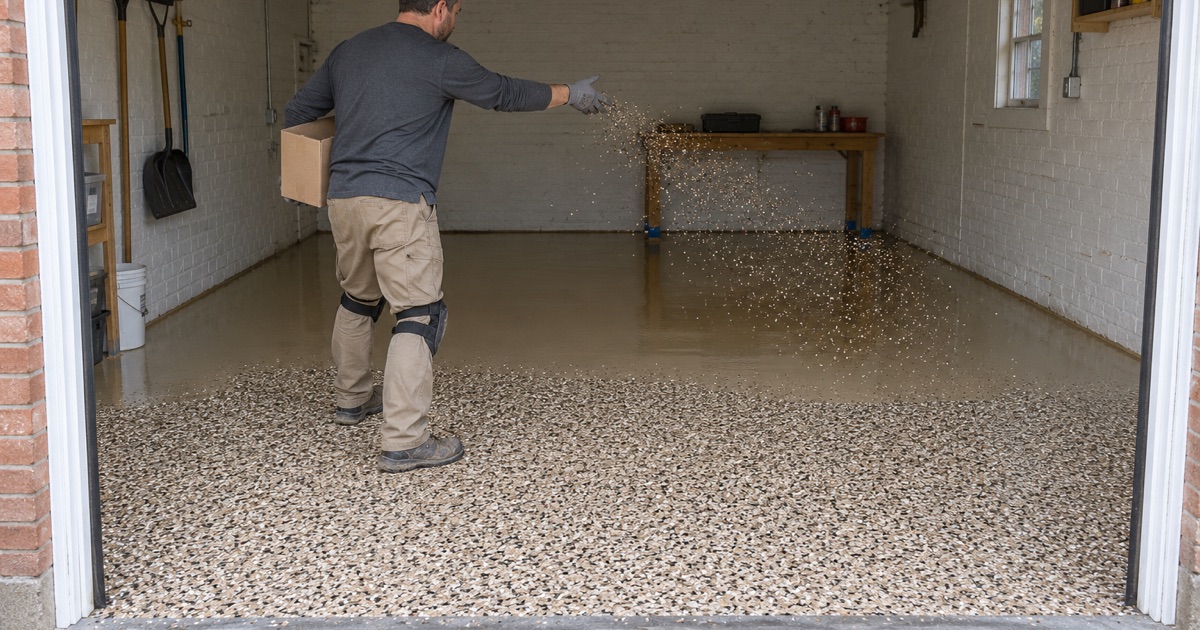
Base Coat, Broadcast and Topcoat
A flake floor starts with a primer or base coat of 100% solids epoxy rolled over a ground slab. While it is still wet, vinyl flakes are broadcast by hand across the surface so they bed into the resin.
Once the base cures, the loose flakes are scraped and vacuumed off, and the surface is knocked down so no sharp chip edges stick up. A clear topcoat then locks the flakes in and gives the floor its final sheen and texture.
Partial Versus Full Broadcast
A partial broadcast scatters chips so some base color shows between them, which gives a lighter speckle and costs less in material. A full broadcast covers the base completely and builds more texture and thickness. For garages we usually recommend a full broadcast, because it hides tire marks, salt film and dust better and gives the topcoat more to grip.
Why the Topcoat Matters Most
The topcoat is the layer tires roll on and boots scuff, so it decides how the floor wears. Many epoxy topcoats amber in sunlight and soften under hot tires, which is why we use a polyaspartic or polyurea topcoat on most flake floors. It holds its color, resists hot tire pickup and stands up to the chemicals that drip off cars.
Topcoat thickness is part of the written build. A heavier topcoat fills more of the space between chips and gives a smoother, easier-to-clean surface, while a lighter one leaves more texture underfoot. We set it by how wet the floor gets and how it will be cleaned.
Choosing a Flake Blend
Chip Size and Pattern
Flakes come in sizes from fine to large. Small chips read as an even, granite-like speckle, while larger chips give a bolder, more scattered pattern that suits a big open garage or a showroom.
Chip size also affects texture. Larger chips leave more ridges under the topcoat, which adds grip but makes the floor slightly harder to mop.
Colors That Hide Salt and Dust
Gray, tan and mixed blends hide the dust, sawdust and dried salt film a garage collects better than very light or very dark solid tones. Blends with a few contrasting chips also mask small scratches and stone chips from tires.
If the garage opens to the street, many owners choose a blend that complements the house’s siding or brick, so the floor reads as part of the house rather than a separate project.
Seeing Samples in Your Own Light
A blend looks different under one garage bulb than it does on a screen or in a showroom. We bring sample boards and lay them on your floor, in the light you actually have, before you choose.
The blend name and the chip size go into the proposal. That way a future repair or a second garage can be matched to the same flake, rather than to someone’s memory of what the first floor looked like.
Where Flake Floors Work Best
Garages in a Northern Illinois Winter
Garages here take calcium chloride brine and rock salt on every tire from November to March. Bare concrete soaks that brine in and scales over winters of freezing and thawing. A flake floor keeps the salt on the surface, where it can be squeegeed out, and its texture keeps the floor walkable while it is wet.
We also schedule garage installs around slab temperature and the dew point spread rather than the calendar. When an unheated detached garage cannot hold the conditions the products need, we tell you plainly that it has to wait for spring.
Basements, Laundries and Workshops
In a basement, a flake floor hides lint and dust and stands up to laundry machines, storage shelves and workbenches. It is also a forgiving surface for a workshop, where dropped tools and spilled finishes would mark a plain coating. Basement flake floors still start with a written moisture test, since a below-grade slab can push moisture into the back of any coating.
Locker Rooms, Showrooms and Back Rooms
Commercial locker rooms, gym floors, small showrooms and back-of-house rooms use flake floors for the same reasons homeowners do: grip, easy cleaning and a finish that hides wear. We schedule commercial work around the hours the building has to stay open.
What Goes Under the Flake
Grinding and Crack Repair
Every flake floor goes over a slab that has been diamond ground or shot blasted to an ICRI surface profile. Acid etching is never used, because it leaves residue and does not remove old sealers or paint.
Cracks and spalls are filled and ground flush before the base coat goes down. A flake floor follows the slab under it, so we tell you beforehand which cracks are likely to show through.
Moisture Testing and Primer
Moisture testing is written into every garage and basement proposal as a line item. If the readings are high, a moisture-mitigation primer goes down before the base coat, priced on its own line so you can see what it adds.
All coatings are chosen within the Illinois VOC limits for floor coatings, and on home jobs you receive a written contract and the state consumer-rights pamphlet before any work starts.
- 20+ Years in Business
- Moisture Testing in Every Quote
- Written Proposals