Evanston Epoxy Flooring has repaired and coated concrete for 20+ years, and concrete floor repair is where many of our jobs begin in Evanston, IL, serving surrounding cities including Lincolnwood, Winnetka, Norridge, Schiller Park and River Grove. A new coating or polish is only as good as the slab under it, so cracks, spalls and failed old coatings are dealt with first rather than covered over.
We read the cracks, the old paint and the old coatings before we quote, and we say plainly when a slab needs repair before it can be coated. Sometimes the answer is a few hours of crack filling; sometimes it is a section of slab that has to be cut out and replaced.
The sections below cover the damage we repair most often on garage, basement and commercial floors: cracks, spalls, salt scaling, failed coatings and old patches. Each one is listed in the proposal with the repair material named, priced separately from the coating that follows.
Cracks: Reading Them Before Repairing Them
Shrinkage and Hairline Cracks
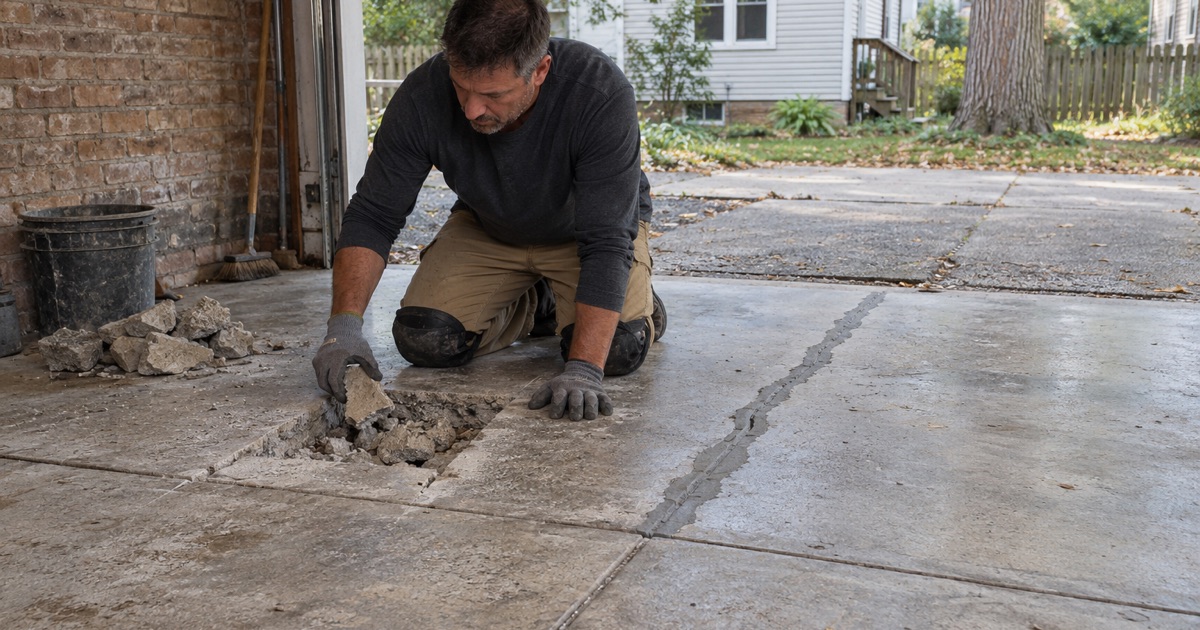
Most concrete floors develop shrinkage cracks as they cure and dry, often running from corners or between control joints. These cracks are usually stable. We clean them out, fill them with a repair material that bonds to concrete, and grind the fill flush so it disappears under the coating.
Where a floor will be polished rather than coated, the repair shows, so we match the filler color as closely as the slab allows and tell you beforehand that the line will still be visible.
Moving and Structural Cracks
Some cracks open and close with the seasons or keep widening as the ground under them settles. A rigid filler in a moving crack breaks loose, and a coating over it cracks along the same line.
We tell you which cracks are moving before quoting, and we do not promise that a coating will hold a slab still. Cracks with an offset, where one side has dropped, or a slab that has sunk or heaved, point to a structural or soil problem that may need an engineer rather than a flooring contractor.
Spalls, Scaling and Salt Damage
Scaled Garage Slabs and Road Salt
Scaling is the flaking of the top layer of concrete, and in northern Illinois garages it is most often caused by calcium chloride brine and rock salt dripping off cars and soaking in through winter after winter of freezing and thawing. The surface turns rough and pitted, worst near the door and under the wheels.
We grind off the loose, scaled layer, rebuild the low areas with a bonded repair mortar, and then protect the floor with a coating that keeps brine on the surface. Repairing scaling without protecting the slab afterward simply resets the clock.
Spalled Edges, Joints and Pop-Outs
Spalls are chips and broken pieces along joints, edges and cracks, often worsened by forklift wheels, steel casters or snow shovels. Pop-outs are small cone-shaped holes left where a piece of aggregate near the surface has broken out.
We saw back to sound concrete around each spall, fill it with a fast-setting repair material that can take traffic, and grind it flush. On commercial floors, joints that take wheel traffic are filled with a semi-rigid joint filler so the edges are supported.
Failed Coatings and Old Repairs
Peeling Paint and Delaminated Epoxy
A peeling floor coating almost always points to one of two things: it was applied over concrete that was never properly opened, or moisture has pushed it off from below. We grind the failed coating off completely, test the slab for moisture, and find out which caused the failure before anything new goes down.
Coating over the remains of a failed floor is the most common way to repeat the failure, so we price full removal as its own line rather than hiding it in the total.
Old Patches and Toppings in Older Buildings
With 40.3 percent of Evanston housing units built in 1939 or earlier, many basement and garage floors here have been patched, topped or partly repoured over the decades. Thin toppings and old patches often sound hollow when tapped, a sign they are no longer bonded to the slab below.
We sound the floor, cut out hollow areas and loose toppings, and repair them back to solid concrete. It is slower than coating over them, but a coating bonded to a loose patch comes up with the patch.
Repair Before a New Floor
Repairing Under Epoxy, Polyaspartic and Polish
The repair method depends on what goes over it. Under an epoxy or polyaspartic system we use fast-setting materials that bond to the primer, and the floor is ground smooth so repairs do not telegraph through. Under polished concrete, the repair stays visible, so we keep patches tight and color-matched. All repair work is listed in the proposal with the material named, so you can see what was done to the slab before the new floor went on.
When a Slab Needs Replacing, Not Repairing
When large areas are sunken, heaved, cracked through in several directions or broken into loose pieces, repair stops being good value. Replacing a section of slab is a bigger job, and in Evanston the City’s Building and Inspection Services Division decides what needs a permit, while structural alterations over a set threshold call for a design professional. We will tell you when we think a floor is past repair, explain why, and check the permit question with the City before any slab comes out.
- 20+ Years in Business
- Moisture Testing in Every Quote
- Written Proposals