Evanston Epoxy Flooring brings 20+ years of concrete coating work to commercial epoxy flooring in Evanston, IL, serving surrounding cities including Lincolnwood, Winnetka, Norridge, Schiller Park and River Grove. A commercial floor has to take more traffic, more chemicals and more cleaning than a home garage, and it usually has to be installed while the business keeps running.
We specify each commercial floor to its real use, schedule the work around the hours the building has to stay open, and write the product, the build and the finished thickness into the proposal. On the pages that follow a board, a facility manager or an owner can check what was quoted against what went down.
Matching the System to the Floor’s Use
Warehouses and Distribution Floors
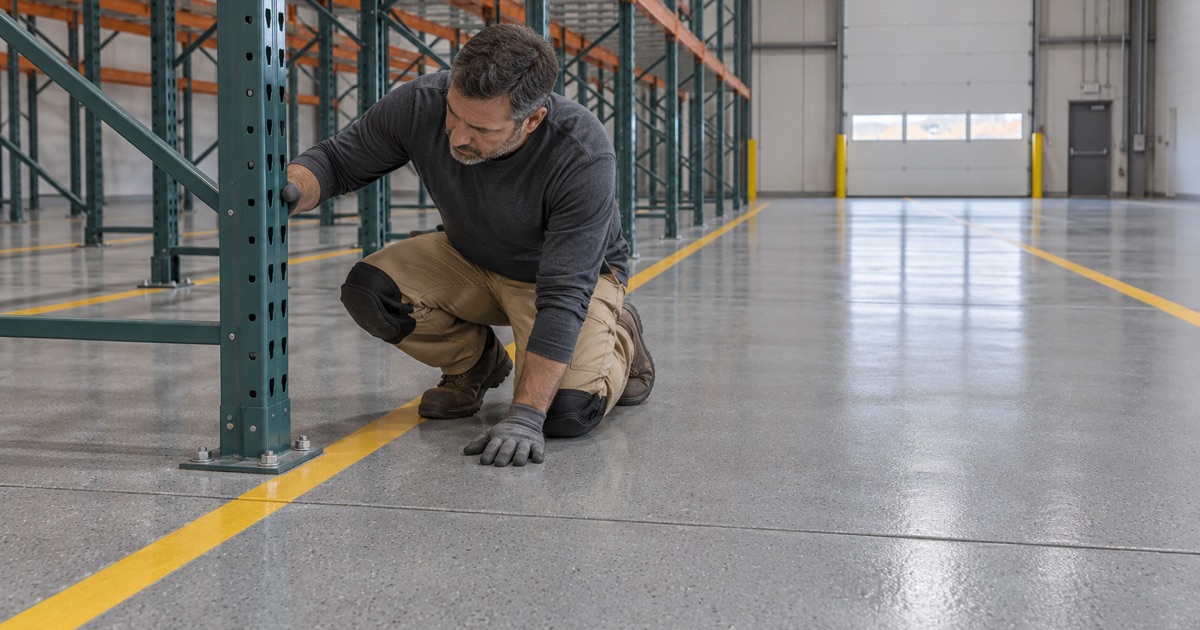
Warehouse floors take forklift wheels, pallet jacks and dragged loads, which wear through a thin coating in high-traffic aisles. We build heavier epoxy systems with an abrasion-resistant topcoat in those areas and repair joints before coating so wheel edges are supported.
Aisle striping, safety zones and pedestrian walkways can be built into the coating rather than painted on top, so they wear at the same rate as the floor around them.
Laboratories and Chemical Areas
Lab floors see solvents, acids, bases and cleaners spilled at benches and around fume hoods. We match the resin system to the chemicals actually used, using the maker’s resistance data, and add a seamless coved base where spills would otherwise run under casework.
The maker’s chemical resistance chart goes into the proposal so your safety officer can check it against the chemicals in use. Some labs also need static control, which calls for a static-dissipative or ESD system built and tested to a stated resistance range rather than a standard epoxy.
Auto Service Bays and Equipment Rooms
Service bays take hot oil, brake fluid, coolant, dropped tools and jack stands. We build them thick, with chemical-resistant topcoats and texture where floors get wet, and pay close attention to trench drains and the transitions at bay doors.
A polyaspartic or polyurea topcoat helps here because it resists hot tire pickup from vehicles pulled in straight off the road. Bays are coated one or two at a time where possible, so the shop keeps earning while the floor is being done.
Condominium Garages and Common Areas
Half of Evanston’s housing units sit in buildings of five or more, and the garage, storage and laundry floors in those buildings are an association decision rather than one owner’s. We work through the board or property manager, plan notice to residents, and phase the floor so cars and storage can be moved in stages.
Condo garages also take the same road salt and calcium chloride brine as any home garage, multiplied by every car in the building. Topcoats and texture are chosen with that in mind, especially at ramps and entrances.
Preparation on a Commercial Scale
Shot Blasting and Grinding Large Floors
Large floors are shot blasted or diamond ground to an ICRI concrete surface profile with dust collection running throughout. Old coatings, curing compounds and sealers come off completely, because a commercial coating bonded to an old film is only as strong as that film. We do not acid etch.
On older commercial slabs we often find layers of paint, mastic or patching from past tenants. Those come off before we price the coating, or are tested in a sample area when their extent is unclear, so the proposal reflects the floor that is actually there.
Joints, Cracks and Moisture
Control joints in commercial floors move and take wheel impact, so we fill them with semi-rigid joint fillers where traffic crosses them and honor them through the coating where the slab needs to move. Cracks are mapped and repaired, and we say plainly which ones a film coating will follow.
Slabs on grade are tested for moisture before coating, with calcium chloride kits or in-slab relative humidity probes, and a moisture-mitigation primer is specified where the readings call for one.
Working Around a Business
Phasing and Closures
Most businesses cannot close for a week. We split the floor into phases, use fast-cure polyaspartic systems where they suit the use, and schedule the loudest grinding and shot blasting inside each town’s construction hours. In Evanston those hours run 7:00 a.m. to 7:00 p.m. on weekdays and 8:00 a.m. to 5:00 p.m. on Saturdays, with no Sunday work. You receive a written schedule showing which areas are closed, when they reopen to foot traffic, and when equipment and vehicles can return.
Noise, Dust and Odor
Grinding is loud and coatings have an odor while they cure, so we plan both around occupants. Dust is captured at the grinder, work areas are sealed off, and ventilation runs during application.
Every coating is chosen within the Illinois VOC limits of 250 g/L for floor coatings and 340 g/L for industrial maintenance coatings, which bind the installer as well as the manufacturer.
Rules That Shape a Commercial Floor
Food Service and Health Plan Review
Kitchens and food areas fall under the Illinois Food Code, which adopted the 2022 FDA Food Code and calls for smooth, durable, easily cleaned floors with coved floor-to-wall joints. In Evanston, food plans go through the City’s Health and Human Services review, and its packet asks for the floor and base or cove finish by brand and color. We supply that information for the plan review rather than leaving it to the owner to chase.
Line Striping, Safety Colors and Slip Resistance
Commercial floors often need marked aisles, forklift lanes, hazard zones and parking stalls. We build striping into the coating system and add slip-resistant aggregate where the floor gets wet or oily, choosing the texture level by what the floor carries and how it is cleaned.
- 20+ Years in Business
- Moisture Testing in Every Quote
- Written Proposals