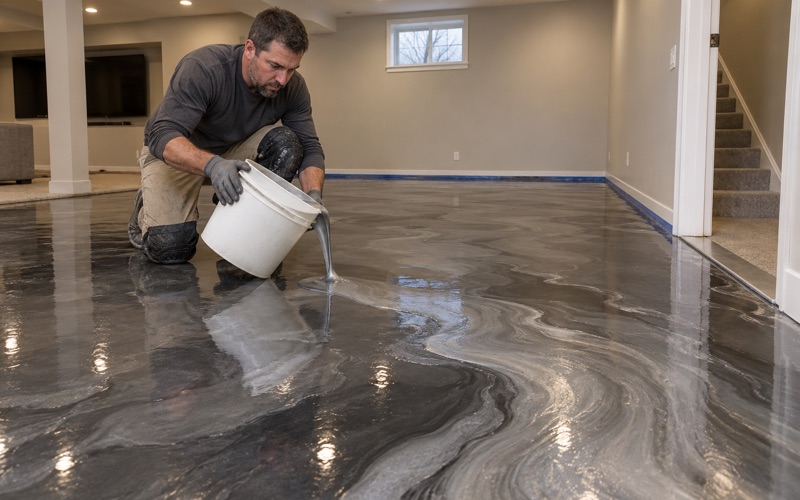
Evanston Epoxy Flooring handles epoxy flooring in Chicago Ridge with more than 20 years in the trade behind us, and much of the floor work in this village is commissioned by a building owner rather than a homeowner. The floors in question are shared ones: laundry rooms, tenant storage, stairwell landings and parking surfaces, coated while residents still need to use them.
That changes how a job is planned. A landlord needs a schedule that keeps a laundry room out of service for as short a window as the chemistry allows, a written scope that a property manager can file, and a contractor whose village paperwork is in order before the first visit. We build our quotes around those three things.
Before anything is priced we walk the slab, read its cracks and any old paint or sealer, and tell the owner plainly if repair has to come first. The proposal then names the product, the system build and the finished thickness, so a manager can check what was quoted against what went down.
Mid-Size Apartment Buildings and the Floors Owners Pay For
Half the Village Rents
The American Community Survey’s 2024 five-year estimates count 2,610 renter-occupied and 2,624 owner-occupied households in Chicago Ridge, an almost even split. Of the village’s 5,751 housing units, 2,994, or 52.1 percent, sit in buildings of 5 to 19 units. That is a different housing market from the detached-garage suburbs people tend to picture when they think of floor coatings.
The regional shorthand treats Chicago Ridge as a shopping stop, but those housing numbers point to a village of mid-size apartment buildings where floors are a line in an operating budget. For an owner, the decision turns less on looks than on how long a coated common floor holds up under steady tenant traffic before it needs attention again.
Slabs from 1960 to 1989
Most of that housing stock went up between 1960 and 1989: 1,199 units date from the 1960s, 1,151 from the 1970s and 1,000 from the 1980s, together 58.3 percent of the total. A common-area slab from those decades has had a long service life, and it may carry an earlier paint or sealer.
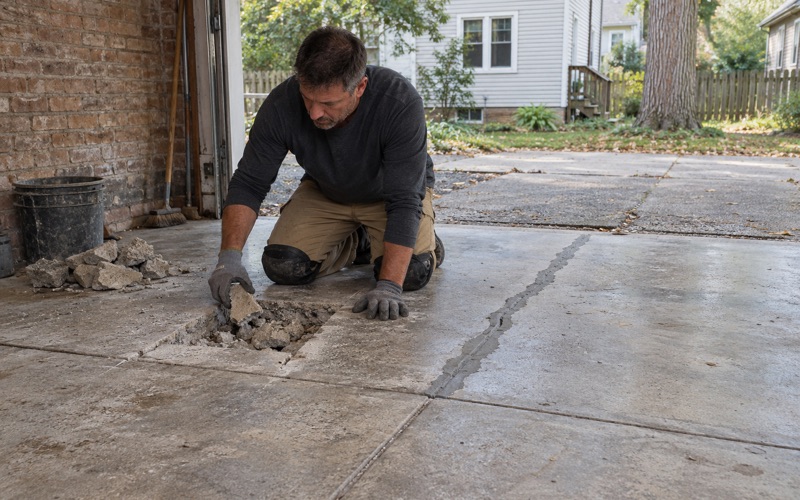
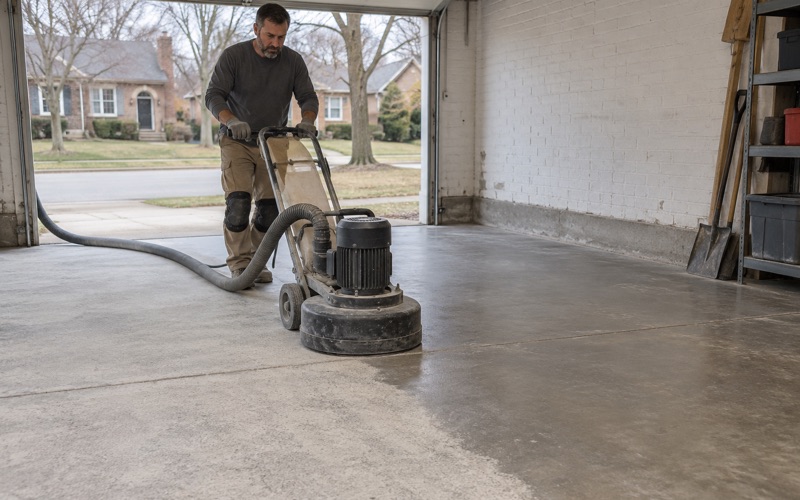
That old film is the first thing we look at. A coating bonds to whatever is beneath it, so a laundry room floor painted twenty years ago and patched since gets ground back with a diamond grinder or shot blaster until we reach sound concrete, never acid etched. Where the slab has cracked or spalled, the quote says so and prices the repair separately.
Laundry, Storage, Stairs and Parking
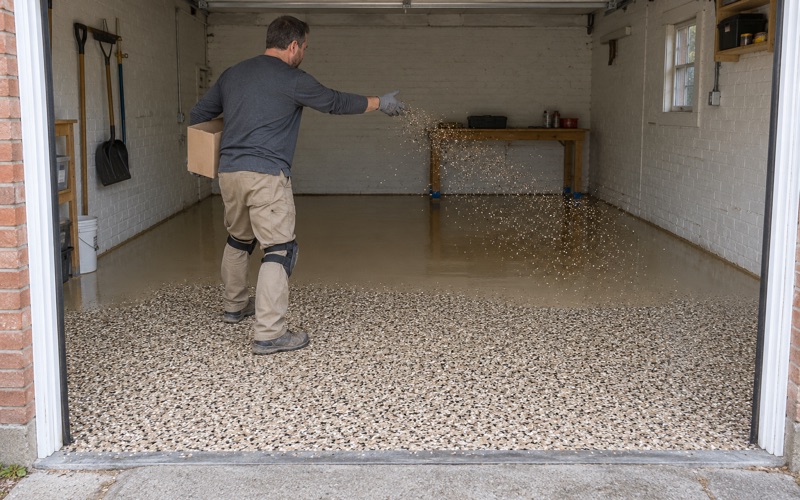
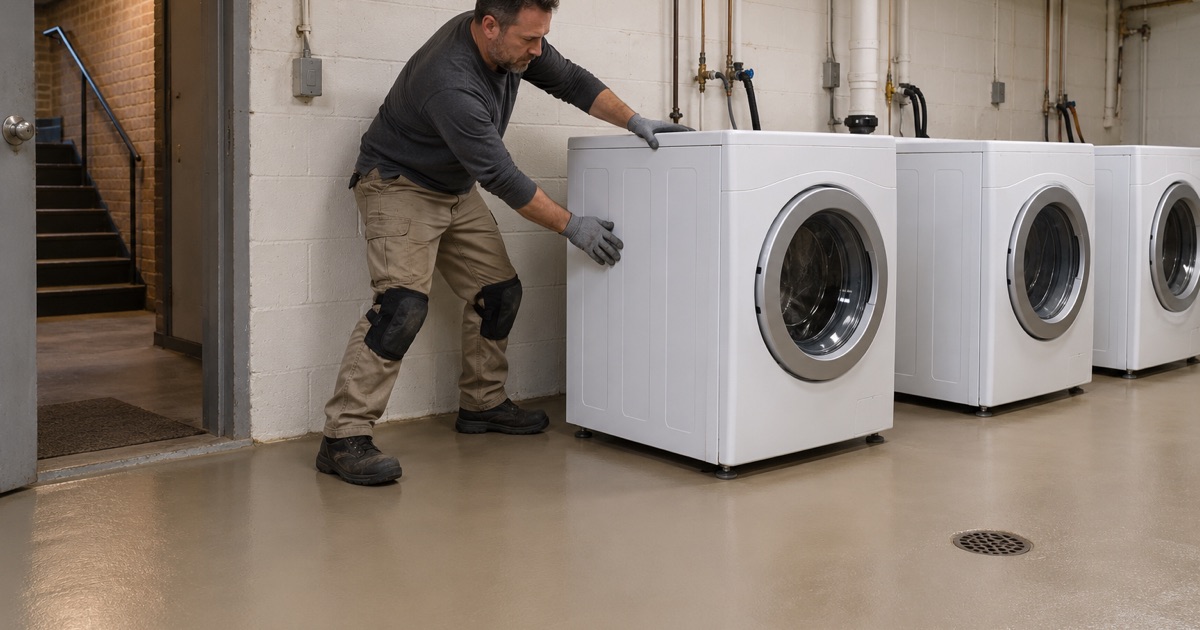
Shared laundry rooms take water, detergent and the scuffing of carts and machines being moved. We typically build them with 100% solids epoxy and a quartz aggregate broadcast for grip, with the floor drain detailed so the coating terminates cleanly at the grate rather than lifting at its edge. Any sump pit in the room is detailed the same way.
Storage rooms and stairwell landings see less water but more dragged boxes and furniture, so a thinner build with a vinyl flake broadcast and a clear topcoat often makes sense. Where a building has its own parking floor, hot tire pickup becomes the failure to design against, which steers us toward a fully cured epoxy base under a polyaspartic or polyurea topcoat.
Looking for epoxy-flooring closer to Palos Hills? See Epoxy-Flooring Services in Palos Hills.
Coating Floors in Occupied Buildings
Tenant Access Comes First
In a building of 5 to 19 units, nobody moves out for a floor job. Residents still need a route to their storage, their laundry and the back door, so we plan the work with the owner or manager in stages, closing one room or one landing at a time where the layout allows it.
We ask the manager to post notice to tenants with the dates, the rooms affected and the hours nobody can walk on the floor. Diamond grinding and shot blasting are loud, so we book them inside the village’s construction hours and finish them in daylight, well before residents settle in for the evening.
Cure Time Set by the Slab, Not the Calendar
How long a laundry room stays closed depends on the slab, not on a promised date. We read slab temperature and the dew point spread at the surface before mixing, because a coating laid on a slab too close to dew point can develop amine blush, a waxy film that weakens the next coat’s bond.
For an occupied building that reading shapes the tenant notice. A fast-curing polyaspartic topcoat can return a storage corridor to foot traffic sooner than a thick epoxy build, and we lay out that trade-off for the owner before the system is chosen. Some owners take the faster return; others want the heavier film for a room that sees carts every day.
Moisture Testing on Older Common-Area Slabs
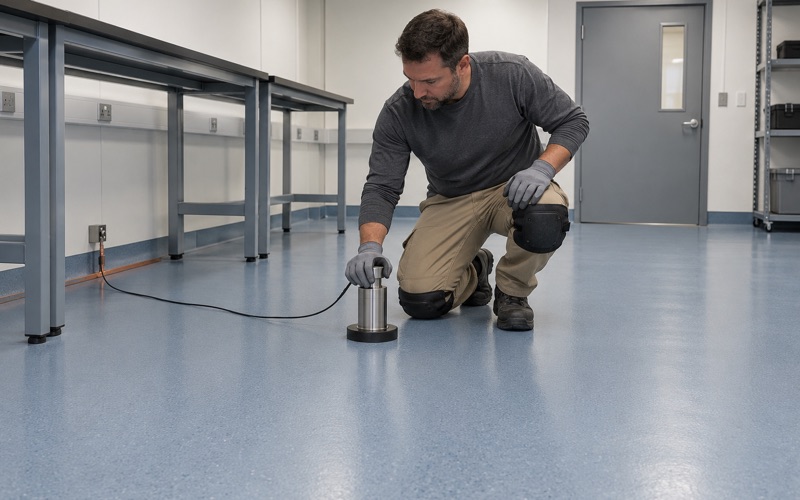
A slab poured in the 1960s or 1970s may or may not sit over a vapor retarder, and records that would settle the question are not always on hand. So moisture testing is a line item in the quote, using ASTM F1869 calcium chloride kits or ASTM F2170 in-situ relative humidity probes depending on the room.
If the readings come back high, we specify a moisture-mitigation primer under the system rather than hoping the film holds. The warranty exclusions are read out to the owner before the contract is signed, with moisture named first, and we say plainly that a coating follows any movement in the slab beneath it rather than stopping it.
Ridgeland Avenue’s Retail and Industrial Floors
From the Chicago Ridge Mall to the Commons
Ridgeland Avenue carries the village’s retail floors. The Chicago Ridge Mall at 95th Street and Ridgeland opened in 1981 and covers 889,610 square feet, with Kohl’s, Dick’s Sporting Goods and Burlington as anchors after Carson’s closed in 2018 and Sears in 2021. It changed hands again in 2024, when Second Horizon Capital bought it from Starwood Capital.
We have no relationship with the mall or its owner, and we mention it because it sets the scale of commercial flooring on the corridor. Farther south, the Commons of Chicago Ridge at 9900 S. Ridgeland Avenue holds more than 55 strip stores, including Marshalls, Ross Dress For Less, Five Below, Shoe Carnival, The Home Depot and Pep Boys.
Retail floors on a corridor like this take carts, displays that get moved at every reset, and a steady flow of shoppers. For a back-of-house area or a service bay, we look at the existing coating, test for moisture and quote a build to the traffic the space actually sees.
Coating Around Open Hours
A tenant space, a stockroom or a back-of-house corridor on Ridgeland cannot simply close for a week. We schedule commercial work around the hours a store has to stay open, which often means working in stages around trading hours and choosing a fast-cure topcoat so the floor returns to service sooner. Shop floors that see pallet jacks get a heavier build than a fitting room.
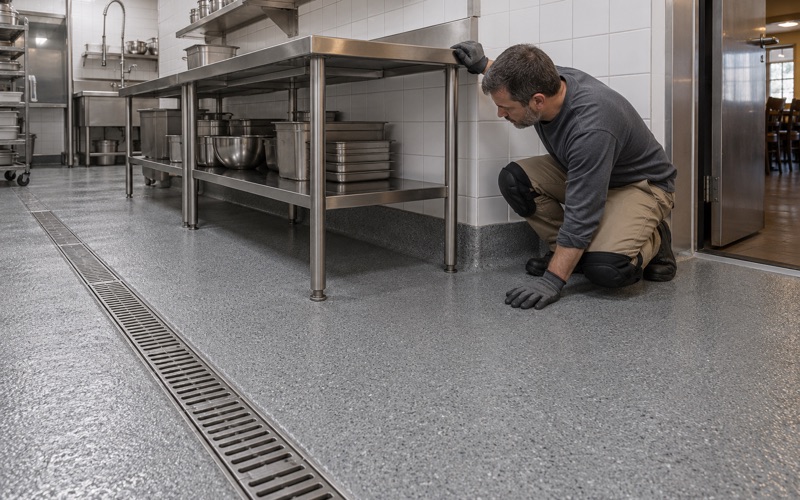
Any food service in a retail space brings its own rules. Illinois has adopted the 2022 FDA Food Code, which asks for smooth, durable, easily cleanable floors and coved floor-wall junctures under 6-201.13, so a kitchen floor there is built with urethane cement and a cove base rather than a garage-style flake system. In Chicago Ridge the health authority is the Cook County Department of Public Health.
The Park at Chicago Ridge
Commercial development in the village is currently centered on its industrial sector, the Park at Chicago Ridge, a 135-acre industrial park with rail access and expressway connections. Warehouse and production floors there are a different job from a stairwell landing: wider slabs, forklift traffic and, in some spaces, a need for static-dissipative flooring held to a stated resistance range.
On those slabs we profile to the ICRI CSP range the chosen system calls for, by shot blasting where the area is open enough. Where a plant has to keep lines running, we phase the work bay by bay so production keeps moving. A bare slab that only needs dust control may get a lithium silicate densifier instead of a coating at all.
Registering with the Village of Chicago Ridge
Registration, Insurance and the $10,000 Bond
The Village of Chicago Ridge requires every contractor to register at Village Hall, 10455 S. Ridgeland Avenue, before a permit is issued. A general contractor pays a $100 registration fee and files a current certificate of insurance and a $10,000 surety or performance bond. We complete that registration before a job is scheduled.
Illinois issues no state license for flooring or coating contractors, so the village registration and bond are the binding requirements here. Instead of quoting a license number that does not exist, we give the owner our village registration, bond and insurance certificate to keep with the building’s records. Building matters run through the village’s Building Department, which works under the International Building Code the village adopted in 2003.
Chicago Ridge sits in Worth Township, Cook County, but the permit and the registration both run through the village itself, so Village Hall on Ridgeland Avenue is where that paperwork starts. If a floor job also needs an electrician, that trade registers separately, paying $75 and filing its own insurance, bond and license copy.
Contracts for Owners and Homeowners
Half the village’s households own their homes, and 1,833 of those owners live in detached houses, so garage and basement floors still come up. On any home job we hand over a written contract and the Home Repair: Know Your Consumer Rights pamphlet before work starts, as the Illinois Home Repair and Remodeling Act requires.
For a rental building, the written scope matters for a different reason: it is what the owner shows a property manager, an insurer or the next buyer. Ours lists the product, the build, the finished thickness, the moisture results and the exclusions, so nobody has to rely on memory of what was promised.
VOC Limits and What a Coating Is Not
Coating products for these jobs are chosen within the Illinois VOC limits in 35 Ill. Adm. Code Part 223, which bind the installer as well as the manufacturer. That matters in a building where residents share hallways and air with the room being coated.
We also do not sell a floor coating as radon reduction; in Illinois that work requires an IEMA radon mitigation license. When an owner asks about fire separation or egress in a stairwell, we point them to the Building Department and the Chicago Ridge Fire Department rather than guessing.
- 20+ Years in Business
- Moisture Testing in Every Quote
- Written Proposals