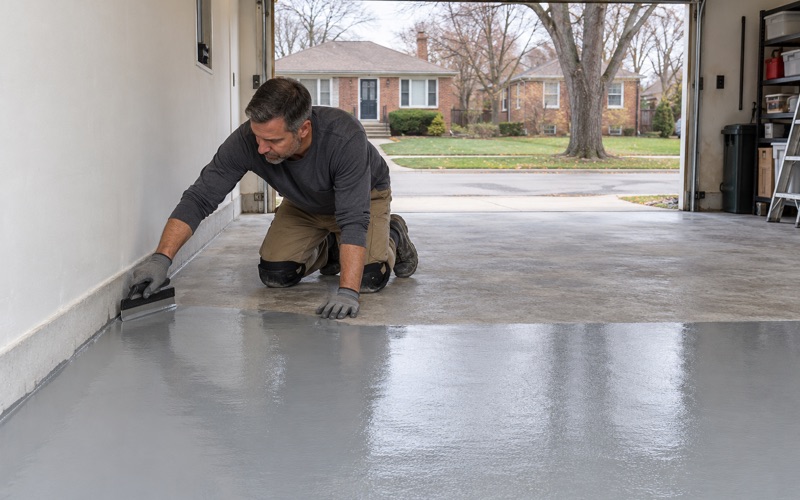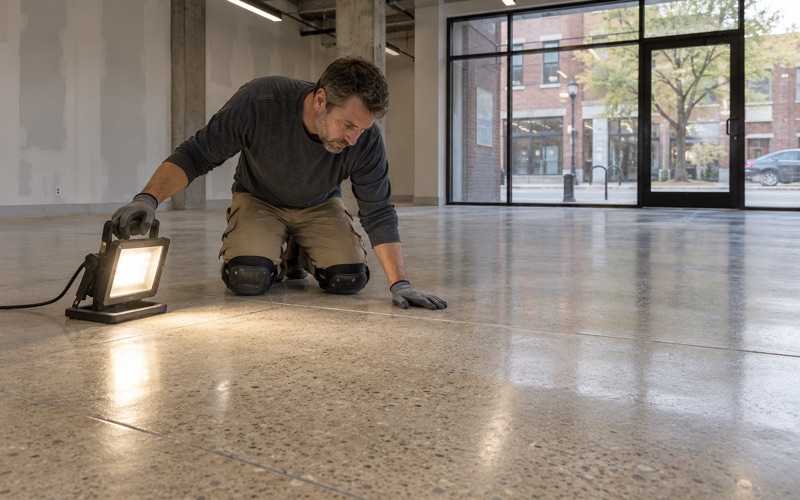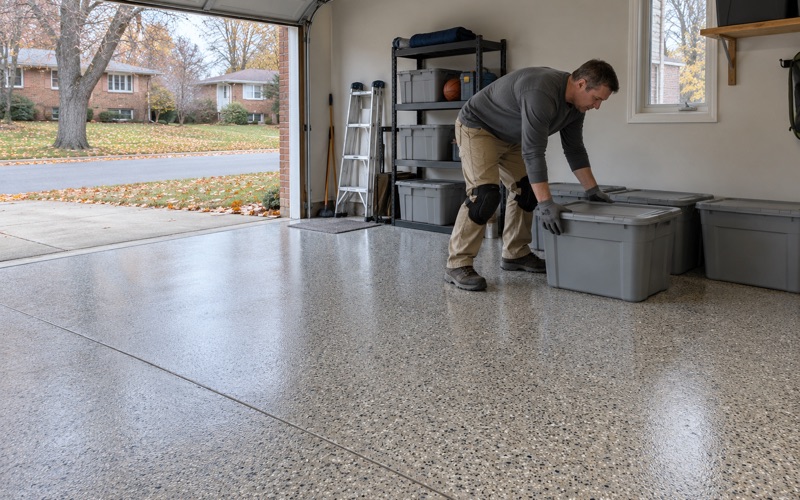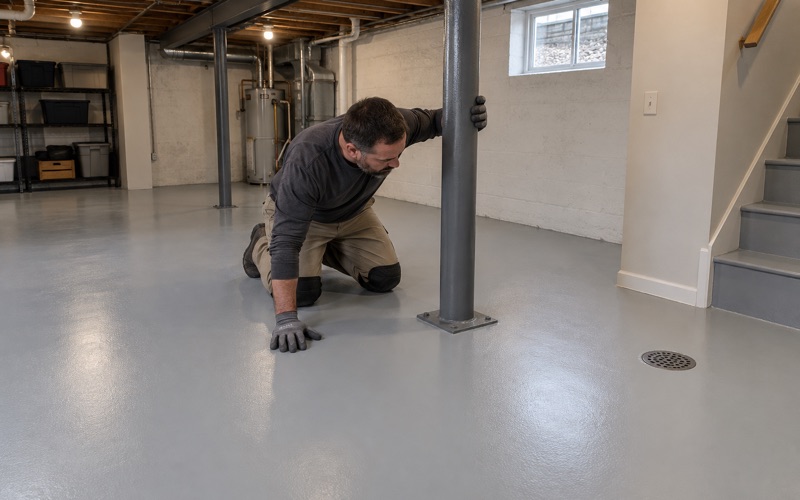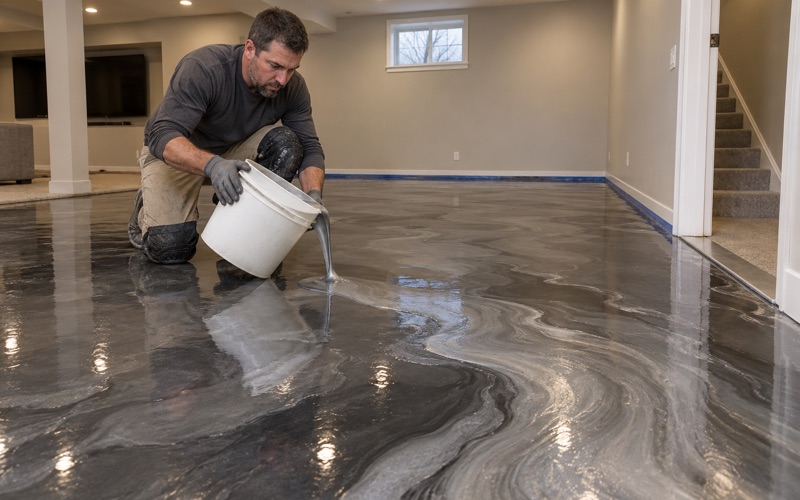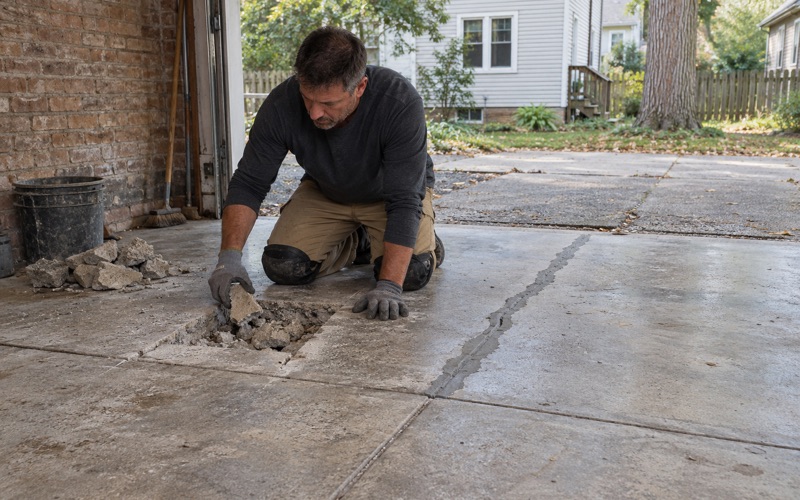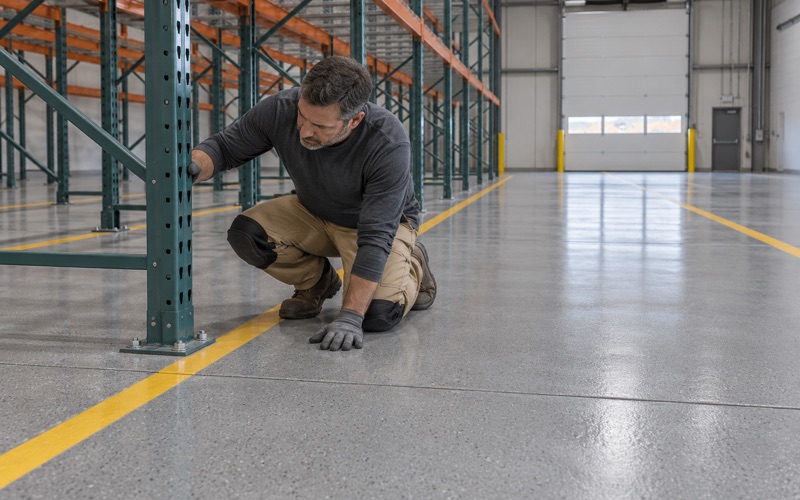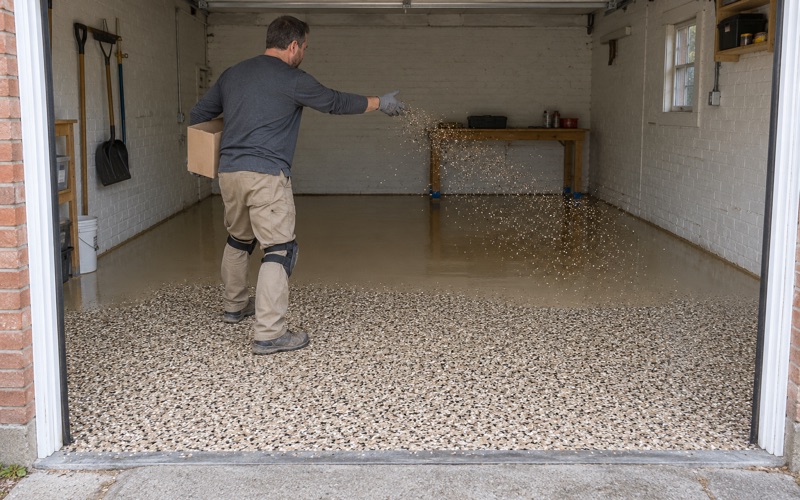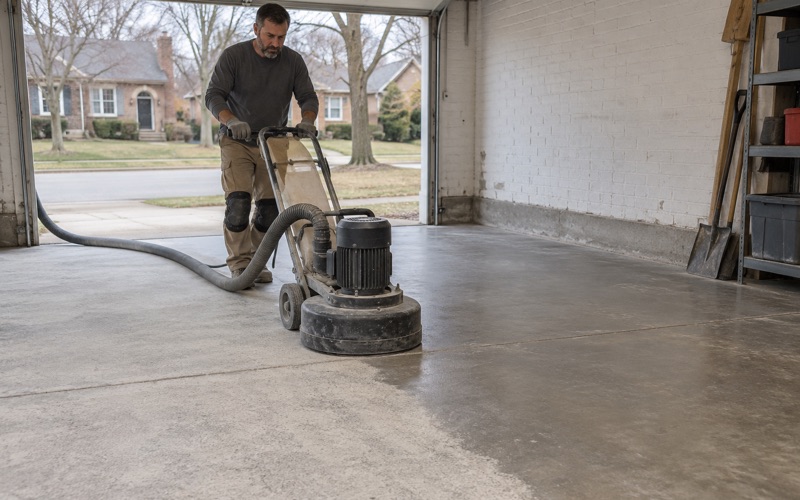
Evanston Epoxy Flooring installs epoxy flooring in Burr Ridge with more than 20 years in the trade behind each estimate, on garage slabs, basements, condominium storage rooms and commercial floors that have to keep working while the job goes on. Every system starts on concrete opened mechanically with a diamond grinder or shot blaster. We do not acid etch, because grinding gives a profile we can check against the ICRI CSP scale.
Before we quote, we read the slab: the cracks, the old paint, any earlier coating that is lifting. If the concrete needs repair before it can take a coating, the estimate says so in plain words. The proposal then names the product, the system build and the finished thickness, so what we priced can be checked against what went down.
Moisture testing is a line item in that proposal for garage and basement slabs alike, and the warranty exclusions are read aloud before anything is signed, with moisture named first. A coating is a film that follows the slab beneath it; we say so up front instead of promising it will stop concrete from moving.
One Village, Two Counties Along County Line Road
Which side of the road the slab is on
Burr Ridge is a village in both Cook and DuPage counties, and County Line Road is where one hands off to the other. Village hall at 7660 S. County Line Road geocodes to DuPage County, in Downers Grove Township. Burr Ridge Village Center at 701 Village Center Drive geocodes to Cook County, in Lyons Township.
For a homeowner, that split rarely matters until something official is involved. For us it shapes the first conversation, because the agencies that might care about a floor job are not the same on both sides. We ask for the street address before the site visit and note which county it falls in on the estimate.
Pleasantview to the east, Tri-State to the west
The village’s economic development plan names two fire protection districts. Pleasantview Fire Protection District serves the east side of Burr Ridge in Cook County, and Tri-State Fire Protection District serves the west side in DuPage County. On a commercial job, that is the district a property manager already deals with, and we ask how the building handles stored materials before we bring resin and solvent on site.
Health oversight follows the same line, though the village does not spell it out on its own pages. The Cook portion falls under the Cook County Department of Public Health and the DuPage portion under the DuPage County Health Department, by county jurisdiction. That matters most on a food-production or commercial kitchen floor.
Three sewer authorities and the I-55 split
Sewage is split three ways. Properties in Cook County are served by the Metropolitan Water Reclamation District, DuPage properties generally north of I-55 by the Flagg Creek Water Reclamation District, and those south of I-55 by a DuPage County facility. The village itself maintains the local sewers and three lift stations.
Whichever of the three treats a property’s wastewater, grinding slurry and resin wash never go down a floor drain on our jobs. Dust is vacuumed at the grinder, and liquid waste is collected and hauled off. Where a garage or basement has a floor drain or sump pit, we detail the coating around it rather than over it, so the drain keeps doing its job.
Looking for epoxy-flooring closer to Chicago Ridge? See Epoxy-Flooring in Chicago Ridge.
Houses From the 1980s Through the 2000s: Test, Don’t Assume
What the housing count shows
Of 4,828 housing units in Burr Ridge, 2,972 were built from 1980 through 2009, which is 61.6 percent of the stock. The single biggest decade is the 1990s, with 1,173 units. Ownership runs high as well: 4,263 of 4,536 households own, a 94.0 percent share.
That age profile tells us roughly when a slab was poured, and almost nothing about what is under it. Whether a house of that era got an under-slab vapor retarder is not recorded anywhere at the village level. Newer construction does not prove one is there, so we do not price a floor as if it were.
Moisture tests written into the scope
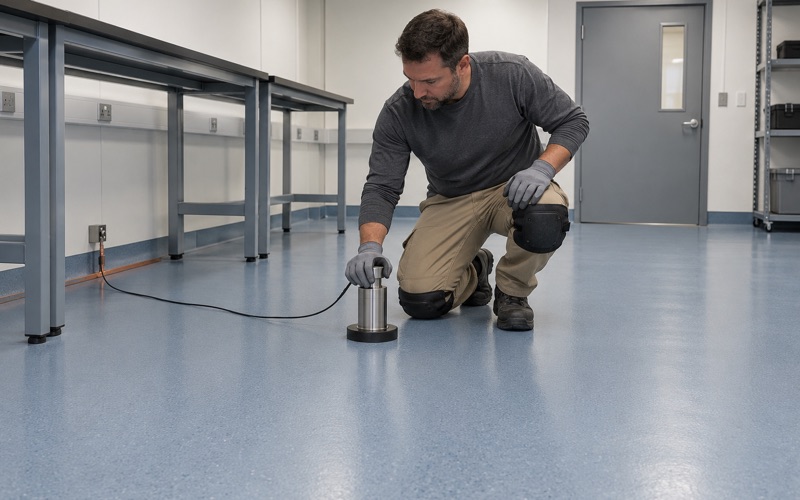
On a Burr Ridge basement or garage from the 1990s, we test before we choose a primer. We start with an ASTM D4263 plastic sheet test as a quick read, then use ASTM F1869 calcium chloride emission testing or ASTM F2170 in-situ relative humidity probes for numbers we can compare to the product’s limits.
When the readings run high, the system changes rather than the schedule. A moisture-mitigation primer goes down under the 100% solids epoxy, and the warranty paperwork records the reading it was built for. When the numbers sit past what any primer is rated to handle, we tell the owner that before money changes hands.
Cracks, old paint and what a coating cannot do
A slab from the 1980s has had decades to crack, settle and collect a coat or two of garage paint. We grind through old paint and failing coatings to sound concrete, then look at each crack to see whether it is a stable shrinkage line or one that is still moving. Stable cracks get filled; active ones get a frank conversation.
That conversation is short: an epoxy or polyaspartic film follows the concrete under it. If a crack keeps opening, it will telegraph through the new floor, and no topcoat changes that. Where a slab needs patching or joint work first, the proposal lists it as its own line with its own price.
Offices, the Corporate Park and the I-55 Frontage Roads
Burr Ridge Corporate Park at I-55 and County Line Road
Burr Ridge sits where I-294 meets I-55, and I-55 cuts the village roughly in half, with 149,000 cars a day passing businesses on four frontage roads. Burr Ridge Corporate Park, at County Line Road and I-55, is one of five corporate parks in the village. The work there runs from lobbies and amenity floors to back-of-house corridors.
The village’s commercial base also takes in manufacturing, warehouse and freight operations, which means service-bay, warehouse and food-production floors alongside lobby and office floors. Commercial jobs are scheduled around the hours a building has to stay open. That often means grinding after close, coating overnight and handing back a floor that can take foot traffic by morning, where the system allows it.
Food-production and service-bay floors
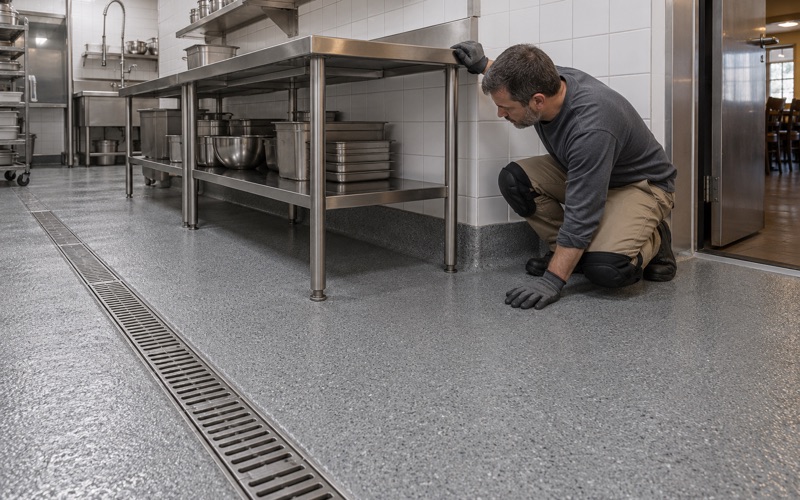
A food-production floor answers to the Illinois Food Code, which adopts the 2022 FDA Food Code. Section 6-201.13 calls for coved floor and wall junctures, so we run the resin up the wall into a cove instead of stopping at a sharp corner. Section 6-201.11 allows an antislip finish where traction is needed, and we set the quartz aggregate broadcast to suit it.
Service bays and warehouse aisles take a different build. Where hot water, oils or forklift traffic are part of the day, urethane cement or a thicker 100% solids epoxy with a polyaspartic or polyurea topcoat is the usual choice. The proposal states the finished thickness in mils either way. Static-dissipative systems are available where a tenant’s equipment calls for a specified resistance range.
Condominiums and buildings of 50 or more units
Burr Ridge is not only detached houses. Of its units, 426 are in buildings of 50 or more, and 281 of those are owner-occupied, along with 454 attached units. Work on a garage stall, storage room or corridor in those buildings usually involves an association, and its rules come before ours.
We schedule condominium jobs with the association before the first bag is opened: elevator use, loading access, where the grinder and dust collector can sit, and which hours the building allows noise. Grinding and shot blasting are planned inside the village’s construction hours, so a one-day job does not spill into a neighbor’s evening.
The Village of Burr Ridge Contractor License, Bond and Code
License, bond and insurance in place before work
Illinois issues no state license for flooring or coatings work, so the Village of Burr Ridge contractor license is the credential that binds here. Community Development requires it of every contractor and subcontractor on permitted work: $200 for a general contractor with subcontractors and $100 for all others, valid one year from issuance.
The license comes with a $10,000 surety bond naming the village as bond holder and indemnitee, liability insurance of at least $1,000,000 aggregate with the village listed as additional insured, and workers’ compensation or a self-employment letter. Instead of a state license number, which does not exist for this trade, we show a Burr Ridge owner those documents.
The 2021 codes and the Illinois VOC limit
Building Ordinance 1225, effective January 1, 2025, adopts the 2021 International Residential Code and International Building Code with local amendments. The 2021 IRC is also where the garage vapor retarder exception sits, in R506.2.3, which is one more reason a garage slab here gets tested rather than assumed dry.
Our coatings stay within the Illinois VOC limits in 35 Ill. Adm. Code Part 223 Subpart C, which bind the installer as well as the manufacturer, alongside the national rule in 40 CFR 59 Subpart D. We name the product on the proposal, so a building manager in the corporate park can pull its data sheet before the overnight shift starts.
Contracts, curing and radon
Every home job gets a written contract and the state’s Home Repair: Know Your Consumer Rights pamphlet before work starts, as the Illinois Home Repair and Remodeling Act requires. Its start dates follow slab temperature and dew point rather than the calendar, and when an unheated garage has to wait for spring, we say so.
On the morning of a pour in a Burr Ridge garage or basement, we read the dew point spread at the slab surface along with the air temperature. When the concrete sits too close to the dew point, moisture condenses on it and amine blush can form on fresh epoxy. If the readings disagree with the plan, the pour moves, and the owner hears why that day.
We also do not sell a floor coating as radon reduction. In Illinois that work takes an IEMA radon mitigation license, and a coated basement floor is not a mitigation system.
- 20+ Years in Business
- Moisture Testing in Every Quote
- Written Proposals