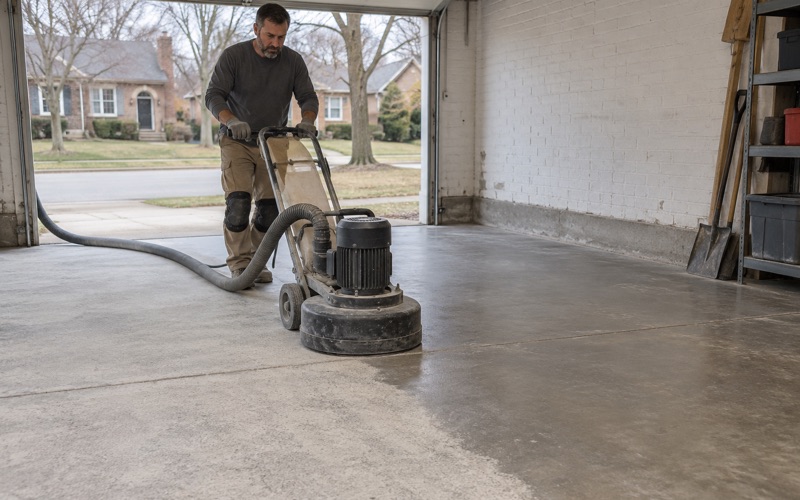
Evanston Epoxy Flooring has spent more than 20 years putting epoxy flooring in Bellwood garages and work spaces, and the job almost always starts the same way: on a slab poured long before anyone thought about coating it. We open that concrete with a diamond grinder or a shot blaster, never acid, so the coating bonds to sound material instead of a weak top skin.
Before we quote, we read what is already on the floor: the cracks, the old paint, any coating someone rolled on years ago. If the slab needs repair first, the proposal says so in plain words. It also names the product, the system build and the finished thickness, so you can hold what we quoted up against what went down.
Moisture testing is a line item in that proposal rather than an upsell after a blister appears. On a home job you also get a written contract and the state’s Home Repair: Know Your Consumer Rights pamphlet before any work begins, as the Illinois Home Repair and Remodeling Act requires.
From 8,746 Residents to 20,729 in One Decade
A Village That Poured Most of Its Slabs in the 1950s
Bellwood was incorporated on May 21, 1900, but the floors we work on mostly date from a later burst. The village held 8,746 people in 1950 and 20,729 by 1960, more than doubling in ten years. Housing counts tell the same story: 2,661 of Bellwood’s 6,340 homes, 42.0 percent, were built between 1950 and 1959.
Add the 1940s and everything older, and 69.9 percent of the stock predates 1960. Fewer than a fifth of the homes went up after 1970. A garage slab in this village is, in practice, an old slab, and that changes what we test for and how hard we grind before any epoxy goes down.
What a Postwar Slab Is Missing
Concrete poured in the 1950s went down decades before under-slab vapor retarder practice was written into ASTM E1745. Nothing we can see from the surface tells us whether a sheet of plastic is down there, so we do not guess. On Bellwood garage and basement slabs alike, we treat the absence of a retarder as the starting assumption.
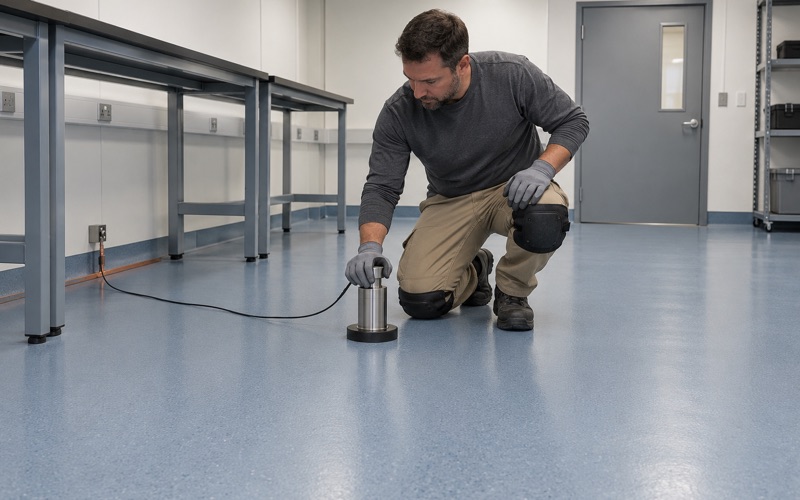
That is why the test comes before the color chart. A quick ASTM D4263 plastic sheet test flags trouble, then ASTM F2170 in-situ relative humidity probes or an ASTM F1869 calcium chloride kit give a number we can compare with the product’s limit. A high reading means a moisture-mitigation primer goes into the system build, priced up front.
Seventy Years of Paint, Patches and Oil
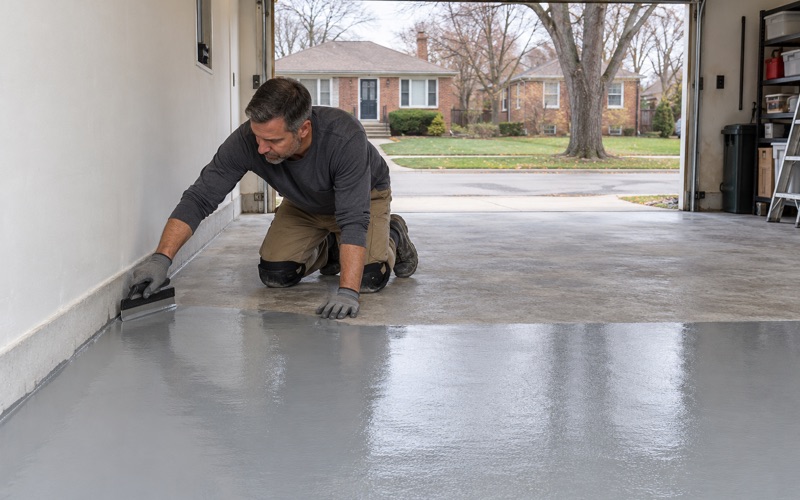
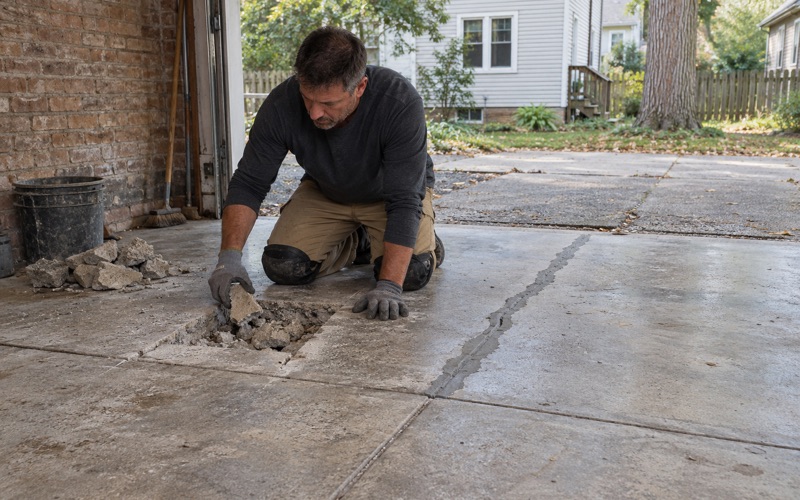
An old garage floor rarely arrives bare. Expect layers of porch paint, a hardware-store epoxy kit that has started to peel, oil soaked deep into the pores and patches that never bonded. Each of those has to come off under the grinder, because a new coating only holds as well as whatever sits directly beneath it.
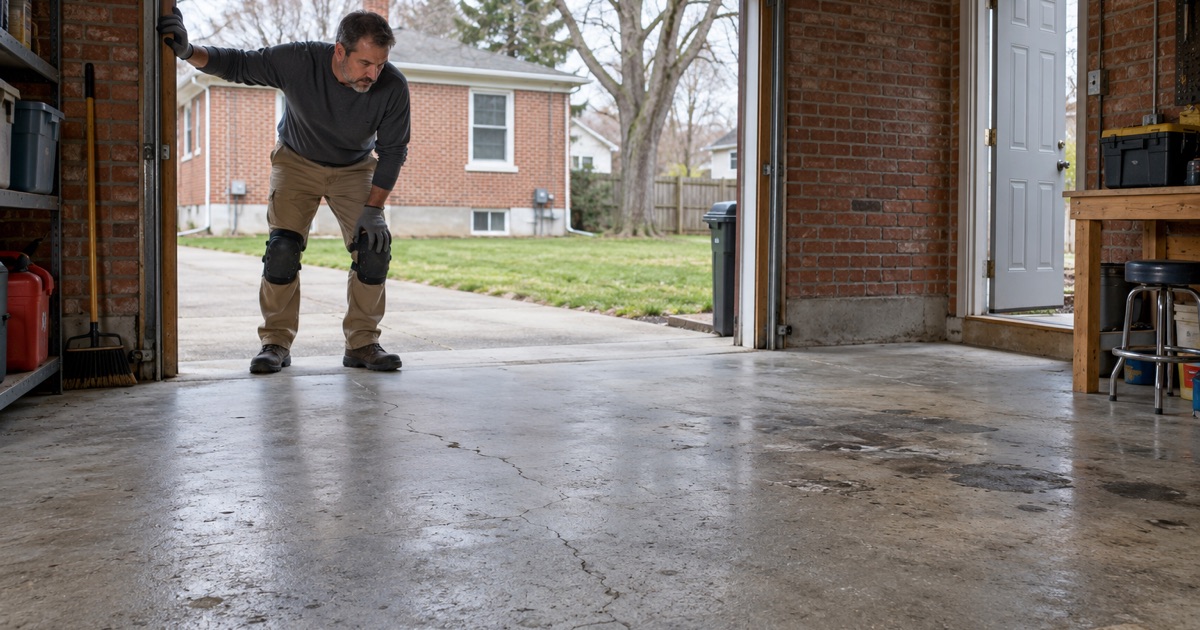
Cracks get the same reading. A coating is a film that follows the slab under it, so a crack that is still moving will come back through any system we apply, and we say that before the job rather than after. Static cracks get filled and ground flush; active ones get explained honestly in the proposal.
Looking for epoxy-flooring closer to Lake Forest? See Epoxy-Flooring Services in Lake Forest.
Bungalow, Ranch or Georgian: Three Garage Starting Points
The village describes its own housing as “its many brick bungalows and ranch and Georgian homes,” and the typical floor job in Bellwood belongs to one of those three. They were not all built at once, and each hands us a different starting point, so we do not price a garage here from a photo.
The Brick Bungalow Garage
The bungalow is the oldest of the three styles, and Bellwood still counts 1,089 homes built in 1939 or earlier. On a slab that age we expect wear, settling and repairs from several owners. Before quoting, we map every crack and old patch, because the repair work, not the coating, is often what sets the price.
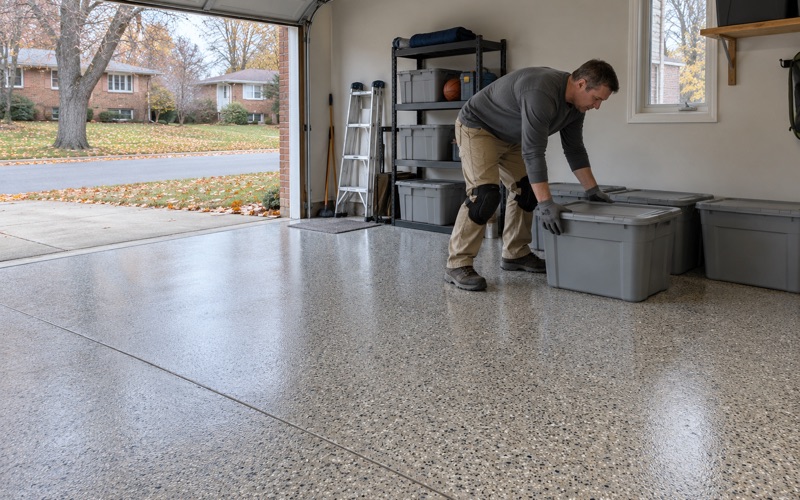
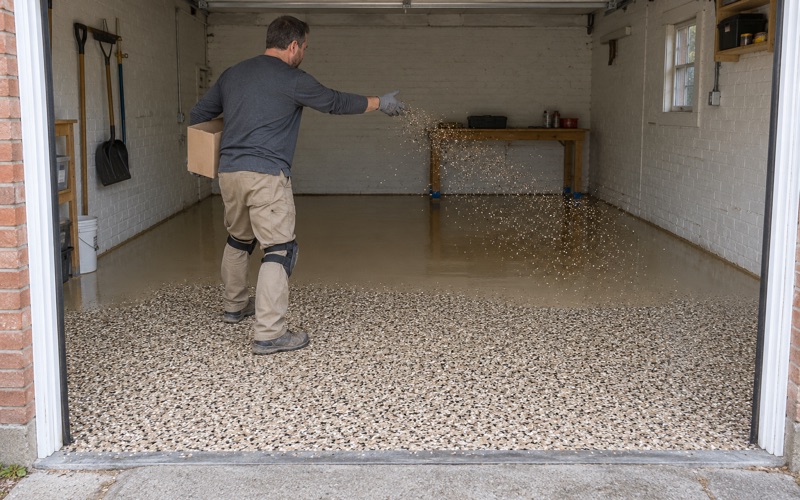
Size and use shape the system. A one-car space with a door that sees daily traffic suits a 100% solids epoxy base with a vinyl flake broadcast and a polyaspartic topcoat, which stands up to hot tire pickup and to the calcium chloride brine and rock salt that ride in on the tires.
The 1950s Ranch
The ranch is the house of the boom decade, and its garage is often the slab that has worked hardest: decades of cars parked in the same two tire lanes, oil drips at the same spot, salt water pooled at the door. We grind to a profile in the ICRI CSP range the primer calls for, which on a worn ranch slab often means more than one pass.
Where a ranch garage shares a wall with the house, dust and noise control matter. Our diamond grinders run with vacuum extraction, and we plan the loud work inside the village’s construction hours so a one-day floor does not run into a neighbor’s evening. If the garage is unheated and the slab is too cold for the product, we schedule the cure by slab temperature and dew point, not by the calendar.
The Georgian Home
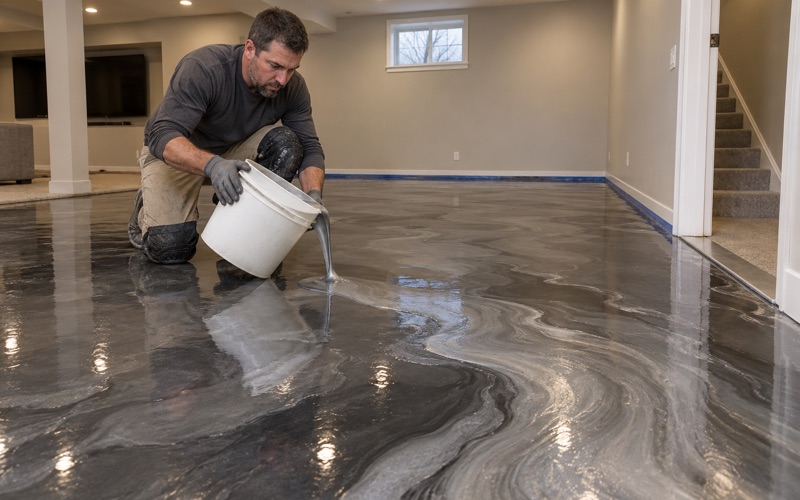
Georgian houses are the most formal of the three. When an owner wants the garage to read as part of that house, the options widen: a quartz aggregate broadcast for a tighter texture, or a solid color under a clear polyaspartic or polyurea topcoat. We write the build and finished thickness into the proposal, so the floor you pictured is the floor on the contract.
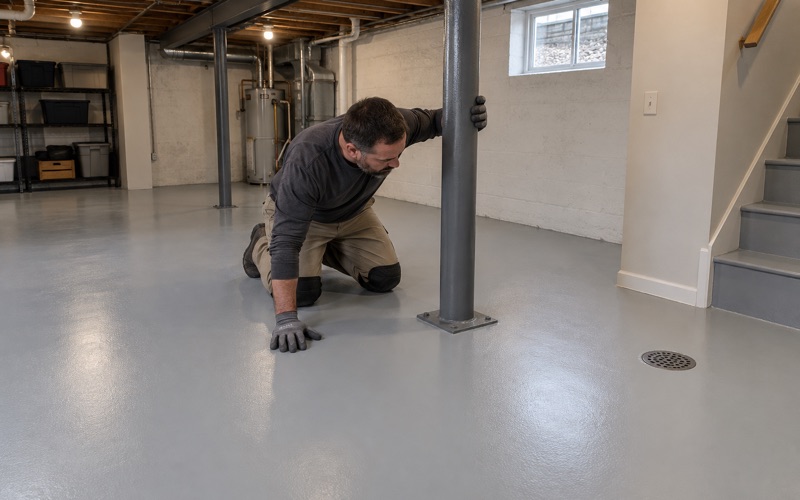
Some Georgian and older houses also have a basement worth finishing. Basement concrete carries its own moisture questions, and a coating will not stop vapor rising through a slab that was never sealed from below. The test numbers decide whether a mitigation primer is needed before any color goes down. We also do not sell a basement coating as radon reduction; in Illinois that work requires an IEMA radon mitigation license.
Nine in Ten Owners in a Detached House
Of Bellwood’s 5,948 occupied homes, 4,665 are owner-occupied, or 78.4 percent. Among those owners, 4,168 live in single-family detached houses, which is 89.3 percent. That means the person who signs our contract here is usually the same person who parks on the floor every morning.
An Owner Decides on Use, Not Resale
Someone who parks on a floor every day judges it differently from someone preparing a house for sale. Hot tire pickup, salt staining and grip under wet shoes matter as much as color. We answer those with the build itself: a full 100% solids base, a flake broadcast for texture and a topcoat picked for abrasion.
An owner is also the one who lives with the warranty. Ours lists its exclusions before the sale, with moisture named first, and the proposal carries the test readings that exclusion refers to. If the numbers call for a mitigation primer or slab repair, you see that cost before signing.
Contracts, Licensing and the Village Building Department
Illinois issues no state license for flooring or coating work, so we do not quote a state license number. Instead we show the contractor license, bond and insurance the Village of Bellwood asks for, and we check with its Building Department on whether a job needs a permit before it is scheduled.
The village reports its building code as the 2006 International Building Code, adopted in 2008. A specification lifted from a town on a newer code edition does not carry over automatically, so we read requirements against Bellwood’s own adoption rather than assuming them. That matters most on the commercial work covered below.
The 289 Rented Detached Houses
Not every detached house here is owner-occupied. The census counts 289 rented single-family detached homes in Bellwood, and on those the person ordering the floor is a landlord, not the driver who parks on it. A landlord tends to ask a different question: how long the floor lasts between tenants, and how easily it cleans at turnover.
For a rental we lean toward a simpler, tougher build and schedule the work around the tenant’s access to the garage. Where a property is a two-flat or a condominium instead, we settle the schedule with the other owner or the association before the first bag is opened, so nobody comes home to a garage they cannot use.
Commercial Floors on St. Charles Road and Mannheim Road
Beyond the garages, commercial floor work in Bellwood follows the two corridors the village is redeveloping, St. Charles Road and Mannheim Road. Commercial jobs run on the building’s clock rather than ours, so grinding and coating are planned around the hours a business has to stay open.
The Bellwood Gateway Project on St. Charles Road
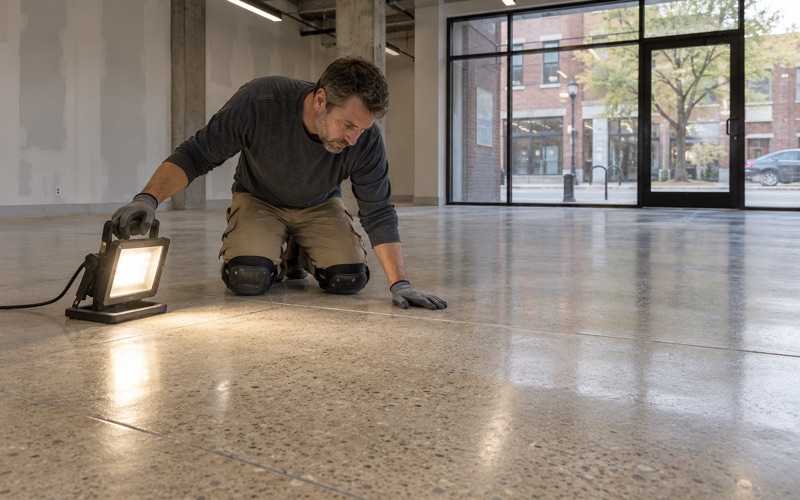
The Bellwood Gateway Project on St. Charles Road is in its first phase, and a redevelopment corridor tends to mean storefronts changing hands, with floors that are either new slabs or old ones being reused. A reused slab carries whatever the last tenant left: tile adhesive, sealers, paint lines. We grind all of it off before choosing a system.
A new slab has the opposite problem: it can look dry and still hold water. We test it with in-situ probes against the product’s limit and the ASTM F710 thresholds before coating, and if the opening date is tight, we say so in writing rather than putting resin on concrete that is not ready.
Mannheim Road and Food Service Floors
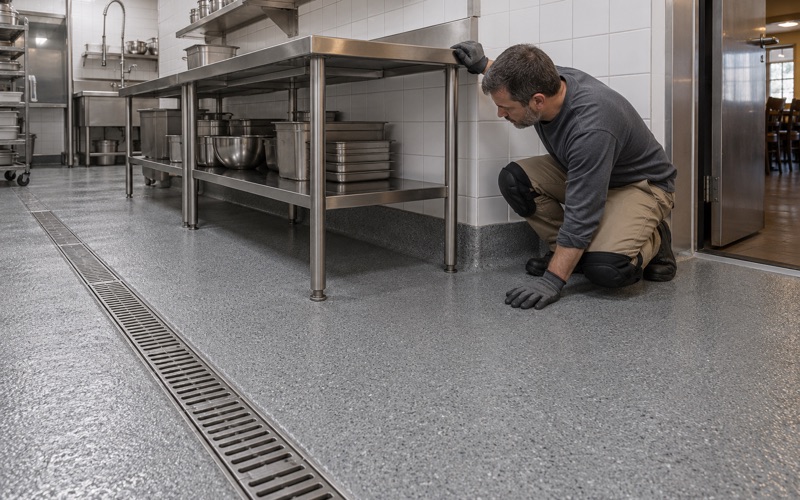
Any restaurant or food shop on Mannheim Road or St. Charles Road answers to the Cook County Department of Public Health, whose jurisdiction covers suburban Cook County outside Chicago, Evanston, Oak Park, Skokie and Stickney Township. The Illinois Food Code adopts the 2022 FDA Food Code, so we build kitchen floors with coved floor and wall junctures as section 6-201.13 calls for.
A kitchen floor also has to be cleanable and safe underfoot. A urethane cement system handles hot water washdown and thermal shock better than standard epoxy, and section 6-201.11 allows an antislip surface where safety calls for it, so we tune the aggregate to the station rather than texturing the whole room the same way.
Postwar Industrial Slabs in the East End
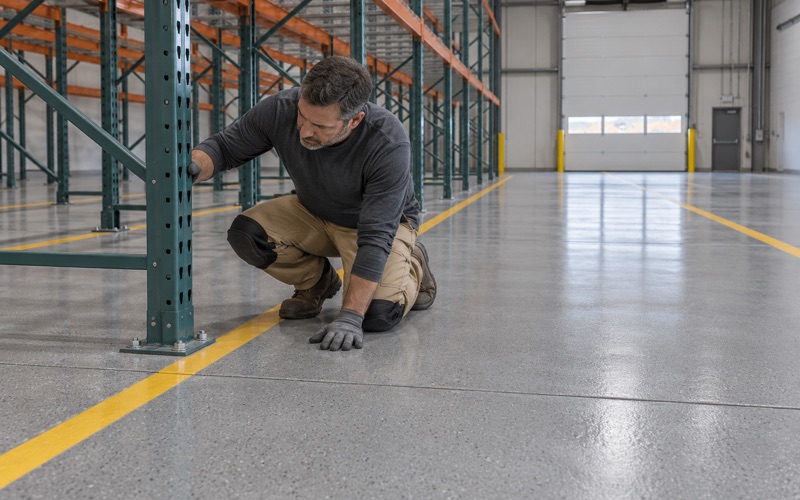
After World War II, large industries located in the eastern part of the village along the Indiana Harbor Belt tracks. Where slabs from that era remain in use for shops, storage or light manufacturing, they usually need a shot blaster rather than a hand grinder to reach a clean profile.
Industrial floors bring their own specification questions, from static-dissipative flooring with a stated ESD resistance range to chemical spills at a loading area. Every coating we choose stays within the Illinois VOC limits in 35 Ill. Adm. Code Part 223 Subpart C, a rule that binds the installer as well as the manufacturer.
- 20+ Years in Business
- Moisture Testing in Every Quote
- Written Proposals