Evanston Epoxy Flooring has spent more than 20 years on epoxy-flooring in Barrington and across the north and northwest suburbs, and the commercial side of that work here is mostly about vehicles. A floor that carries cars all day wears differently from a floor that carries boxes or foot traffic, and the coating has to be chosen for that load first.
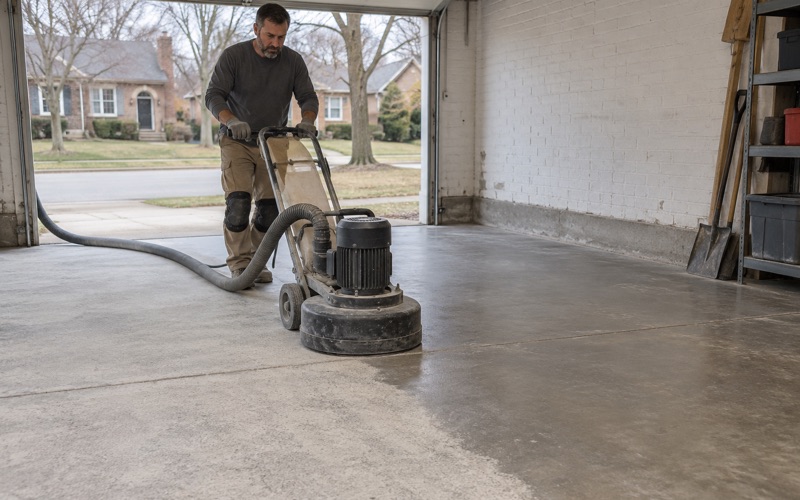
We open every slab mechanically with a diamond grinder or shot blaster, and we never acid etch, because a service-bay coating that lets go usually lets go at the bond. Our written proposal names the product, the system build and the finished thickness, so a fixed-operations manager can check what went down against what was quoted. Moisture testing sits in that proposal as its own line, priced before the work instead of after a blister.
Commercial work is scheduled around the hours a building has to stay open, and for a dealership that means the service lane, not the showroom. The sections below cover the campus that drives this market, what a working bay does to concrete, why a brand standard comes before color, and how a department keeps writing repair orders while we work.
Six Franchises on One Barrington Road Campus
A 45-acre campus inside the village
Motor Werks of Barrington occupies a 45-acre automotive campus at 1475 S. Barrington Road, with BMW, Mercedes-Benz, Cadillac, Honda, INFINITI and Porsche dealerships. The US Census Geocoder places that address inside Barrington village, in Barrington Township, Cook County. That matters before a quote, because the village spans Cook and Lake counties and parts of four townships, and which authority answers for a job follows the parcel, not the mailing address.
Several franchise service departments run side by side on that one campus. Separate franchises usually mean separate bays, lifts and traffic patterns, so we treat a campus inquiry as a set of separate floors rather than one big slab. A coating that suits a high-volume service drive may not be the right build for a detail bay or a parts room next door.
The third-largest employer in the village
Motor Werks of Barrington ranks third among the village’s top employers at 355 people, behind Barrington CUSD 220 at 1,200 and the Barrington Park District at 379. A school district and a park district do not run lifts and drain pans. For a commercial floor contractor, that list says the heaviest vehicle wear on concrete inside the village sits in service bays.
That shapes how we prepare for a Barrington commercial call. We arrive expecting oil, coolant and brake fluid in the slab, lift anchors in the floor, and a manager who needs bays back by a set hour. The questions we ask first are about the brand, the bay count and the service schedule, not the color.
Looking for epoxy-flooring closer to Burr Ridge? See Burr Ridge Epoxy-Flooring.
What a Service Bay Does to a Floor
Hot tires and the topcoat
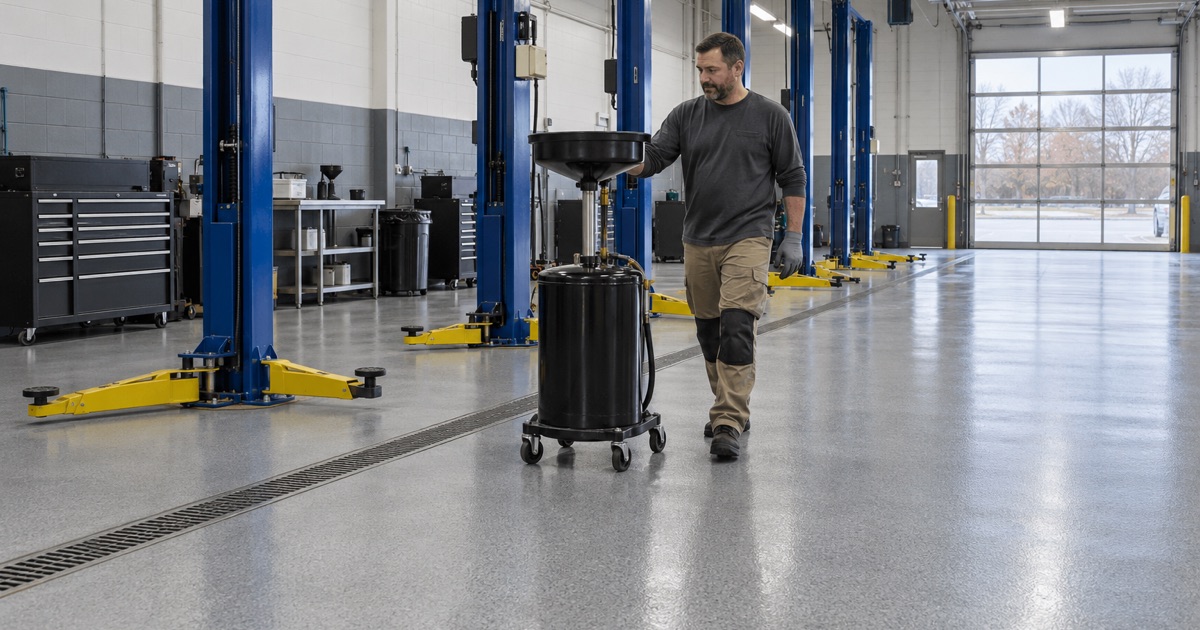
A car pulled in off the road brings tires hot enough to soften a weak coating, and as they cool the rubber can grip the film and lift it. That is hot tire pickup, and it shows first in the drive lane and at the lift where cars sit longest. We answer it at both ends: a 100% solids epoxy base on a properly profiled slab, finished with a polyaspartic or polyurea topcoat.
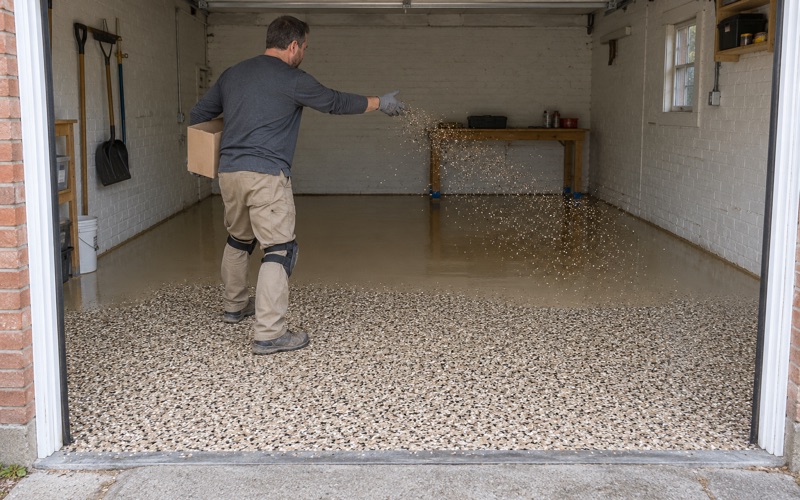
A service drive at a busy store can see a car roll in every few minutes, so a coating that tolerates a weekend garage may not survive a weekday in the bay. We size the base coat and the topcoat build for that cycle count rather than for appearance alone. Where a bay will also take quartz aggregate broadcast for traction, we build that into the same system.
Fluids soaked into the concrete
Years of oil, coolant, transmission fluid and brake fluid leave a slab contaminated below the surface, and a coating laid over that can let go. Grinding opens the top of the slab to the ICRI CSP profile the system calls for, but deep saturation sometimes needs cleaning and repeated grinding before any primer goes down. We say so in the walkthrough instead of discovering it with the crew on site.
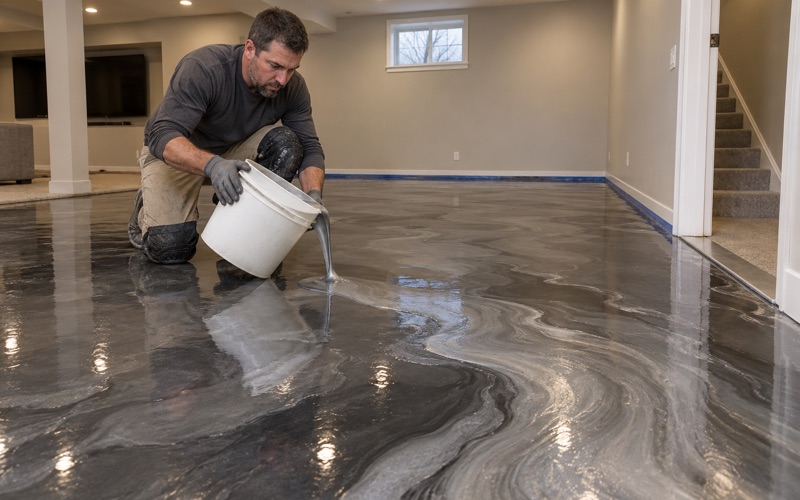
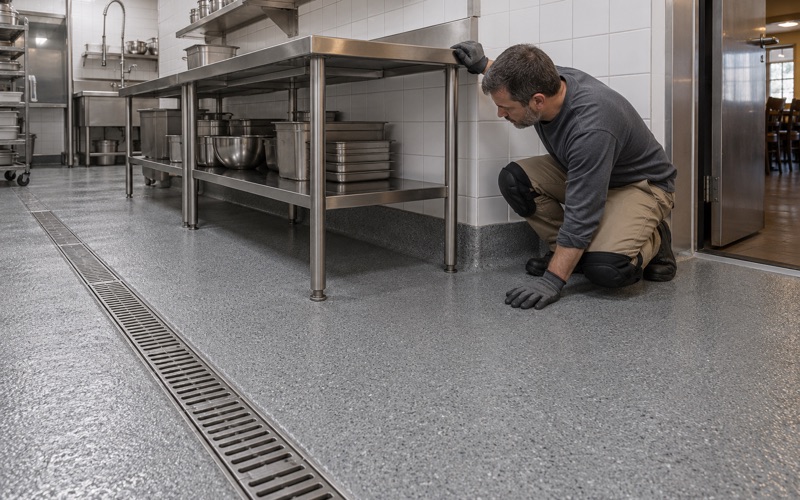
Floor drains and trench drains in a service area need their own detailing, because fluid and wash water collect there and the coating edge is where it gets under the film. We terminate the system into the drain body rather than stopping short of it. Where a shop washes bays down, urethane cement is an option worth pricing for its tolerance of water and chemical exposure.
Lift loads and cracks
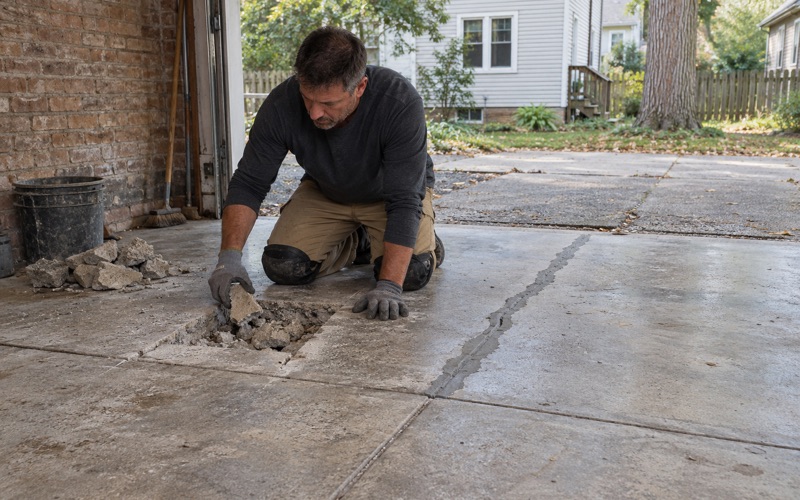
A two-post or four-post lift concentrates a vehicle’s weight onto anchor points and a small footprint of slab. Cracks that radiate from lift anchors, or run between them, can tell us the concrete is moving or was stressed, and we read them before we quote. When a slab needs repair before it can be coated, the proposal prices the repair separately and says why.
We are also plain about the limit of the product. A coating is a film that follows the slab under it, so a moving crack at a lift can telegraph through any system we put down. We would rather say that before a contract than have a service manager learn it from a line across a new floor.
The Brand’s Facility Standard Comes Before the Color Chart
Ask for the standard first
Franchise dealers may build to a manufacturer’s facility program, and that program may specify the floor finish in the service area: the color, the gloss, the texture, sometimes the product family. We never assume what a given brand’s standard says. What we do is ask the dealership for its current standard in writing before we price anything.
If the standard names a product or system, we tell the dealer whether we can supply it as written, and we do not substitute a lookalike and call it compliant. If it describes a finish without naming a product, our proposal states the product, system build and finished thickness we would use to meet it, so the dealer or the brand’s facility reviewer can check it against the document.
Color, gloss and traction inside the standard
Within whatever the standard allows, the practical choices are about the work. A lighter, higher-gloss floor reflects bay lighting back toward the underside of a car on a lift, while a darker or vinyl flake floor hides tire marks between cleanings. Traction matters where technicians walk through fluid, and a quartz broadcast trades a little cleanability for footing.
We put samples on the actual slab when we can, because a chip held up in a showroom reads differently than a finished bay under shop lights. The choice gets written into the proposal by product and color name, so the second building on a campus can be matched to the first if a dealer wants them consistent.
Moisture and warranty terms on a working slab
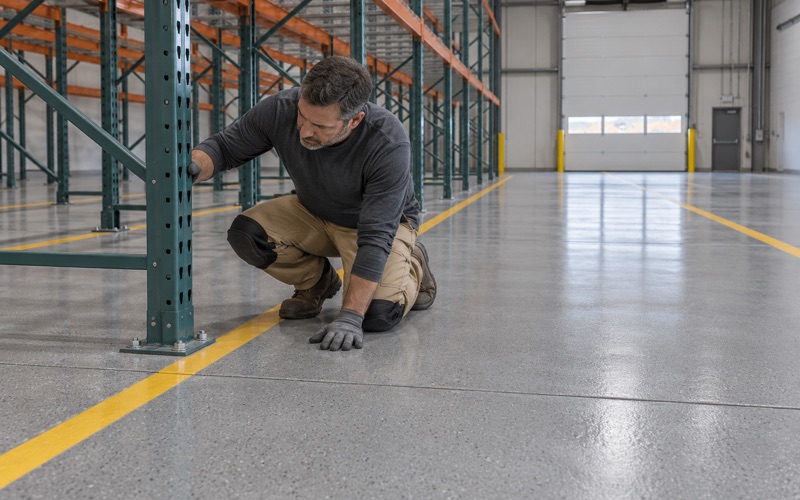
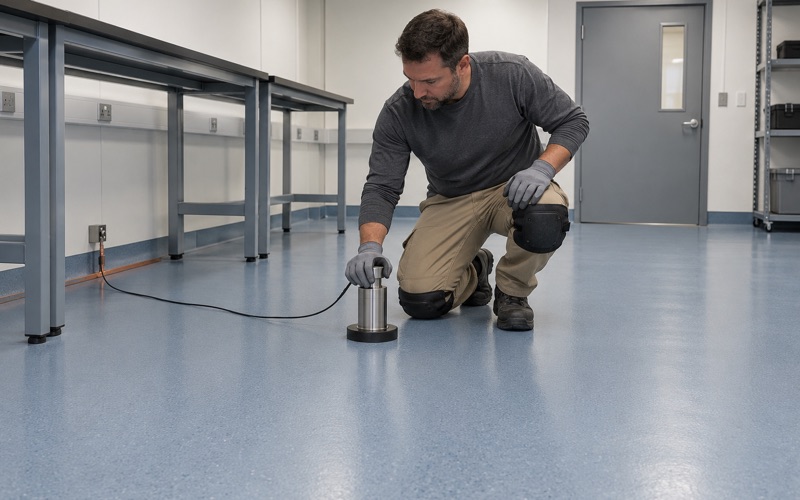
A service building’s slab may have no vapor retarder under it, or one that has failed, and moisture coming up through concrete is a common reason a commercial coating blisters. We test before we quote, using ASTM F2170 in-situ relative humidity probes or ASTM F1869 calcium chloride tests, and read the results against the coating maker’s limits. Where readings run high, a moisture-mitigation primer goes into the build and into the price.
Warranty exclusions get read aloud before the job is sold, and moisture is the first one we name. A dealer comparing bids should know which conditions void a coating warranty before signing, not after a bay floor lifts. We also ask whether the brand’s program carries its own warranty or inspection terms, since those may sit alongside ours.
Coating Bays Without Closing the Service Department
Phasing the work bay by bay
No service department wants every lift down at once, so we phase the floor in sections a manager can live without. A common plan takes a block of bays out of rotation, grinds within the village’s construction hours, and returns the block once the topcoat has cured enough for traffic. Polyaspartic topcoats help here because they reach service sooner than many epoxy topcoats.
Cure follows slab temperature and dew point, not the calendar or the shop’s appointment book. We check the dew point spread at the slab surface before each coat, because condensation on a cold bay floor can cause amine blush and poor adhesion. If a bay with open overhead doors is too cold to cure properly, we say the schedule has to move.
Dust, VOCs and village paperwork
Grinding runs with dust extraction so a neighboring bay or the customer lounge stays usable. Coatings are chosen within the Illinois limit on VOC content, which binds the installer as well as the manufacturer, and that matters in a building where staff keep working next to a curing floor.
Illinois issues no state license for flooring or coating work, so instead of a license number we show whatever contractor registration, bond and insurance the Village of Barrington asks for. Fire questions go to the Barrington Fire Department, which has covered only the village’s roughly five square miles since the Barrington Countryside Fire Protection District ended its joint-service agreement with the village effective January 1, 2014. A dealer site just past the village line answers to the district instead.
A Porsche service building on Dundee Road
A new Porsche showroom and service center is under construction at 24 E. Dundee Road, near Grove Avenue. We have not confirmed which side of the village line that address falls on, so before quoting any floor work there we would check which village and fire authority hold the parcel rather than assume from a Barrington mailing address.
New construction changes the floor question. Fresh concrete has to give up its water before it will take a coating, and a new slab poured over a vapor retarder meeting ASTM E1745 behaves differently from an old one without, so testing still comes first. Ground and coated at the right moisture reading, a new service floor starts with none of the oil saturation an older bay carries.
If a dealership wants a floor in place before opening, the coating date depends on the slab’s readings, not the ribbon-cutting. We would rather tell a project manager that early than coat green concrete to hit a date.
- 20+ Years in Business
- Moisture Testing in Every Quote
- Written Proposals